

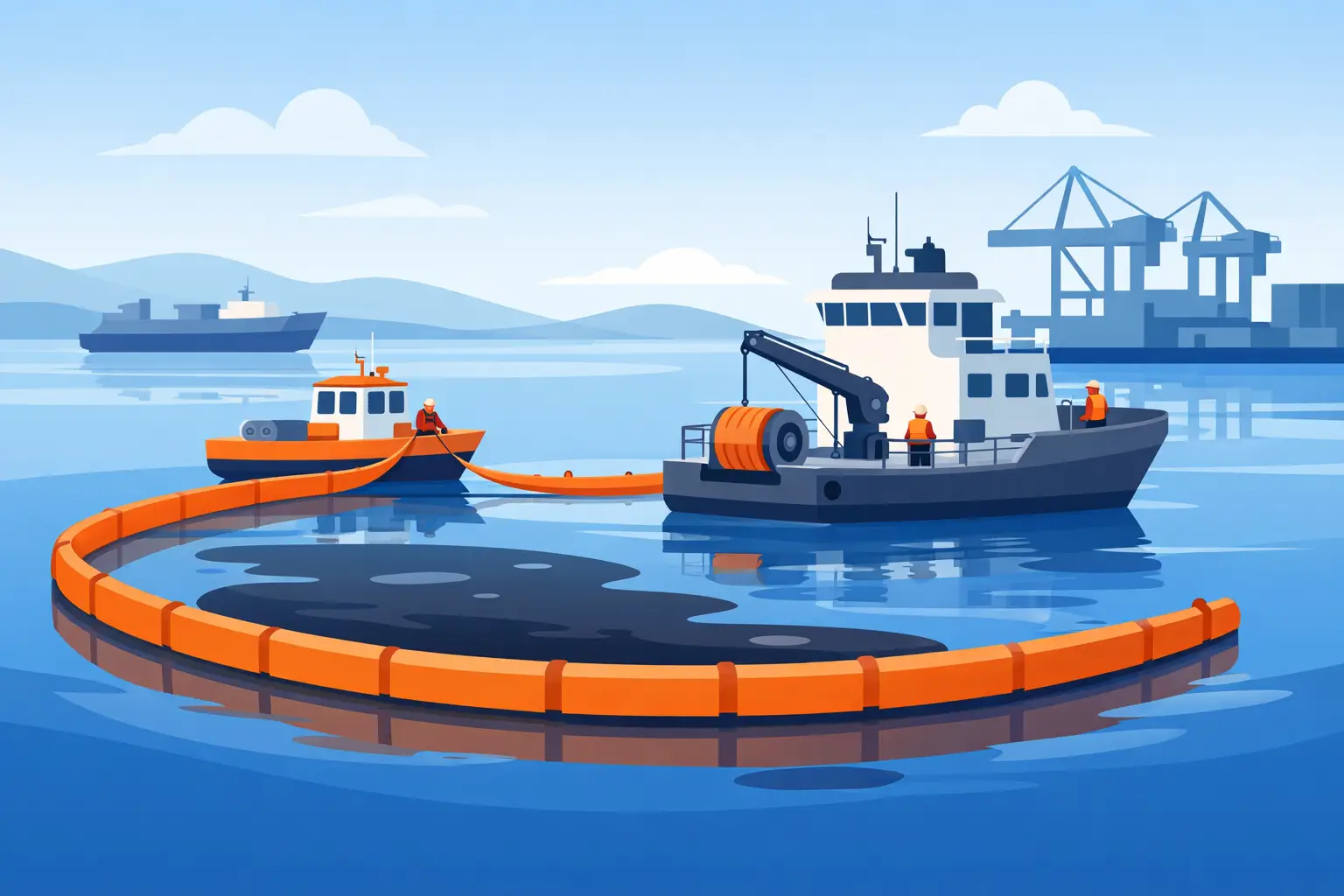
A marine boom deployment example is most useful when it reflects the decisions a response team must make under pressure: where the oil is moving, what must be protected first, and whether the selected boom can hold position in real site conditions. A boom is not simply placed around a spill. Its performance depends on correct sizing, deployment angle, anchoring, towing method, and ongoing adjustment as wind, current, and vessel traffic change.
For port operators, terminal managers, marine contractors, and EHS teams, the goal is to contain recoverable oil quickly while preventing it from reaching sensitive shorelines, seawater intakes, marinas, and vessel berths. The following practical scenario shows how a harbor fuel spill response may be planned and executed.
Marine Boom Deployment Example: A Harbor Fuel Spill
A service vessel is moored alongside a fueling berth in a protected commercial harbor. During fuel transfer, a hose connection fails and releases an estimated 500 gallons of marine diesel into the water. The release occurs on an outgoing tide, with a moderate cross-current moving toward a nearby marina and a stormwater outfall.
The first response priority is source control. The vessel crew stops the transfer, closes valves, secures the damaged hose, and reports the incident under the site emergency plan. Absorbent pads, socks, and temporary drain protection may be used at the berth edge, but they are not a substitute for waterborne containment.
The response team then confirms three practical facts before deploying boom: the direction and speed of current, the wind direction, and the location of assets that cannot be allowed to become contaminated. In this example, the marina entrance is the highest-priority protection point, while the stormwater outfall is the secondary target.
A combination of containment and diversion boom is selected. The initial containment boom is deployed close to the vessel to limit immediate spread. A second length is positioned farther down-current at an angle, directing oil toward a sheltered recovery area rather than attempting to block the full force of the current at a right angle.
Why Boom Angle Matters More Than Length
A common operational mistake is to deploy a boom straight across a moving waterway. When current pushes directly against the boom, oil can collect, submerge beneath the skirt, or escape around the ends. This is known as entrainment, and it reduces containment effectiveness even when the boom appears correctly installed from shore.
In this deployment, the diversion boom is set at approximately 30 to 45 degrees to the current. This reduces the force acting on the boom and guides floating fuel toward the recovery zone. The exact angle depends on current velocity, available space, boom type, and anchor points. A narrow harbor with strong tidal movement may require a shallower angle and more boom length than a calm marina basin.
The boom is not selected solely by length. Teams must consider freeboard, skirt depth, tensile strength, ballast, connector type, and whether the boom is intended for sheltered water, protected water, or more exposed marine conditions. Lightweight harbor boom can be quick to handle and suitable for calm basins, but it may not be appropriate where wave action, wakes, or currents are significant.
For this incident, the team uses a durable flotation boom with sufficient skirt depth for protected harbor conditions. The boom sections are connected and checked before launching. Each connection is secured, because a poorly joined section can become the point where oil escapes.
Establishing the First Containment Line
The first boom is deployed from the response vessel around the affected side of the fueling berth. It is not pulled tightly against the vessel hull, since the team needs space to work and recover pooled fuel. Instead, it creates a controlled pocket around the release area.
One end is secured to a suitable berth-side bollard, while the other is managed by the response vessel. Depending on site configuration, both ends may be anchored to fixed points. Anchors must be selected for the seabed and water depth, with adequate line length to maintain holding strength through tidal change.
The team checks that the skirt is fully deployed below the waterline and that no section is twisted. They also inspect for gaps along the berth, around pilings, and at the boom ends. A boom can contain only what it encloses. Small gaps become significant once wind and current concentrate oil along the barrier.
Diverting Oil Away From the Marina
With the immediate source area controlled, the second boom is deployed down-current to protect the marina entrance. Rather than placing the boom directly across the entrance, which could impede vessel access and place excessive load on the barrier, the team establishes a deflection line outside the channel.
This line guides oil toward a quieter corner of the harbor where skimming and absorbent recovery can be performed safely. The recovery pocket is positioned where currents are weaker and response personnel can access it from a workboat or shoreline position.
This approach involves a trade-off. A diversion strategy may allow a limited amount of oil to travel farther from the original release before recovery, but it prevents contamination of a more sensitive or difficult-to-clean area. The correct choice depends on local conditions, access, tide, and the environmental priority of the protected asset.
Recovery Begins Before Containment Is Perfect
Boom buys time. It does not remove oil from the water. Once the first containment line is stable, recovery should begin as early as conditions allow.
In the harbor scenario, responders use oleophilic absorbent boom and pads inside the contained area to collect lighter sheens and residual diesel. Where product has accumulated to a recoverable thickness, a portable skimmer may be deployed. Recovered liquid is transferred into compatible temporary storage, such as a portable tank or approved drum, for proper waste handling.
Absorbents are useful for final polishing and localized recovery, especially around pilings, vessel hulls, and sheltered corners. They should not be relied upon as the main response method for a large free-floating release. Saturated materials must be replaced promptly and managed as contaminated waste according to the site plan and applicable requirements.
Response supervisors should maintain a simple but disciplined record of actions: estimated release volume, weather and tide conditions, boom lengths deployed, anchoring points, recovery quantities, photographs, and any observed escape paths. These details support incident reporting, contractor coordination, and later improvements to the emergency plan.
Adjusting the Deployment as Conditions Change
A boom deployment is an active operation, not a one-time installation. In the example, the outgoing tide gradually weakens, then reverses. The response team must reassess the boom angle and the recovery pocket before the incoming tide carries remaining product in a different direction.
Wind can also push diesel against the boom or toward shoreline structures. Vessel wakes may cause splash-over, particularly where freeboard is too low or the boom has been deployed in conditions beyond its design range. If conditions worsen, additional boom, secondary containment lines, or a revised recovery location may be required.
Teams should inspect the deployment at regular intervals for sagging sections, line chafe, connector separation, submerged skirts, and oil accumulating at the ends. If a boom is overloaded, tightening it further can make performance worse. Relieving tension, repositioning anchors, or adding a second angled section may be more effective.
Equipment Readiness Determines Response Speed
The best deployment plan is of limited value if the boom is unavailable, incomplete, or stored without the accessories needed to install it. A practical marine spill response cache should match the credible release scenarios at the site, including fuel transfer operations, vessel maintenance, hydraulic oil leaks, and shoreline contamination risks.
For most harbor and waterfront operations, readiness should account for containment boom, absorbent boom, pads and rolls, anchors, anchor line, connectors, reels or storage racks, skimming equipment where appropriate, temporary recovered-oil storage, PPE, and tools for deployment. The amount and type of equipment depend on the site’s risk assessment, water conditions, access routes, and required response time.
Pre-incident planning is equally important. Teams should identify berth bollards, anchor locations, boat launch access, protected assets, recovery zones, and safe staging areas before an emergency occurs. A short field exercise can reveal whether boom sections are manageable by available personnel and whether a planned anchor point is accessible at low tide.
Ocean Safety Supplies supports marine operators with containment boom, absorbents, spill response equipment, and practical supply support for emergency readiness. Selecting the right equipment before an incident helps reduce response delays when every minute of containment matters.
A well-planned marine boom deployment is not about creating a perfect barrier in every condition. It is about making fast, informed choices that control the source, protect the highest-risk areas, create a workable recovery zone, and adapt as the water moves.