

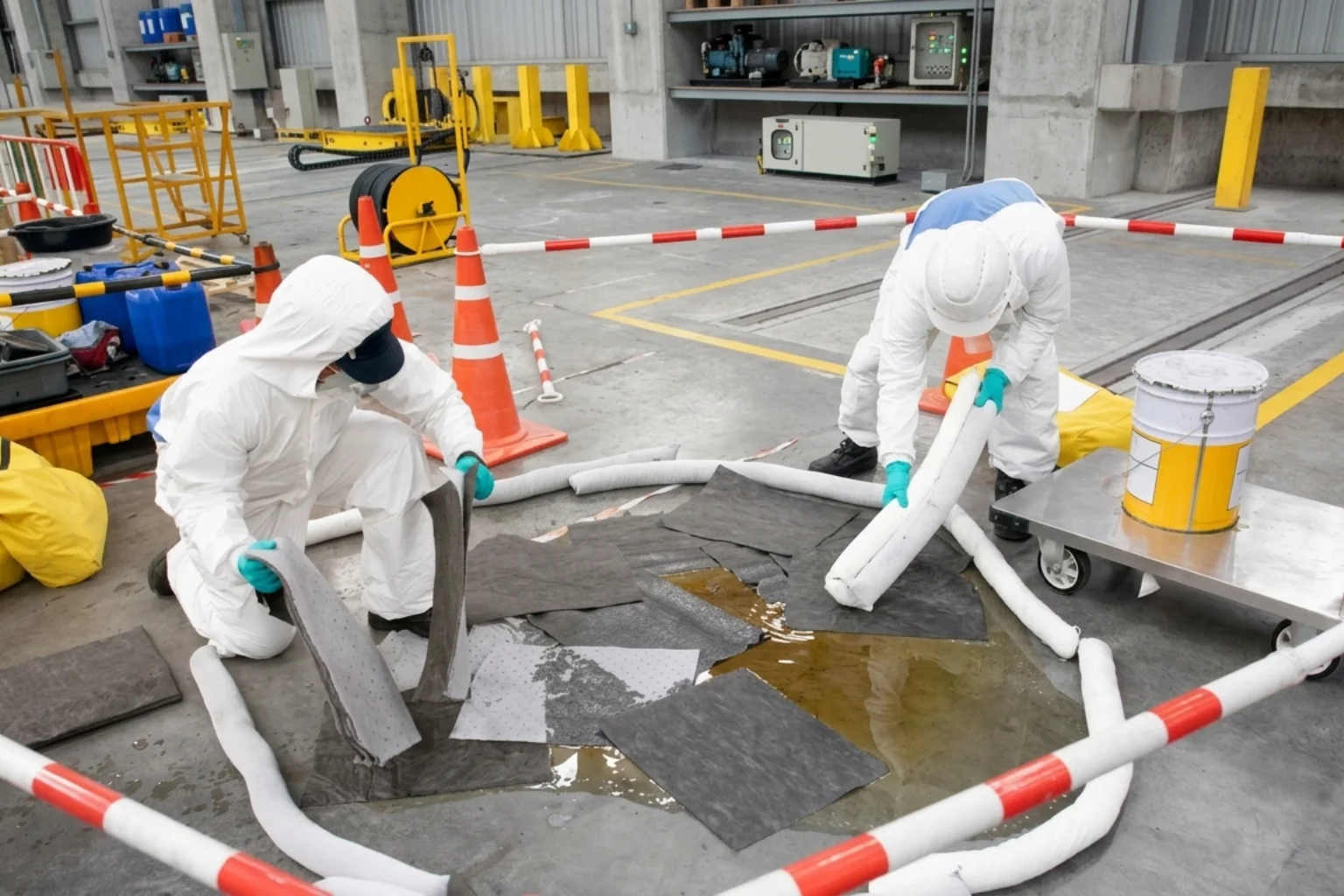
A leaking drum on a warehouse floor gives you very little time to guess. The right chemical spill cleanup absorbents can limit spread, protect staff, and reduce cleanup costs within minutes. The wrong choice can react with the liquid, break down under contact, or leave your team managing a larger hazardous area than necessary.
For most facilities, absorbents are not a generic consumable. They are part of spill readiness, compliance, and business continuity. EHS teams, maintenance managers, and procurement buyers need products that match the chemicals on site, fit the spill risk profile, and are available when an incident happens, not weeks later.
What chemical spill cleanup absorbents are designed to do
Chemical absorbents are built to capture aggressive liquids safely and quickly. Unlike general-purpose pads used for routine drips or oil-only products intended for hydrocarbons, chemical absorbents are selected for broader chemical compatibility. They are commonly used for acids, bases, solvents, coolants, and mixed unknown liquids where a more cautious response is needed.
The main job is simple: contain the spill, absorb the liquid, and support safe collection for disposal. In practice, performance depends on more than absorption rate. Buyers also need to consider whether the material resists degradation, whether it sheds fibers, how it performs on smooth or rough floors, and whether it can be deployed fast under pressure.
That is why absorbent selection should be tied to the site assessment. A lab with small-volume corrosive spills needs a different setup than a manufacturing plant handling drums, IBCs, or transfer points with a higher likelihood of larger releases.
How to choose chemical spill cleanup absorbents
The right choice starts with the liquid itself. If your facility stores or handles corrosives, aggressive chemicals, or a range of unknown liquids, a dedicated hazmat absorbent is usually the safest fit. These products are designed for broad chemical resistance and are often color-coded for quick identification during emergencies.
If the spill profile is mostly non-aggressive liquids such as water-based fluids, coolants, or light oils, general-purpose absorbents may be sufficient in some areas. But this is where many sites over-standardize. Using one absorbent for every scenario can simplify purchasing, yet it may create unnecessary risk if a stronger chemical is spilled in the same zone.
It also depends on spill size. Pads and rolls are effective for drips, overspray, and smaller surface spills. Socks are better for stopping spread around drains, machinery, or storage areas. Pillows are useful when liquid is pooling heavily in one spot, especially near leaking containers. Granules still have a place in some operations, but they can be slower to deploy and less efficient to recover compared with pads, socks, and pillows in controlled indoor environments.
Another factor is the work area. In tight process rooms, lightweight and easy-to-handle absorbents help response teams move faster. In outdoor or marine-adjacent settings, weather exposure, surface conditions, and runoff risk may shape the product choice. Fast deployment matters, but controlled containment matters just as much.
Key types of chemical spill cleanup absorbents
Pads and rolls
Pads and rolls are the standard option for routine response and staged preparedness. They are easy to position, quick to issue from spill kits, and practical for benches, floors, and walkways. Rolls work well where coverage area matters, while pads are more convenient for fixed kit packing and small incidents.
Their limitation is capacity relative to concentrated pooling. For a fast-spreading leak from a drum or tote, pads alone may not control the edge quickly enough unless socks are used first.
Socks and booms
Chemical absorbent socks are designed to contain movement. They form barriers around drains, machinery, and spill perimeters, helping prevent liquid from migrating into traffic lanes or sensitive areas. In many facilities, socks are the first line deployed, followed by pads or pillows inside the contained zone.
For larger areas or more demanding containment needs, booms may be appropriate. These are especially relevant where spill pathways are less predictable or where outdoor response needs stronger physical control.
Pillows
Pillows are useful when a spill is concentrated in one location, such as beneath a valve, flange, or leaking container. Their higher capacity makes them efficient for ongoing leaks while repair or transfer work is taking place. They are not usually the first choice for wide-area surface sheens, but they are highly effective at the source point.
Loose absorbents and granules
Loose absorbents can work well on uneven ground and in applications where sweeping and collection are standard practice. They can also help with irregular spill shapes. The trade-off is cleanup time, product waste, and in some cases dust generation. For facilities focused on clean, fast indoor response, format-based absorbents often provide better control.
Compatibility matters more than capacity alone
One of the most common purchasing mistakes is comparing absorbents only by price per bale or total stated capacity. Capacity figures are useful, but they do not tell the whole story. A lower-cost absorbent that fails under chemical exposure creates a more expensive incident.
Compatibility should always come first. Some chemicals require materials that resist breakdown, while mixed-chemical environments may justify a more universal hazmat absorbent across multiple zones. This can increase unit cost, but it often improves response confidence and reduces selection errors during an emergency.
There is also a training benefit. When teams can quickly recognize which absorbent is intended for hazardous chemical spills, response time improves. In a real incident, simple product identification can be as valuable as incremental absorption performance.
Where facilities should position absorbents
Absorbents only work if they are close to the risk. Storing all spill materials in one central room may look organized on paper, but it slows response at the point of release. High-risk areas should have dedicated spill kits or staged absorbent stocks near drum storage, chemical dosing points, loading areas, maintenance zones, laboratories, and waste accumulation points.
The quantity on hand should reflect both the largest credible spill and the likely incident frequency. A small lab may only need compact chemical spill kits with pads, socks, disposal bags, and PPE support. A warehouse handling multiple chemical containers may need larger mobile kits, refill stock, and backup containment products for drains and transfer areas.
This is where supply reliability matters. Procurement teams are not just buying absorbents. They are buying readiness. A stocked supplier with practical technical guidance helps sites maintain the right mix without overbuying slow-moving items or running short on critical response products.
Chemical spill cleanup absorbents as part of a larger response plan
Absorbents should sit within a broader spill control system. Secondary containment, proper storage, drain protection, PPE, waste handling supplies, and emergency response equipment all affect how well a site manages a spill. Absorbents are essential, but they perform best when the rest of the control measures are already in place.
For example, a facility with good containment pallets and transfer discipline may mostly need absorbents for minor incidents and maintenance leaks. A site with frequent chemical movement across multiple work areas may need a more layered setup, including portable spill kits, larger containment capacity, and replacement stock ready for immediate restocking.
That practical view is why many industrial buyers prefer working with a single supplier that understands spill control in context. Ocean Safety Supplies supports that approach with stocked inventory, fast response, and a broad range of spill control and workplace safety products for operational readiness.
What buyers should ask before ordering
Before placing a repeat order or setting a new site standard, it is worth confirming a few operational details. What chemicals are actually present in the area, not just listed in a general inventory? What spill sizes are realistic? Do teams need compact kits, bulk absorbent stock, or both? Is the cleanup happening on smooth sealed floors, rough outdoor surfaces, or near drains and sensitive equipment?
It also helps to ask how quickly product can be replenished after use. A spill kit that cannot be refilled promptly leaves the site exposed to the next incident. For many facilities, fast delivery and dependable local stock are not purchasing conveniences. They are part of risk control.
The best absorbent program is the one your team can use correctly at speed. Choose products that match the chemicals you handle, stage them where incidents are most likely, and buy from a supplier that can keep your shelves and spill kits ready when response time counts.