

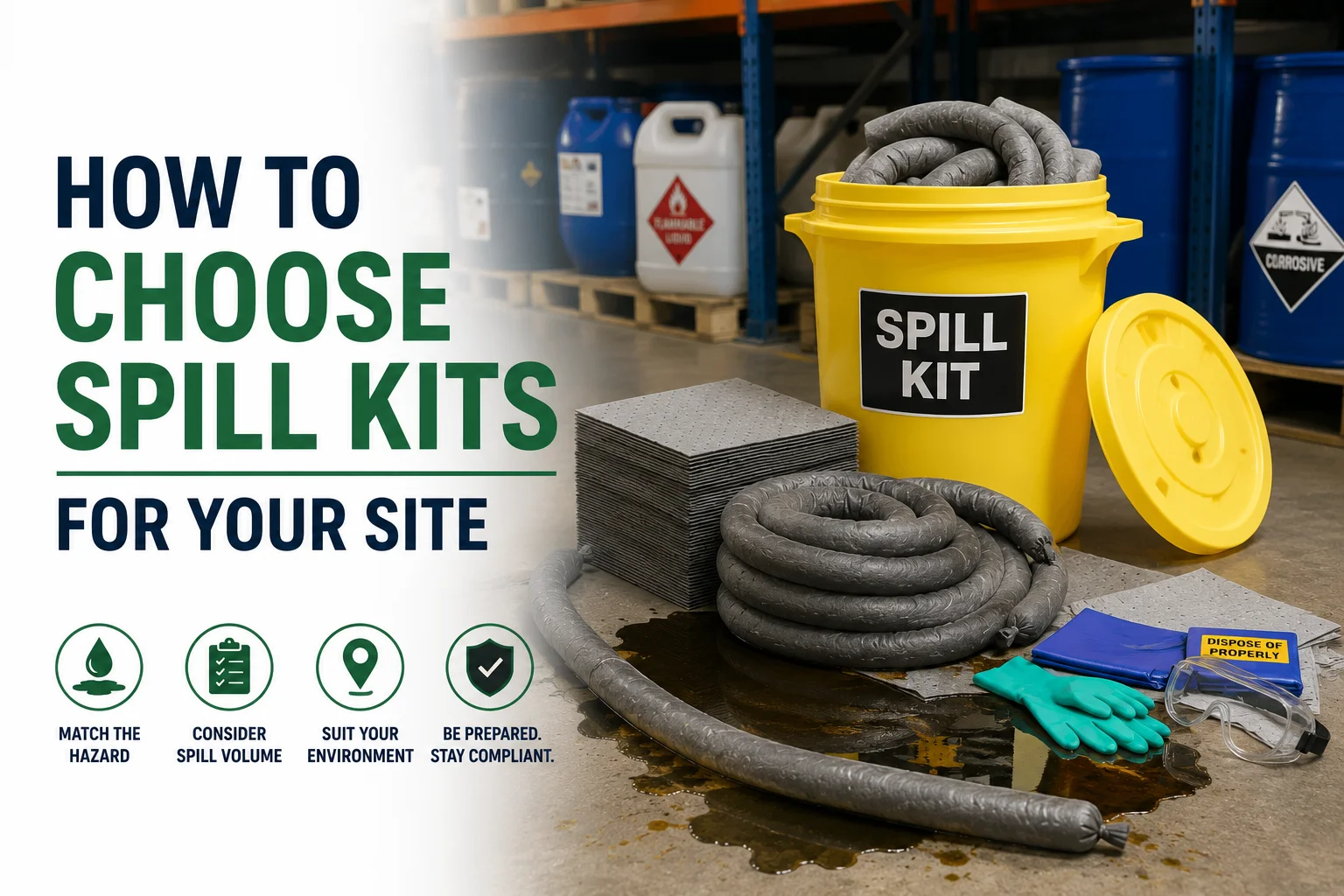
A spill rarely gives you time to think. When hydraulic oil hits a warehouse floor, a corrosive chemical leaks in a lab, or fuel drips onto a loading area, the right response depends on having the right kit within reach. That is why knowing how to choose spill kits is not just a purchasing task – it is part of site readiness, incident control, and compliance.
For most facilities, the wrong kit fails in predictable ways. It is too small for the likely spill volume, stocked with the wrong absorbents, placed too far from the hazard, or bought as a generic box without considering how the site actually operates. A better approach is to match the kit to the liquids you handle, the areas where spills are most likely, and the response expectations of your team.
How to choose spill kits by spill type
The first decision is the type of liquid you need to control. This matters more than capacity, container style, or price because absorbents are designed for specific applications.
If your site mainly handles oils, fuels, coolants, and hydrocarbons, an oil-only spill kit is usually the correct choice. These absorbents are made to take in oil-based liquids while rejecting water, which makes them especially useful outdoors, near drains, on docks, in marine settings, and in areas exposed to rain. If a diesel spill occurs in a wet loading yard, an oil-only kit helps you recover the product without soaking up unnecessary water.
If you work with chemicals such as acids, caustics, solvents, or mixed unknown liquids, a chemical spill kit is the safer option. These kits are intended for more aggressive substances and are commonly selected for laboratories, process areas, chemical stores, and manufacturing lines. They offer broader compatibility, but they are not a substitute for checking the actual substances on your site. Compatibility still matters.
For general workplace spills such as water-based liquids, mild oils, paints, and coolants in lower-risk areas, a universal spill kit may be appropriate. These are common in workshops, maintenance departments, warehouses, and general industrial spaces where the liquid profile is mixed but not highly hazardous.
This is where many buyers oversimplify the decision. If the site stores both hazardous chemicals and routine oils, one kit type may not cover every risk. In that case, separate kits in separate zones often make more operational sense than relying on one all-purpose solution.
Start with your actual spill risk, not just the product list
A practical spill kit selection starts with a short site review. Look at what liquids are stored, transferred, decanted, or used in daily operations. Then consider where a spill would most likely happen and what it could affect in the first few minutes.
A forklift charging area may need coverage for battery acid. A generator room may need oil and fuel absorbents. A warehouse with drum storage may need larger response capacity near racking or transfer points. A marine or offshore environment may require oil-only materials that can perform around water exposure. The right answer depends on the hazard at that location, not on what is cheapest or most common in a catalog.
It also helps to think beyond the first spill. Ask whether the incident is likely to be a small leak from a container, a moderate spill during transfer, or a more serious release from a damaged drum or IBC. Buyers often underestimate likely spill volume, then discover that a small mobile kit is quickly exhausted.
Capacity matters more than most teams expect
Once you know the liquid type, capacity becomes the next key factor. Spill kits are commonly selected by absorbent volume, but published capacity should be treated as a guide, not a guarantee. Real-world performance depends on the liquid viscosity, the surface, and how quickly the team responds.
For small, localized risks such as workbenches, maintenance carts, or service vehicles, a compact spill kit may be sufficient. These are useful when mobility and immediate access matter more than large absorbent volume.
For production areas, warehouses, chemical stores, loading bays, and fuel handling points, larger wheeled spill kits are often the better fit. They provide more absorbents, easier deployment, and better visibility in an emergency. In higher-risk locations, buyers often choose a larger kit not because every spill will be large, but because a bigger reserve reduces the chance of running short during cleanup and containment.
If your site stores drums, bulk tanks, or IBCs, capacity should reflect the realistic worst-case release you expect personnel to manage before escalation. That does not mean every kit must be oversized. It means the kit should fit the response plan for that specific area.
How to choose spill kits for placement and access
A well-stocked spill kit is ineffective if it is stored in the wrong place. Location should support fast first response. That usually means positioning kits near transfer points, storage areas, loading zones, maintenance spaces, and any place where leaks are most likely to occur.
Portable bag or locker-style kits can work well in service vehicles, small workshops, and controlled indoor areas. Wheeled bins are often more practical for larger industrial spaces because they are visible, durable, and easy to move toward the spill. In outdoor or harsh operating environments, container durability becomes part of the buying decision. Lids, wheels, and overall build quality matter when the kit is expected to sit in active work areas.
Access also needs to match the people who will use it. If a spill could occur on a night shift, in a remote yard, or at a dock edge, the nearest kit should be where operators can reach it immediately. A centrally stored kit may look organized on paper but still fail during a real incident if response time is too slow.
Check the kit contents, not just the label
Two spill kits with the same stated capacity may not offer the same practical value. The content mix matters. Most buyers need a combination of pads, socks, pillows, disposal bags, and basic PPE, but the right balance depends on the expected spill scenario.
Pads are useful for quick absorption and surface cleanup. Socks help contain and direct spills, especially around machinery, drains, and walkways. Pillows are helpful when liquid pools in one spot or leaks continue from damaged containers. Disposal bags and instructions support safer cleanup and post-incident handling.
For some sites, drain protection, extra PPE, or more aggressive containment accessories may also be warranted. A kit chosen only by absorbency number can leave response teams short on the components they actually use first.
Compliance and internal standards should shape the purchase
Spill control is not only an operational issue. It also supports environmental protection, housekeeping standards, and site compliance expectations. EHS teams, facility managers, and procurement leaders should align on what is required in each area.
That may include matching kit types to stored substances, placing kits near hazardous material zones, maintaining inspection schedules, and ensuring used items are replenished quickly. In regulated environments, documented preparedness matters. Buyers should also consider whether site procedures call for specific PPE, labeling, or disposal practices after cleanup.
If your business operates across multiple facilities, standardizing spill kit types by risk category can simplify training and restocking. The trade-off is that standardization should not ignore local hazards. A consistent purchasing approach works best when it still allows for site-specific differences.
A lower upfront cost can create a higher response cost
Price matters, especially for multi-site procurement, but the lowest-cost kit is not always the lowest-cost decision. Lower-grade containers can crack in active work areas. Generic content mixes may not suit the liquids on site. Smaller kits may need frequent replacement or fail during a moderate spill, increasing downtime and cleanup cost.
A better purchasing decision looks at durability, suitability, replenishment needs, and the operational cost of a delayed or ineffective response. Trusted industrial buyers usually prefer kits that are clearly specified, easy to deploy, and simple to restock. That is often where long-term value sits.
For businesses that need immediate availability, stocked inventory and reliable delivery also matter. Ocean Safety Supplies supports buyers who need practical spill readiness, not just a line item on a purchase order.
Make spill kit selection part of response readiness
The best spill kit is the one your team can identify, reach, and use without hesitation. That means selection should connect with training, inspections, and replenishment. A correctly chosen kit that has missing PPE, no disposal bags, or half-used absorbents is only partly ready.
If you are reviewing how to choose spill kits for a new site or replacing outdated stock, start with the liquid, the location, and the realistic spill volume. Then look at container style, content mix, and placement. When those pieces line up, you get faster containment, safer cleanup, and fewer surprises when an incident happens.
A good spill kit does not just sit on standby. It gives your team a clear first move when time, safety, and control matter most.