

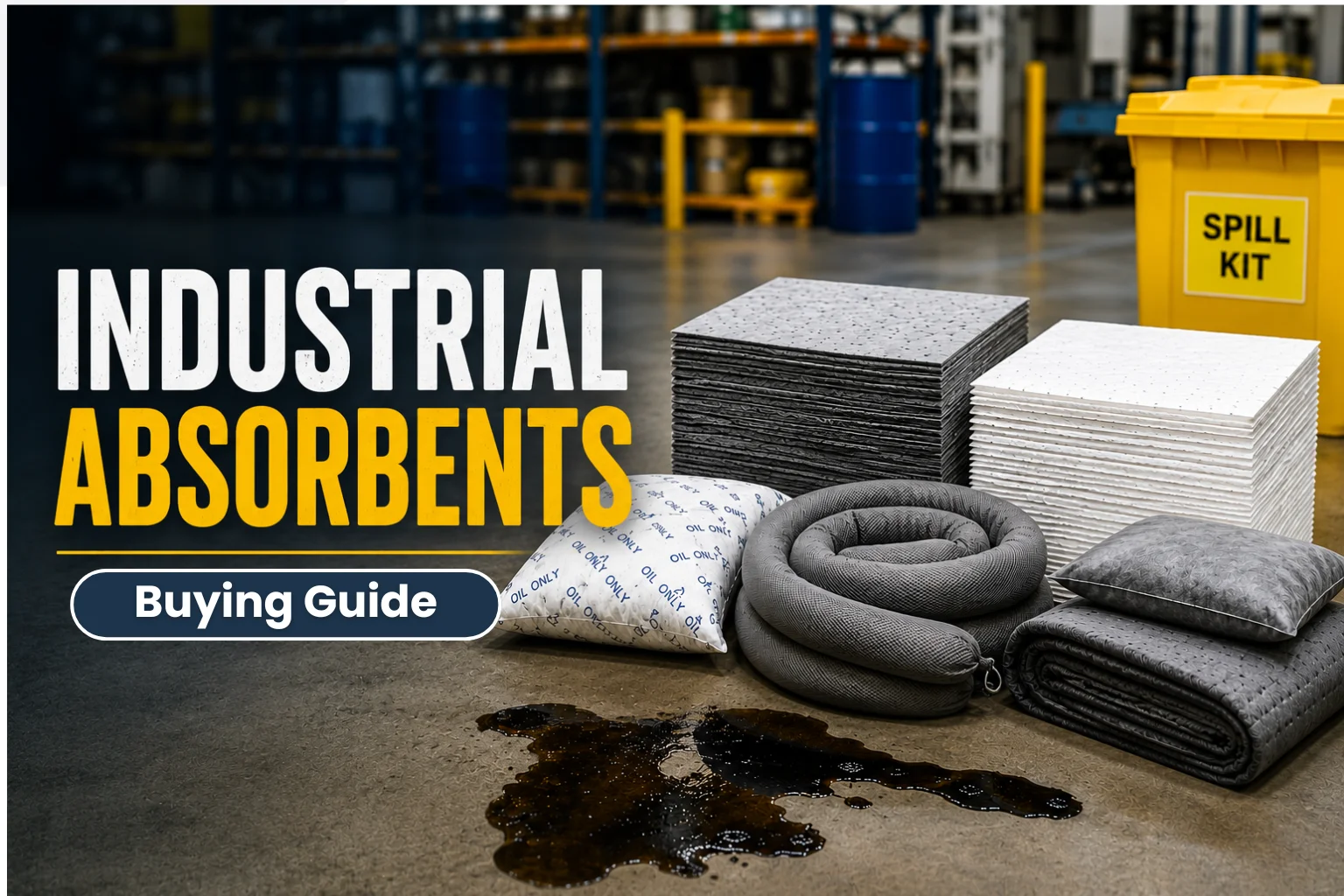
A leaking drum on a warehouse floor and a hydraulic spill under production equipment are not the same problem, even if both need to be contained fast. An effective industrial absorbents buying guide starts with that reality: the right product depends on the liquid, the spill size, the work area, and how quickly your team needs to respond.
For procurement teams, EHS managers, and site supervisors, absorbents are not a commodity purchase. They affect spill response time, housekeeping standards, environmental risk, and ongoing operating cost. Buy too little capacity and you run short during an incident. Buy the wrong type and the product may underperform, create disposal issues, or slow cleanup.
How to use this industrial absorbents buying guide
The fastest way to choose correctly is to work backward from your spill risk. Start with the fluids used on site, then match product type, absorbency class, and pack format to where those spills are most likely to happen. This avoids a common mistake: buying general-purpose absorbents for every area when certain zones need more specialized protection.
If your facility handles oils, coolants, solvents, acids, and water-based liquids in different departments, one absorbent type will rarely cover the entire operation efficiently. Most industrial sites need a mix of products for daily drips, maintenance work, and larger spill response.
First decision: what liquid are you absorbing?
This is the key buying factor. Industrial absorbents are typically grouped into oil-only, universal, and chemical absorbents.
Oil-only absorbents
Oil-only absorbents are designed for hydrocarbons and petroleum-based liquids while repelling water. They are the preferred choice for marine operations, outdoor yards, stormwater-sensitive areas, and any application where oil must be recovered from wet surfaces. If your team works around fuel, diesel, lubricants, or offshore and dockside environments, this category usually makes the most operational sense.
The trade-off is straightforward. Oil-only products are highly effective for hydrocarbons, but they are not the right answer for water-based chemicals or mixed facility spills.
Universal absorbents
Universal absorbents handle a broad range of non-aggressive industrial liquids such as oils, coolants, solvents, water, and light chemicals. For manufacturing plants, workshops, warehouses, and maintenance teams, this is often the most practical everyday option because it covers routine leaks and housekeeping tasks without overcomplicating stockholding.
The advantage is versatility. The limitation is that universal products are not a substitute for chemical absorbents where corrosive liquids are present.
Chemical absorbents
Chemical absorbents are intended for aggressive or hazardous fluids including acids, caustics, and unknown liquids. In labs, chemical storage areas, process plants, and hazmat response situations, they provide a safer and more appropriate response option.
Here, caution matters. If there is any chance of corrosive exposure, choosing on price alone can become expensive very quickly. Compatibility should come before unit cost.
Second decision: which absorbent format fits the job?
After liquid type, the next question is form factor. Pads, rolls, socks, pillows, and loose absorbents solve different response problems.
Pads and rolls for fast surface coverage
Pads are the standard choice for wiping, catching drips, and handling small spills. They are easy to deploy, easy to distribute across workstations, and practical for daily use. In most facilities, pads are the core line item because they support both spill response and preventative housekeeping.
Rolls make more sense when you need continuous coverage along walkways, under machinery, or across larger maintenance zones. They are also useful when teams want to cut absorbent length to fit specific equipment footprints. If your operation has recurring leaks over broad floor areas, rolls often provide better value and faster deployment than individual pads.
Socks for containment
Absorbent socks are built to control spread. They are placed around leaking equipment, along doorways, around drains, or at the perimeter of a spill to stop movement before cleanup starts. For many buyers, socks are not the primary absorbent volume purchase, but they are essential for spill control strategy.
This matters in facilities where liquid migration creates a bigger risk than the spill source itself. A relatively small leak can become a major incident if it reaches a drain, pedestrian route, or loading area.
Pillows for concentrated leaks
Pillows are designed for high-volume drips and pooling liquids in confined areas. They work well under valves, flanges, machine bases, and drum dispensing points where fluid accumulates in one spot rather than spreading thinly across the floor.
If your site has known leak points with repeated saturation, pillows often outperform stacks of pads because they hold more liquid in a smaller footprint.
Loose absorbents and granular products
Loose absorbents are often used outdoors or on rough surfaces where pads and rolls are less effective. They can be practical for uneven floors, roadways, and emergency spill response, but they may create slower cleanup and more waste handling than sheet-based products.
For indoor industrial environments focused on speed and cleanliness, pads, rolls, socks, and pillows are usually the preferred first line.
Capacity, weight, and durability matter more than many buyers expect
Not all absorbents with similar dimensions perform the same way. Basis weight, construction, and bonding affect how much liquid a product holds, how well it resists tearing, and whether it stays intact during use.
Lightweight absorbents may be suitable for minor drips and cost control in low-risk areas. Medium-weight products are often the best fit for general industrial use because they balance absorbency with durability. Heavyweight options are better suited to high-volume spills, aggressive maintenance environments, and areas where the product will be walked on or moved during cleanup.
This is where buying too cheaply can create repeat consumption. A lower-cost pad that saturates fast or tears during pickup may drive higher usage over time. For larger operations, it is usually better to evaluate cost per absorbed gallon rather than cost per pack.
Site conditions should shape your purchase
An absorbent that performs well in a dry indoor plant may not be the right product for a marine terminal, construction site, or outdoor fueling area. Exposure to rain, traffic, wind, uneven surfaces, and drain risk all affect selection.
In wet or outdoor conditions, oil-only absorbents are often the right fit for hydrocarbon spills because they reject water. In high-traffic areas, bonded or more durable materials help maintain product integrity. Around drains and thresholds, socks and booms should be part of the buying decision, not an afterthought.
Storage also matters. If emergency response is time-critical, absorbents should be stocked close to the hazard rather than only in a central store room. That often means buying smaller packs for distributed points of use alongside bulk inventory for replenishment.
Compliance, disposal, and compatibility
Absorbent selection is not only about cleanup performance. It also affects waste handling and regulatory exposure. Once used, absorbents take on the classification of the absorbed liquid. That means disposal requirements may change depending on whether the spill involved oil, solvent, or hazardous chemical.
For EHS and procurement teams, this makes compatibility a practical purchasing issue. The wrong absorbent can complicate handling procedures or create unnecessary risk for responders. If your site works with aggressive chemicals, verify compatibility before standardizing products across departments.
It is also worth reviewing whether absorbents are being purchased as part of a larger spill control program. In many facilities, absorbents should align with spill kits, secondary containment, drain protection, and emergency response equipment. Buying them in isolation can leave gaps in actual readiness.
Buying quantities: daily use versus emergency stock
One of the most common purchasing mistakes is using the same stock logic for routine maintenance and incident response. Daily-use absorbents support housekeeping and minor leaks. Emergency stock exists for larger, less frequent events. They should be planned separately.
For routine consumption, look at monthly usage by area, fluid type, and maintenance activity. For emergency preparedness, size stock against the largest credible spill scenario in that zone. A drum storage area, loading dock, and lab will each require a different approach.
Buyers who manage multiple sites often benefit from standardizing core SKUs while allowing for site-specific additions. That keeps ordering simple without forcing every facility into the same risk profile.
What a smart specification looks like
A good purchase specification is clear enough that operations gets what it needs and procurement can reorder consistently. It should define the absorbent type, format, weight, intended liquid, application area, and pack size. If response time is critical, include storage location and replenishment expectations as part of the plan.
This is where a dependable stockist matters. Fast-moving industrial absorbents are often needed with short lead times, especially after a spill event or audit finding. Ocean Safety Supplies supports buyers who need stocked inventory, practical product guidance, and quick turnaround across routine orders and urgent replenishment.
Final buying advice
The best absorbent is not the one with the lowest price tag or the broadest claim on the label. It is the one your team can deploy quickly, safely, and repeatedly in the real conditions of your site. If you buy with the spill type, work area, and response requirement in mind, absorbents stop being a basic consumable and become part of a faster, more reliable safety operation.