

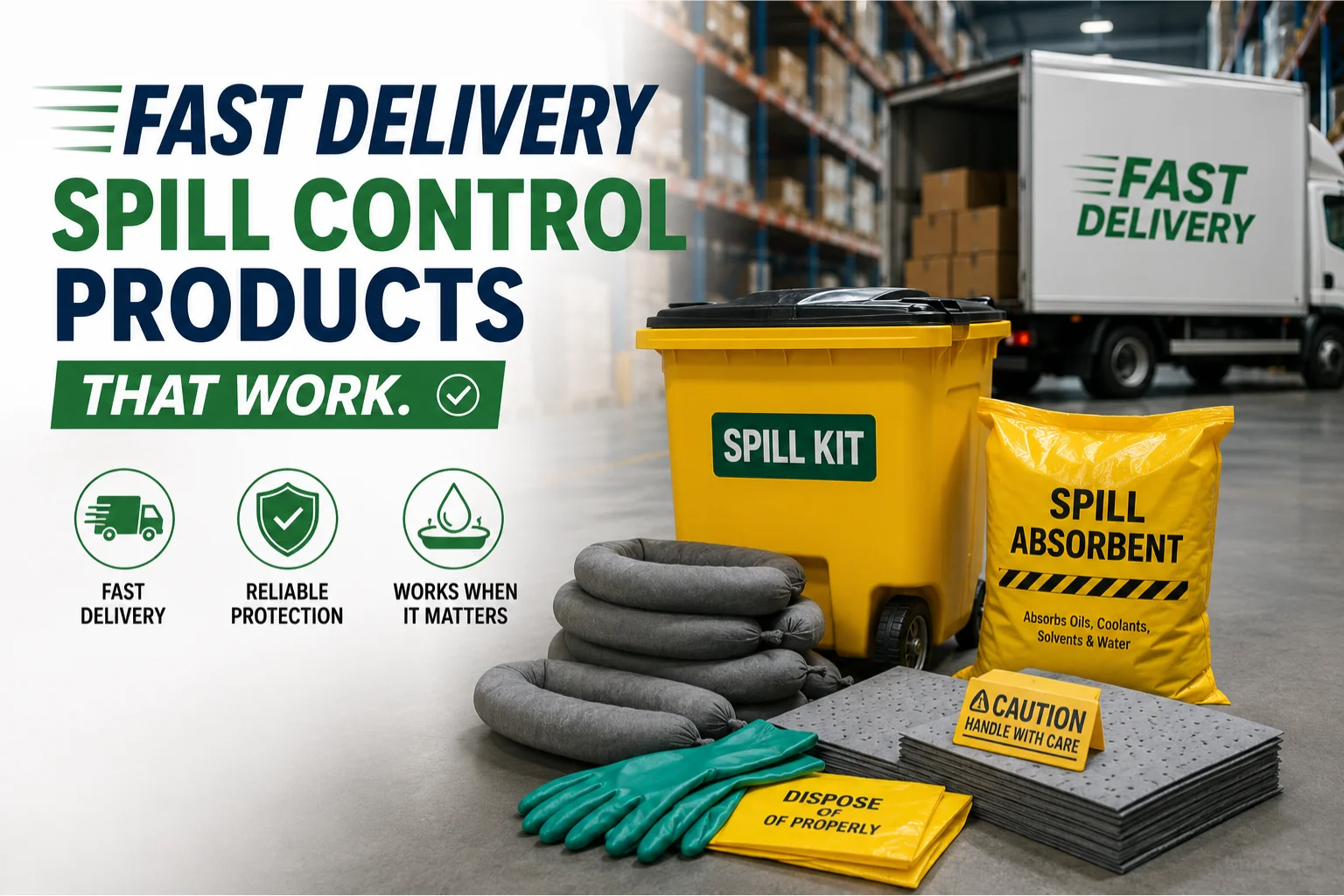
A leaking drum in a warehouse, a chemical splash near a lab bench, an oil sheen at a marine worksite – none of these incidents wait for standard lead times. Fast delivery spill control products matter because response windows are short, operational pressure is real, and delays can quickly turn a manageable spill into downtime, cleanup costs, and compliance risk.
For procurement teams, EHS managers, and facility operators, speed is only useful if the products arriving are the right ones. A next-day shipment of the wrong absorbent grade or an undersized spill kit does not solve the problem. The real value comes from stocked inventory, practical product guidance, and dependable fulfillment that supports immediate action on site.
Why fast delivery spill control products matter
Spill control is one of those categories where timing directly affects consequences. If absorbents, containment, or emergency response supplies are not available when needed, the result can be product loss, damaged flooring, environmental exposure, interrupted production, or a reportable incident. In higher-risk settings such as manufacturing plants, warehouses, labs, workshops, and marine operations, even a small delay can create larger safety and operational problems.
This is why many businesses no longer treat spill supplies as occasional purchases. They treat them as readiness stock. Fast delivery spill control products support that approach by helping teams replenish after an incident, close gaps found during inspections, and build out coverage for new work areas without waiting through long procurement cycles.
There is also a practical purchasing advantage. When a supplier holds broad inventory locally and can dispatch quickly, buyers can consolidate more of their spill control needs with one source instead of managing multiple vendors for kits, absorbents, containment pallets, drain protection, and specialty response items.
What buyers usually need most urgently
Urgent spill control orders are rarely random. In most cases, the requirement falls into a few predictable categories tied to routine risk points across industrial and commercial facilities.
Spill kits for immediate response
Spill kits are often the first product requested after an incident or audit finding. They give teams an organized response package that can be placed close to risk areas and used without delay. The right kit depends on the liquid involved, the likely spill volume, and the work environment.
General purpose kits are common for mixed facility use where water-based liquids, coolants, and non-aggressive fluids are present. Oil-only kits are more suitable for hydrocarbons, marine operations, and outdoor areas where water rejection matters. Chemical spill kits are necessary where corrosives or more aggressive liquids are handled. Fast availability is especially important here because a missing or depleted kit leaves a visible preparedness gap.
Absorbents for day-to-day spill management
Absorbent pads, rolls, socks, pillows, and loose absorbents are often the products buyers need fastest because they are consumed regularly. A site may have spill kits in place, but once a leak starts recurring around machinery, pumps, drums, or transfer points, loose absorbent stock can disappear quickly.
Pads and rolls help with broad surface coverage and routine drips. Socks are better for surrounding and stopping spread. Pillows work well for heavier pooling near persistent leak sources. The right product format depends on whether the goal is wipe-up, perimeter control, or sustained absorption over time.
Secondary containment and leak prevention
Not every urgent requirement follows an active spill. Sometimes a site identifies a storage risk during inspection and needs containment pallets, drip trays, portable bunds, or drum accessories delivered quickly to prevent an incident before it happens. This is common when new chemicals arrive on site, storage layouts change, or temporary operations need compliant containment with little notice.
In these cases, fast delivery is less about emergency cleanup and more about restoring compliance and reducing exposure before operations continue.
Choosing fast delivery spill control products without buying twice
Speed matters, but rushed purchasing can create waste if product selection is not aligned with the actual hazard. Commercial buyers usually get the best result by checking three things before placing an urgent order.
First, confirm the liquid type. Oil, water-based fluids, solvents, and corrosive chemicals do not all require the same absorbent media. Second, estimate realistic spill volume, not ideal conditions. Many sites under-specify kit capacity based on average incidents rather than worst credible spills near storage or transfer areas. Third, think about placement. A large central kit may look efficient on paper, but smaller kits positioned near risk points often improve actual response times.
There is always a trade-off between immediate availability and exact specification. If a niche item has a longer lead time, a stocked alternative that covers the primary hazard may be the smarter short-term decision. This is where practical supplier guidance helps prevent delays without compromising safety.
What reliable supply should look like
Fast delivery claims are common. Reliable fast delivery is more specific. For industrial buyers, it usually means the supplier can confirm stock, recommend the correct product category, process orders quickly, and ship from an established warehouse rather than relying on uncertain back-to-back sourcing.
That distinction matters when operations are under pressure. A supplier with deep stock across spill kits, absorbents, containment products, and related safety items can support both urgent one-off requirements and routine replenishment. It also reduces the friction of sourcing from multiple channels when a site needs a broader readiness package.
Ocean Safety Supplies is built around that practical model – stocked inventory, fast dispatch capability, and a broad product range that supports both routine compliance and emergency response needs.
Fast delivery spill control products for different work environments
Not every site evaluates spill control the same way. Product urgency and selection are shaped by the operating environment.
Warehouses and logistics facilities
These sites often need quick replenishment of general absorbents, spill kits, and drum spill pallets. Forklift traffic, drum handling, battery maintenance, and fluid transfer create frequent low-to-medium spill risks. Buyers usually prioritize products that are easy to stage at receiving zones, storage aisles, and loading areas.
Manufacturing and maintenance operations
Manufacturing plants often need a wider mix. Oils, coolants, chemicals, and washdown fluids may all be present. Here, fast delivery is important not only for spill response but also for keeping maintenance teams supplied with routine absorbent stock that prevents minor leaks from escalating into slip hazards or production interruptions.
Laboratories and chemical handling areas
Labs usually require tighter matching between spill media and chemical risk. Chemical spill kits, neutralizing agents where applicable, and compact absorbent formats are often preferred because storage space is limited and response needs are more specific. In these settings, buying the wrong category can create a handling issue rather than solve one.
Marine and outdoor operations
For docks, vessels, fuel handling areas, and offshore support environments, oil-only absorbents, booms, and water-repelling response products are often essential. Delivery speed is critical when weather, vessel schedules, or active sheen response create immediate pressure. Product durability and suitability for outdoor conditions matter just as much as dispatch time.
Planning ahead still matters
Fast delivery is not a replacement for planning. It is a safeguard that supports business continuity when stock runs low, incidents happen, or operating conditions change faster than expected. The strongest spill control programs combine on-site readiness with access to a supplier that can replenish quickly and accurately.
That usually means reviewing high-risk areas, setting minimum stock levels, and standardizing core products across facilities where possible. It also means reassessing after any spill event. If a kit was too small, if absorbents ran out, or if containment was missing, those are procurement signals worth acting on immediately.
For multi-site businesses, standardization can make urgent purchasing simpler. If each location uses the same absorbent grades, kit formats, and containment categories where appropriate, replacement orders are faster and less prone to error. The caveat is that standardization should not override site-specific hazards. A warehouse and a chemical process area may share some products, but they should not be treated as identical risk environments.
What to expect from a serious supplier
Industrial buyers do not need marketing promises. They need confidence that products are in stock, specifications are clear, and orders move quickly. A serious spill control supplier should be able to help buyers narrow the product type, confirm fit for application, and support both urgent requests and repeat ordering.
Breadth also matters. When the same supplier can provide spill kits, absorbents, containment pallets, drain protection, emergency showers, and related safety equipment, procurement becomes easier and site readiness becomes more consistent. That is especially useful for teams managing audits, shutdown preparation, expansion projects, or post-incident replenishment under time pressure.
The best time to source fast delivery spill control products is before a shortage becomes visible on the floor. If a site already knows its risk points and response expectations, quick access to stocked products becomes a practical advantage rather than a last-minute scramble.
When response time, compliance, and day-to-day operations are all on the line, dependable supply is not a convenience. It is part of the safety system itself.