

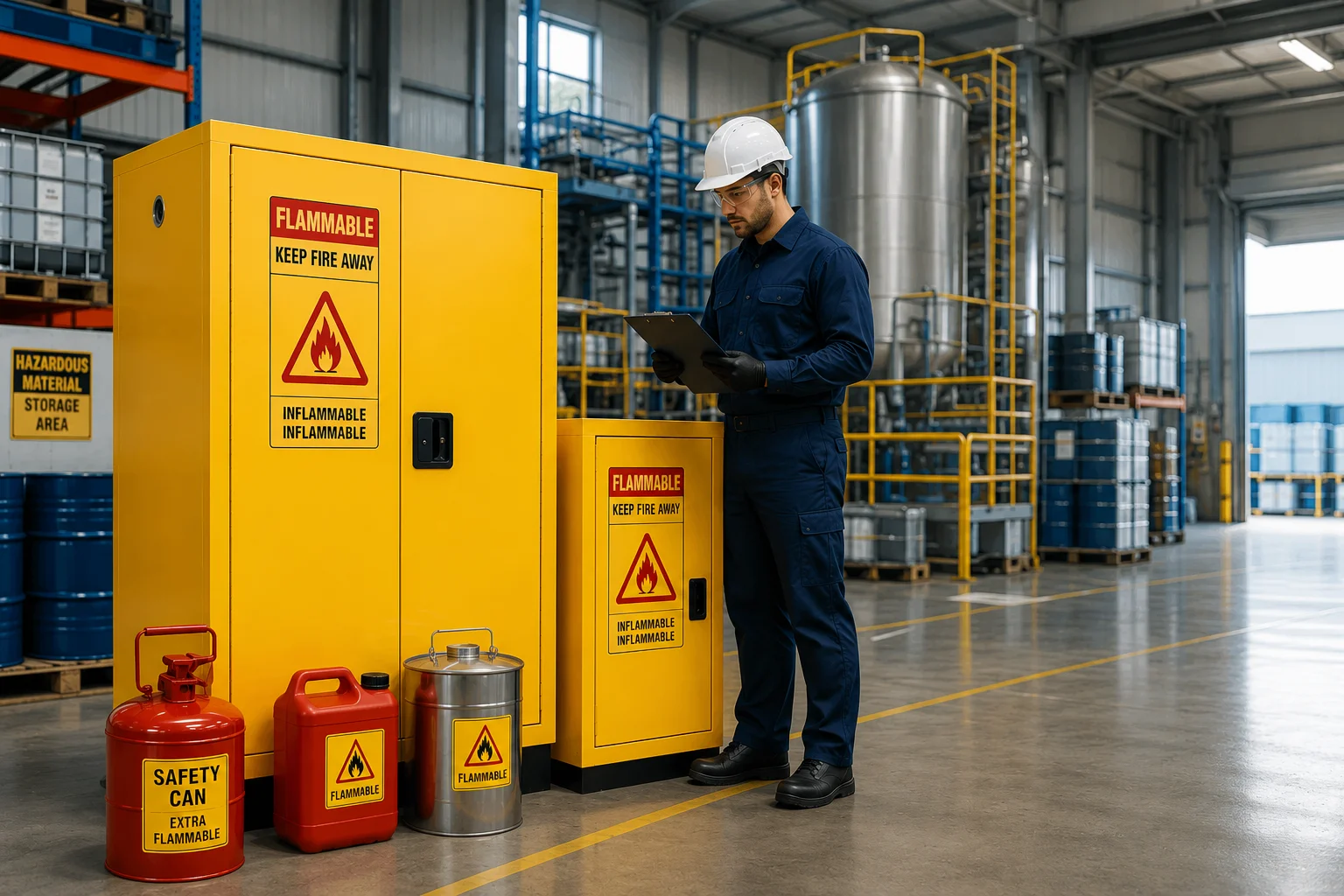
A dented solvent drum in a busy maintenance room can turn a routine shift into a shutdown. That is why flammable cabinets are not a box-checking purchase. They are a front-line control for storing fuels, paints, solvents, and other combustible liquids in a way that reduces fire risk, supports compliance, and keeps operations moving.
For procurement teams, EHS managers, and site supervisors, the real question is not whether a cabinet is needed. It is which cabinet fits the storage load, the work area, and the pace of the operation. The right choice protects people and inventory. The wrong one creates access problems, poor storage habits, and avoidable exposure during inspections or emergencies.
What flammable cabinets are designed to do
Flammable cabinets are built to isolate hazardous liquids from ignition sources and limit the speed at which a fire can involve stored contents. In practical terms, that means a dedicated storage point with a reinforced structure, self-closing or manual-closing doors depending on the model, leak-retaining sump capacity, and clear hazard labeling.
They also help control day-to-day risk. Containers are less likely to be left on benches, near electrical equipment, or in traffic areas when there is a designated cabinet close to the point of use. That matters in warehouses, workshops, laboratories, plants, and marine environments where materials move fast and shortcuts tend to appear when storage is inconvenient.
A cabinet alone does not replace safe handling procedures, spill readiness, or ventilation planning. It works as one part of a broader hazardous materials control strategy. Sites that get the best results treat storage, transfer, spill response, and emergency access as one connected system.
How to assess flammable cabinets for real operations
The most common buying mistake is sizing a cabinet around current container count only. Storage demand tends to grow, and once a cabinet is full, users start staging cans outside it. A better approach is to review actual liquid types, package sizes, issue frequency, and where the materials are used.
If operators need constant access on the production floor, a smaller cabinet near the work zone may be more effective than one large unit placed far away. If the site holds reserve stock, a higher-capacity cabinet in a controlled storage area may make more sense. It depends on whether the cabinet is intended for point-of-use storage, central storage, or both.
Door style is another practical factor. Manual-close doors can suit lower-traffic applications where users are trained to shut the cabinet after each access. Self-closing doors can reduce the chance of cabinets being left open in active environments. In tight rooms, door swing and clearance matter more than buyers sometimes expect. A cabinet that technically fits the floor space can still be awkward to use if pallet movement, trolleys, or adjacent equipment block access.
Interior configuration should match the products being stored. Adjustable shelves help when container heights vary. The sump at the base should provide enough retention for leaks and drips from routine handling, not just major spill scenarios. For operations storing multiple container formats, flexibility inside the cabinet often saves time and reduces unsafe stacking.
Capacity, placement, and workflow
Capacity is easy to compare on paper, but placement decides whether the cabinet improves safety or creates friction. A well-sized cabinet in the wrong location often leads to poor compliance at the user level. People store what they need close at hand. If proper storage slows the job too much, improper storage becomes routine.
That is why placement should be reviewed with operations, not just facilities or procurement. Look at travel paths, ignition sources, forklift routes, and how often liquids are issued. Cabinets near maintenance areas, paint rooms, process lines, and laboratories should support quick, orderly access without obstructing egress or everyday movement.
There is also a trade-off between centralization and convenience. Central storage can simplify inventory control and reduce duplicate stock. Point-of-use cabinets can improve handling discipline and reduce the temptation to leave partial containers exposed. Many sites need both. Reserve stock belongs in a controlled area, while limited daily-use quantities are better kept near the task.
Key features that matter on the ground
Not every feature carries the same operational value. Buyers should focus first on construction quality, door reliability, visible hazard identification, and spill retention. These are the basics that affect performance every day.
After that, details start to separate a cabinet that works well from one that is simply compliant on paper. Durable finishes matter in corrosive or high-humidity environments. Shelf load capacity matters when heavier metal containers are involved. Locking options matter where access must be restricted or stock control is tight. Grounding points may be relevant depending on the liquids and transfer procedures in use.
Vent openings are often misunderstood. Some buyers assume venting is always required, but application needs vary by site conditions, local requirements, and the materials handled. The same is true for under-bench, slimline, and high-capacity models. There is no single best format. The right design depends on volume, room layout, and how the products are actually used.
Flammable cabinets and compliance planning
Compliance is one reason companies invest in flammable cabinets, but compliance should be treated as a practical operating standard, not just an inspection concern. Cabinets should support safer segregation, better housekeeping, clearer labeling, and more controlled storage limits.
For many organizations, the issue is not just having a cabinet on site. It is whether the cabinet selected is appropriate for the materials, the quantity stored, and the work area. An undersized or poorly located unit can still create handling and storage problems even if it appears to address the requirement.
Documentation and internal procedures matter here. If teams know what belongs in the cabinet, what does not, how much can be stored, and who checks condition and housekeeping, the cabinet becomes part of the site system rather than a passive asset. That reduces drift over time, especially in facilities with multiple shifts or contract labor.
Choosing flammable cabinets for different environments
Industrial workshops usually need cabinets that can handle frequent access, occasional rough treatment, and mixed container sizes. Durability and ease of use are usually more important than compact aesthetics. Laboratories may prioritize footprint, compatibility with smaller containers, and placement close to controlled work areas. Warehouses often need a clearer distinction between reserve storage and working stock.
Marine and offshore environments introduce another layer. Corrosion resistance, secure placement, and dependable door operation become more important where humidity, vibration, and exposure conditions are harsher. Construction sites may need more temporary planning, especially where hazardous liquids are stored in changing work zones and site layouts evolve week to week.
This is where supplier support matters. A catalog specification helps narrow the options, but experienced guidance can prevent mismatches between the product and the site. Ocean Safety Supplies supports buyers who need practical answers fast, especially where storage needs connect with spill kits, secondary containment, emergency response equipment, and broader hazardous material controls.
Common buying mistakes to avoid
The first mistake is buying only on price. A cabinet that does not match the application often leads to secondary costs through poor usage, added handling time, or replacement needs. The second is underestimating future capacity. If liquid use is likely to expand, buying to the exact current requirement can be short-sighted.
The third is ignoring workflow. A compliant cabinet that is hard to reach, hard to open, or difficult to organize will not deliver the intended safety outcome. The fourth is treating the cabinet as a standalone fix. If transfer points, spill response materials, and training are weak, the cabinet only solves part of the exposure.
A better purchasing approach is to look at the full storage chain – receipt, decanting, use, return, spill control, and emergency access. That gives buyers a clearer view of what cabinet type will actually support the operation.
Making the purchase decision with confidence
When comparing flammable cabinets, focus on the basics first: what you are storing, how much of it is in daily circulation, where it is used, and what level of access control is needed. From there, review cabinet size, door type, internal layout, retention capacity, and installation location.
A fast decision is valuable, but a rushed one can be expensive. The best cabinet choice is usually the one that fits both compliance needs and operator behavior. If it is practical to use, teams are more likely to use it correctly every day.
When hazardous liquids are part of the job, storage should not be left to improvisation. A well-chosen cabinet creates order, reduces fire exposure, and gives your site one less preventable risk to manage.