

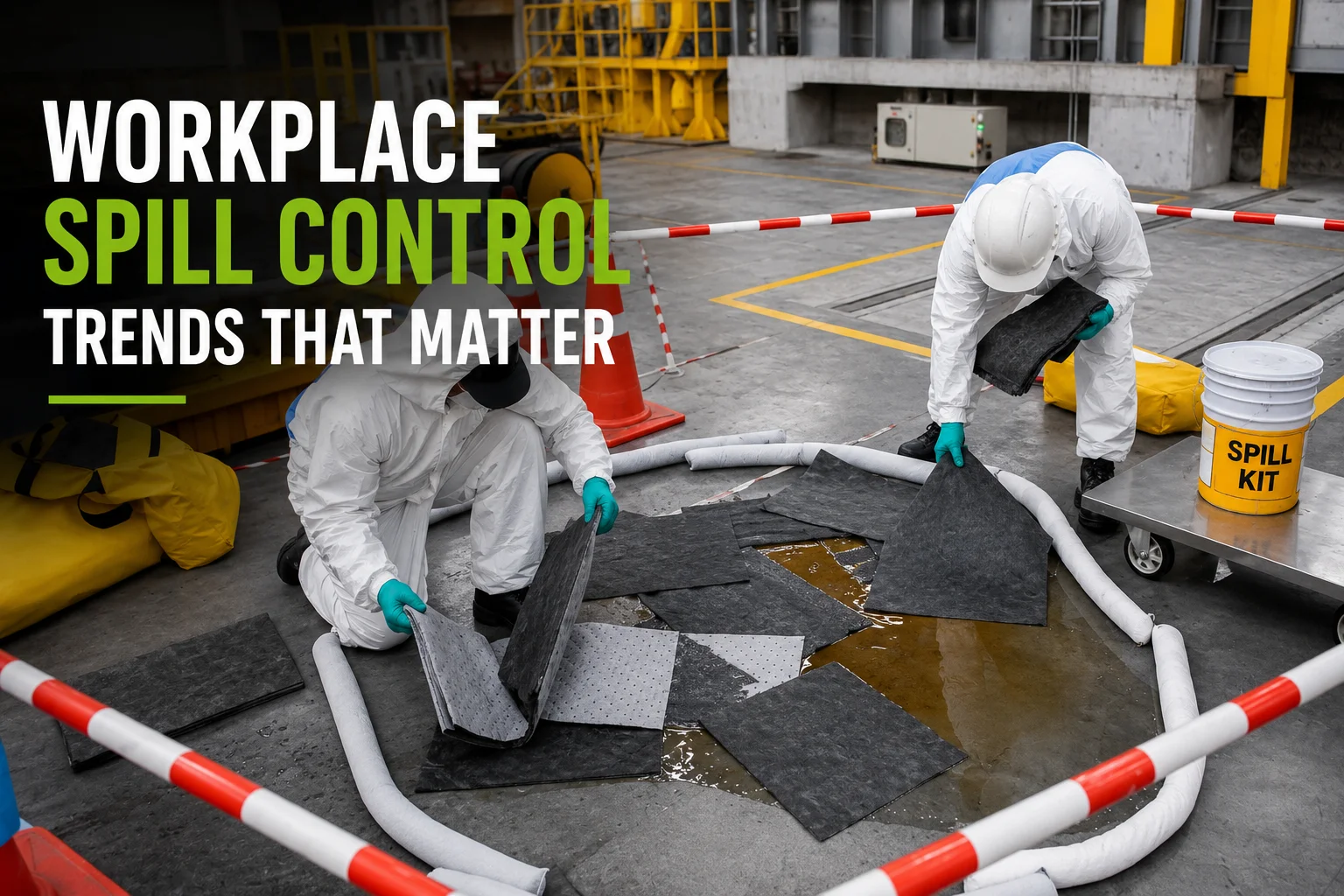
A leaking drum in a warehouse rarely stays a small problem for long. One missed transfer, one poorly placed absorbent, or one overloaded storage area can turn a minor incident into downtime, cleanup costs, and compliance pressure. That is why workplace spill control trends are getting more attention from EHS teams, operations managers, and procurement leaders who need practical readiness, not just basic product supply.
For most industrial and commercial sites, spill control is no longer treated as a narrow housekeeping function. It is becoming part of a broader operational risk strategy tied to worker safety, environmental protection, and business continuity. The shift matters because sites are handling more varied liquids, tighter audit expectations, and less margin for slow response.
Workplace spill control trends are moving from reactive to planned
One of the clearest changes in the market is the move away from buying spill products only after an incident or audit finding. More companies are standardizing spill preparedness across departments and locations before problems happen. That includes mapping likely spill points, assigning response responsibilities, and keeping the right equipment closer to the actual hazard.
This sounds straightforward, but it changes purchasing behavior. Instead of ordering a generic spill kit for the whole site, buyers are separating needs by risk area. Warehouses may need universal absorbents for oils, coolants, and general liquids. Chemical handling zones may require specialized absorbents and compatible containment. Loading bays often need outdoor-ready containment tools that can perform in wet or uneven conditions.
The result is a more deliberate product mix. Sites are stocking spill kits, absorbent pads and rolls, drain protection, secondary containment pallets, and portable bunds as part of a planned system rather than isolated items. That approach usually improves response speed, but it also reduces wasted spend on products that are technically available yet poorly matched to the actual risk.
More sites are building spill control around specific risk zones
Another major trend is zone-based spill planning. Instead of treating the facility as one uniform environment, buyers are evaluating where spills happen, what liquids are present, and how quickly those liquids can spread.
In practice, this means the spill control setup in a maintenance bay should not look identical to the setup in a laboratory, marine work area, production line, or fuel storage point. The hazard profile is different, and the response equipment should reflect that. A universal absorbent may be suitable in one area and completely wrong in another.
This is where experienced buyers are paying more attention to compatibility, container size, and access. A compact spill kit mounted near a transfer point may prevent a larger release. A larger wheeled kit may be more suitable for transport corridors or loading areas where spills can move fast. Secondary containment is also getting more attention because preventing spread is often more cost-effective than relying on cleanup alone.
There is a trade-off here. A more tailored setup can increase the number of SKUs a site manages. But for many facilities, the benefit is fewer gaps in readiness and better alignment between equipment and hazard.
Compliance is pushing demand for visible, audit-ready systems
Workplace spill control trends are also being shaped by compliance expectations. Buyers are under pressure to show that spill readiness is documented, visible, and supported by the right equipment. This is not only about having absorbents on hand. It is about whether the products are appropriate, accessible, maintained, and positioned to support a safe response.
That is why more organizations are investing in clearly identified spill stations, labeled storage, and containment solutions that support cleaner inspections. Emergency response products are being integrated into site safety planning rather than kept in back rooms or general stores where access may be delayed.
For procurement teams, this trend changes what counts as value. The lowest unit price may not be the best decision if products are not durable, compatible, or consistently available when replenishment is needed. Buyers are looking for supply partners who can support repeat orders, advise on suitable categories, and help standardize products across sites.
Faster response is shaping product selection
Speed matters in spill control, so product selection is becoming more response-focused. Companies are favoring equipment that can be deployed quickly by on-site teams with minimal confusion. That includes pre-packed spill kits, easy-dispense absorbent formats, visible storage cabinets, and containment products that are simple to position under pressure.
This trend reflects operational reality. In most workplaces, the first person responding to a spill is not a specialist cleanup contractor. It is a trained employee, supervisor, technician, or operator dealing with the situation in real time. If the equipment is hard to identify, hard to move, or too complicated to use, the response slows down.
That is one reason product standardization is gaining ground. When teams see consistent spill kit layouts, similar absorbent formats, and familiar containment tools across a site, they respond with more confidence. It also helps with training because the equipment is easier to explain and easier to remember.
Secondary containment is becoming a stronger priority
Many buyers are paying closer attention to prevention rather than relying only on cleanup. Secondary containment pallets, drum spill platforms, IBC bunding solutions, and portable containment tools are becoming central to spill control planning, especially in facilities handling oils, chemicals, and bulk liquids.
This change is practical. Cleanup products are essential, but they are most effective when combined with measures that stop leaks from spreading in the first place. A leaking container stored on suitable containment is very different from a leak spreading across a warehouse floor, toward a drain, or into a traffic area.
The best setup depends on the operation. A fixed containment pallet may suit long-term storage. A portable bund may be better for temporary transfer activity or maintenance work. Some sites need both. The trend is not toward one universal solution. It is toward layered protection that supports storage, handling, and incident response together.
Buyers want fewer suppliers and more dependable stock
A less visible but important shift is how organizations are sourcing spill control products. Procurement teams increasingly prefer fewer vendors that can cover multiple safety and environmental categories with dependable stock availability. Spill control is often purchased alongside flammable storage, emergency showers and eyewash stations, hazardous waste containers, and general workplace safety products.
This matters because readiness is not only about product choice. It is also about supply continuity. A site may have a strong spill plan on paper, but if replenishment absorbents, replacement kits, or containment products are delayed, preparedness drops quickly. Fast delivery and local inventory are becoming part of the spill control value proposition, not just service extras.
For industrial buyers, this makes practical sense. Working with a supplier that understands spill risk, holds stock, and supports repeat purchasing reduces downtime in the buying process and improves consistency across departments.
Sustainability is influencing purchasing, but performance still leads
Sustainability is part of the conversation, especially for larger organizations with environmental targets. Buyers are asking more questions about waste reduction, responsible disposal, and whether product selection can support a cleaner overall spill response process.
Even so, performance remains the deciding factor. If an absorbent cannot handle the liquid, if a containment unit does not fit the footprint, or if a kit is not durable enough for industrial use, sustainability claims will not carry the purchase decision. In most facilities, the winning products are those that meet the hazard, support compliance, and hold up under daily operational conditions.
The more realistic trend is balanced decision-making. Buyers want practical products that reduce environmental exposure and operational waste without compromising response capability. That is a more grounded approach than chasing labels alone.
What these trends mean for current purchasing decisions
For EHS and operations teams, the main question is not whether spill control is important. It is whether the current setup reflects actual site conditions. Many facilities still have legacy spill products in place that were bought years ago, moved between departments, or selected without a full risk review.
A stronger approach is to reassess four things: where spills are most likely, what liquids are present, how quickly teams can respond, and whether existing containment and absorbents are suitable. From there, product selection becomes more precise. Some sites need more point-of-use spill kits. Others need upgraded secondary containment, better labeling, or a more consistent replenishment plan.
For procurement, the market is moving toward reliability over fragmentation. Industrial buyers need products that are in stock, fit the hazard, and arrive fast enough to support ongoing readiness. That is especially true for multi-site operations, marine applications, warehouses, factories, and labs where spill risk is not theoretical.
Trusted by professionals across industries, suppliers that combine inventory depth with practical technical guidance are becoming more valuable in this environment. Ocean Safety Supplies supports that need with stocked spill control, containment, and workplace safety solutions built for fast-moving operational requirements.
The direction is clear. Spill control is becoming more specific, more visible, and more integrated into everyday risk management. The smartest next step is not to wait for a major incident or audit trigger. It is to make sure the products on site match the hazards on site, and that response readiness is as dependable as the operation itself.