

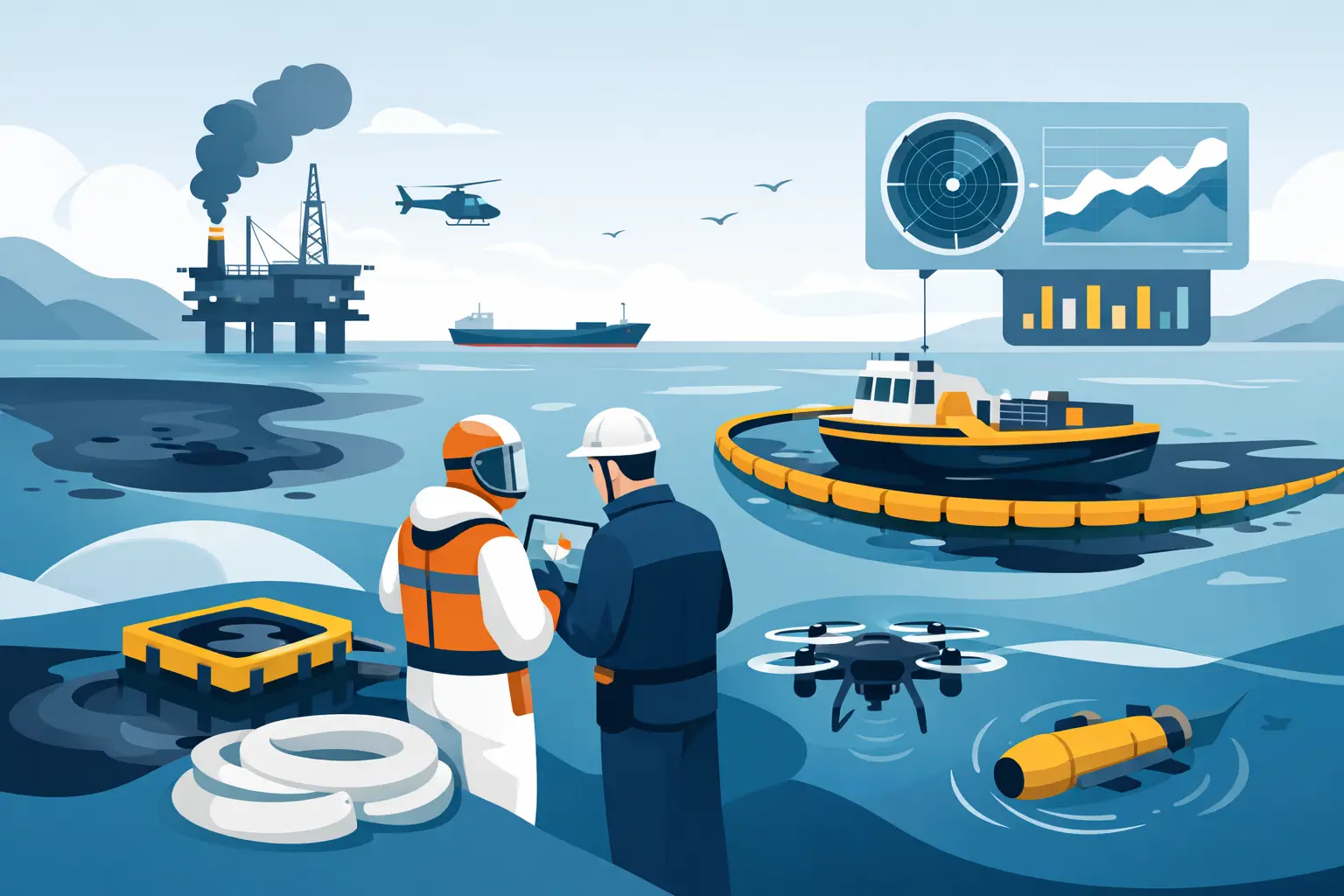
A sheen reported near a terminal, marina, vessel berth, or industrial outfall creates an immediate operational problem: stop the spread before wind, current, rain, and vessel traffic turn a manageable release into a wider recovery effort. The most consequential oil spill response trends are therefore not simply new equipment releases. They are changes in how organizations position equipment, verify response capability, and make faster decisions in the first critical hours.
For marine operators, facility managers, EHS teams, and procurement departments, readiness now means more than keeping a spill kit in storage. It means matching containment, recovery, temporary storage, and personnel protection to credible site-specific scenarios. The right response package depends on the oil type, water conditions, access points, expected release volume, and the time required to mobilize trained personnel.
Oil Spill Response Trends Moving From Plans to Practice
Earlier detection is improving the first response window
Remote cameras, drones, vessel monitoring data, fixed sensors, and satellite-supported surveillance are helping operators identify potential releases sooner. These tools can support incident verification, show the direction of travel, and help responders assess whether a sheen is moving toward drains, shorelines, water intakes, or sensitive assets.
Detection technology does not replace field assessment. Glare, weather, nighttime conditions, and false alarms can limit what a camera or sensor can confirm. A trained response lead still needs to establish the source, identify the product involved, assess immediate hazards, and select practical control points. The value of earlier detection is that it buys time for crews to deploy containment before conditions become more difficult.
For facility and port operators, this reinforces the need to store boom, anchors, connectors, absorbent materials, and deployment accessories close to likely release areas. Equipment that arrives after a spill has crossed a harbor basin or drainage channel has far less value than equipment staged for immediate use.
Containment plans are becoming more location-specific
A generic response plan may satisfy a documentation requirement, but it rarely tells a crew exactly where to place boom when a release occurs at a particular berth or shoreline. One of the most practical trends is pre-planning deployment layouts around real site conditions.
This includes identifying boom anchor points, prevailing currents, tidal effects, protected collection areas, vessel movement routes, access for workboats, and locations for temporary recovered-oil storage. Crews can then use diversionary or deflection boom to guide oil toward a recovery point rather than attempting to enclose a moving slick in open water.
The trade-off is clear. Larger boom inventories provide flexibility across different incidents, but they also require storage space, inspection, transport capacity, and trained handling. A smaller inventory may be suitable for a contained marina or industrial basin, while exposed coastal operations may require heavier-duty boom systems and marine-grade connectors designed for more demanding conditions.
Mechanical recovery remains central, with better matching of equipment
Skimmers remain a core part of many response strategies because they physically remove oil from the water surface. Recent purchasing decisions increasingly focus on matching skimmer type to oil viscosity, debris load, expected wave action, and available power or hydraulic systems rather than treating every skimmer as interchangeable.
Weir skimmers can be effective for a broad range of floating oils and are often valued for their ability to recover relatively thick layers. Oleophilic drum, brush, or disc skimmers can be useful where selective oil pickup and lower water collection are priorities. Suction-based recovery may suit sheltered, accessible areas, but performance can drop when the product is highly viscous or the water is rough.
No skimmer operates independently. Recovery capacity is limited by the complete system: boom placement, skimmer access, pump and hose sizing, debris management, crew capability, and the availability of tanks, bladders, or other temporary storage. Procurement teams should evaluate the recovery train as a package. A high-capacity skimmer without sufficient storage or transfer capability can quickly become the bottleneck.
Faster Deployment Depends on Equipment Standardization
Response teams are reducing deployment time by standardizing components where possible. Common boom connections, compatible pumps and hoses, clearly labeled storage containers, and repeatable packing arrangements help crews avoid unnecessary decisions during an incident.
Color-coded or numbered deployment sections can be especially useful for multi-person teams. Instead of sorting through mixed equipment under pressure, crews can move through an established sequence: contain the source, protect priority areas, position recovery equipment, deploy absorbents for residual sheen, and manage collected waste.
Portable bunds and secondary containment also have a growing role in marine-adjacent response. Many incidents begin during fuel transfer, equipment maintenance, drum handling, or waste movement before oil reaches the water. Controlling a release on land or on the deck is usually safer, faster, and less costly than recovering it after it enters a drainage system or waterway.
Absorbents are being used with more discipline
Absorbent pads, rolls, socks, pillows, and marine booms remain essential for small releases, polishing operations, and final sheen control. The trend is not toward using more absorbent material indiscriminately. It is toward selecting the correct absorbent type and using it at the right stage of the response.
Oil-only absorbents are designed to repel water while absorbing hydrocarbons, making them appropriate for many marine spill applications. General-purpose materials may be useful in workshops or mixed-fluid environments, but they are not always the best choice on open water. Teams should also plan for the waste stream. Saturated absorbents require controlled collection, labeling, temporary containment, and disposal according to applicable requirements.
Overuse creates a practical problem: absorbents can become expensive waste without contributing meaningfully to containment or recovery. Used strategically around vessel scuppers, drains, shorelines, and collection zones, they support a more controlled operation.
Digital Tools Are Supporting Accountability, Not Replacing Training
Digital inspection records, QR-based inventory checks, incident logs, and response checklists are becoming more common. For organizations with multiple locations, these tools make it easier to confirm that spill equipment is present, accessible, and within service requirements.
Their limitation is straightforward. A completed checklist does not prove a crew can deploy boom, start a pump, operate a skimmer, or communicate safely on the water. Practical drills remain necessary. A useful exercise should test the actual route from storage to the release area, the condition of lifting and launch equipment, personnel roles, communications, and waste handling. It should also expose missing accessories that are easy to overlook, such as repair kits, tow bridles, anchors, ropes, hose fittings, and personal protective equipment.
After each drill, teams should revise their equipment list based on what slowed the operation. This is where stock availability matters. Critical replacement items should be replenished quickly so the site is not left underprepared after training or a minor incident.
What Procurement Teams Should Prioritize
The best buying decision starts with a credible response scenario, not a catalog page. Consider the largest realistic release, likely spill locations, distance to water or drains, operating conditions, and whether the site can deploy equipment with its own personnel.
A practical marine response inventory may include containment boom, absorbent boom and pads, a suitable skimmer, pumps and hoses, portable storage, drain protection, portable bunding, waste containers, and appropriate PPE. The exact mix depends on the site. A small marina may prioritize rapid containment and absorbent capacity, while a fuel terminal may require larger boom sections, powered recovery equipment, and planned storage for recovered product.
Equipment durability and delivery lead time should carry real weight in the evaluation. Emergency response products are often purchased only after an inspection finding, a near miss, or an active incident. Working with a supplier that can support product selection, stock dependable equipment, and deliver quickly helps operations teams close readiness gaps before they become environmental events.
Oil spill response is becoming more data-informed and equipment-specific, but the standard for success remains practical: contain the release quickly, recover what can be recovered, protect priority areas, and keep people safe. The strongest response capability is built before the call comes in, with fit-for-purpose equipment that crews can access, deploy, and replace without delay.