

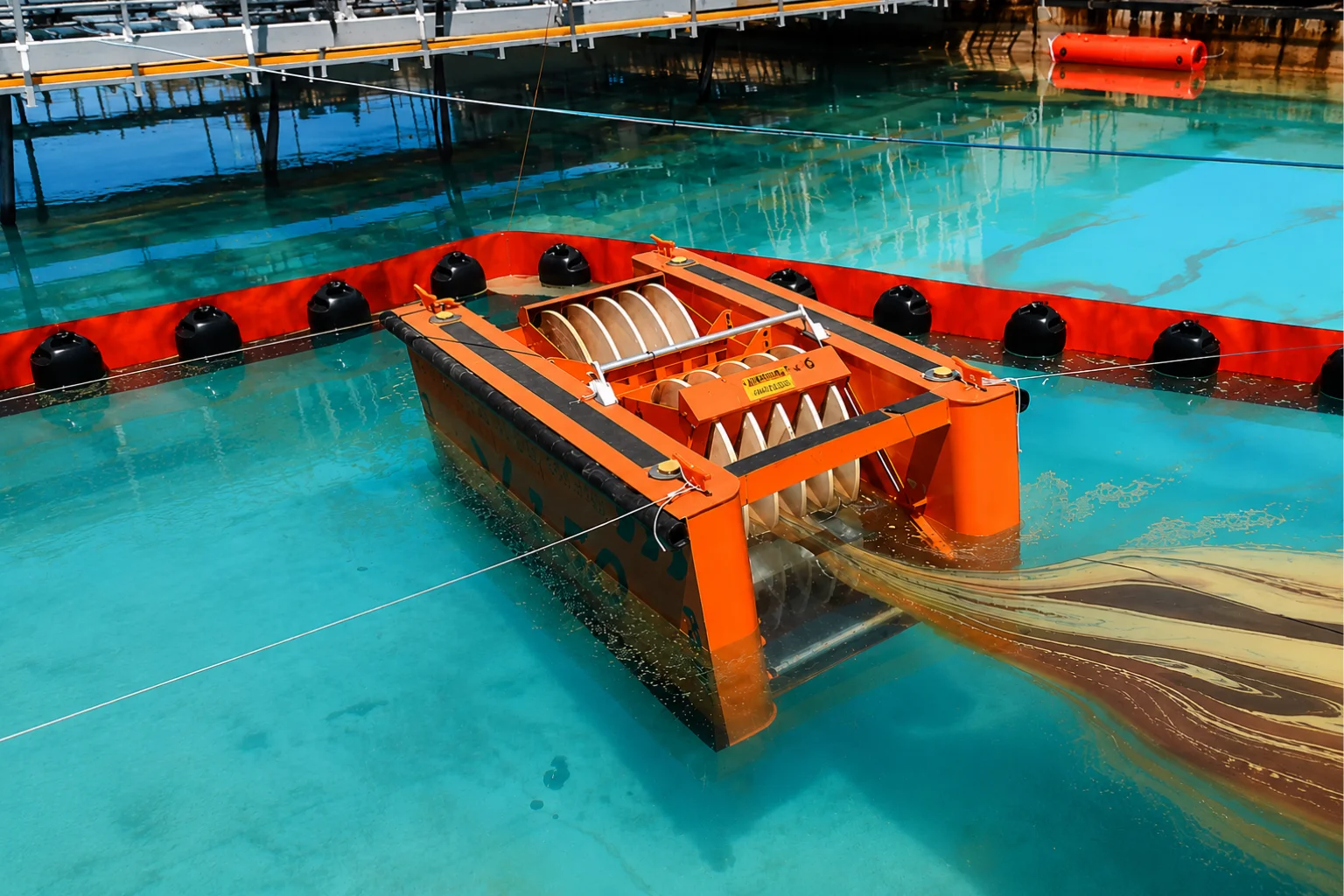
When a spill hits a sump, tank, lagoon, bilge, or containment area, speed matters – but so does recovery efficiency. The right oil skimmer for spill recovery can remove product quickly, reduce waste handling, and help operations teams regain control without turning a contained spill into a longer cleanup problem. For EHS managers, marine operators, and procurement teams, the real question is not whether a skimmer is useful. It is which skimmer will perform reliably in your actual conditions.
Why the right oil skimmer for spill recovery matters
Spill response equipment is often evaluated on urgency first and detail second. That is understandable during an incident, but it can lead to poor equipment selection. A skimmer that works well in calm water may struggle in confined pits. A high-capacity unit may look attractive on paper but become impractical if the recovered fluid contains too much water. In many cases, the difference between a fast, controlled recovery and a slow, labor-heavy cleanup comes down to matching the skimmer to the oil, the surface conditions, and the recovery setup.
For industrial buyers, this is not only a performance issue. It affects disposal costs, labor hours, downtime, and environmental compliance. If recovered material contains excessive water, storage and disposal become more expensive. If the skimmer is too light-duty for the site, teams may need repeated manual intervention. A good selection improves readiness before the next spill happens.
What an oil skimmer actually does in spill recovery
An oil skimmer is designed to separate and collect floating oil from water or another liquid surface. In spill recovery, that means removing hydrocarbons from affected areas so they can be pumped, stored, and handled as recovered product or waste. The best units do this selectively, targeting oil while minimizing water pickup.
That last point matters more than many buyers expect. Nameplate capacity can be misleading if it reflects total fluid movement rather than actual oil recovery. In a real spill, especially outdoors or in marine conditions, the skimmer has to deal with changing oil thickness, debris, movement, emulsification, and access limitations. A lower theoretical flow rate with better selectivity can outperform a larger unit that recovers mostly water.
Common skimmer types and where they fit
Different skimmer designs are built for different operating environments. A drum skimmer uses a rotating drum that attracts oil to its surface, then scrapes it into a collection area. These units are often a strong choice for relatively calm conditions, moderate viscosity oils, and applications where consistent selective recovery is more important than maximum sweep area.
Disc skimmers work on a similar principle, using rotating discs to pick up oil. They are often compact and suitable for tanks, pits, and contained industrial spaces. If access is tight and the spill is localized, a disc skimmer can be practical and easy to position.
Weir skimmers are different. They collect floating liquid over an adjustable lip and are commonly used when a large volume of oil needs to be removed quickly. The trade-off is selectivity. In thicker slicks they can be very effective, but in thin layers or variable conditions they may recover more water than some oleophilic designs.
Brush skimmers are often selected for heavier oils and more demanding recovery conditions. Their bristles can engage viscous product effectively, which makes them useful in marine and industrial spill response where oil characteristics are less predictable.
There is no single best design for every site. The right answer depends on where the spill occurs, the oil involved, and how recovered material will be managed.
How to choose an oil skimmer for spill recovery
The first factor is oil type and viscosity. Light fuels behave differently from heavy bunker oil, lubricants, or weathered hydrocarbons. Some skimmers are better at recovering light product from calm surfaces, while others are built for thicker oil that clings more readily to drums, discs, or brushes. If your operation handles more than one oil type, flexibility matters.
The second factor is the recovery environment. Open water, stormwater pits, interceptor tanks, process sumps, and port facilities all create different constraints. In open or moving water, flotation stability and wave tolerance become important. In confined industrial spaces, compact size, hose routing, and ease of lowering the unit into position often matter more than raw capacity.
The third factor is debris. A spill area with trash, leaves, solids, or process residue can interfere with some skimmer mechanisms. Buyers sometimes focus only on oil recovery rate and overlook how quickly fouling can reduce performance. If your site conditions are messy, ask how the unit handles contamination and how easy it is to clean.
Recovery rate also needs careful interpretation. Instead of looking only at the maximum advertised throughput, consider realistic oil recovery under your expected slick thickness. A skimmer that can recover a high percentage of oil with low water content often reduces downstream handling costs, even if the published flow rate is lower.
Power source is another practical decision. Pneumatic, hydraulic, and electric options each have operational implications. Electric units may be convenient on fixed industrial sites with reliable power access. Pneumatic systems can suit hazardous environments where air supply is available. Hydraulic systems are common in larger response setups and marine applications. The best choice depends on what your team can deploy quickly during an incident.
Site conditions that change the buying decision
A skimmer that looks suitable in a catalog can become the wrong choice once deployment realities are considered. Freeboard, access points, hose lengths, suction head, storage tank position, and operator availability all influence field performance. If the unit is difficult to launch safely or requires supporting equipment your team does not keep on hand, the response slows down immediately.
Temperature also changes performance. Oil viscosity rises in colder conditions, which can affect adhesion, pumping, and transfer. In hot outdoor locations, lighter oils may spread rapidly into thinner layers, making selective recovery more difficult. Salinity, agitation, and weather exposure can matter too, especially in coastal and marine environments.
This is why procurement based only on a broad specification sheet can be risky. The better approach is to match the skimmer package to the real response scenario, including pump compatibility, hoses, temporary storage, and operator handling.
Beyond the skimmer – the full recovery setup
An oil skimmer rarely works as a standalone answer. Effective spill recovery depends on the full system around it. Containment booms may be needed to concentrate product before skimming. Transfer pumps and hoses must match the recovered fluid. Temporary storage tanks or portable containment must be ready to receive the collected oil-water mixture. In some operations, absorbents are still needed for final polishing after bulk recovery is complete.
For that reason, buyers often get better results when they source skimmers as part of a broader spill response plan rather than as a one-off purchase. Ocean Safety Supplies supports this more practical approach because the skimmer itself is only one part of operational readiness. What matters is whether the site can respond fast with compatible equipment already available.
When high capacity is not the best answer
It is easy to assume that the biggest skimmer is the safest purchase. Sometimes it is. In a major marine spill or large containment basin, higher recovery capacity can be critical. But in many industrial facilities, oversized equipment creates its own problems. It may require more storage volume, more support equipment, and more operators than the site can provide. It may also recover more water, increasing disposal cost without improving the actual cleanup pace.
A more compact, selective skimmer can be the better business decision for routine spill readiness, interceptor maintenance, or contained recovery zones. The key is to choose for the likely event profile, not just the worst-case headline number.
What buyers should ask before purchasing
Before selecting a unit, it helps to ask a few direct questions. What oils are most likely to be spilled on site? Where would recovery take place? How thick is the likely surface layer? Will there be waves, debris, or restricted access? What power source is available during an emergency? How will the recovered liquid be stored and disposed of?
These questions are simple, but they quickly narrow the field. They also help suppliers recommend equipment that is operationally realistic instead of just technically possible.
Choosing for readiness, not just response
The most effective oil skimmer for spill recovery is the one your team can deploy quickly, operate safely, and rely on under actual site conditions. That usually means balancing capacity with selectivity, matching the skimmer type to the oil involved, and thinking beyond the unit itself to the full recovery system. If your operation treats spill control as part of business continuity rather than a box-checking exercise, equipment selection becomes much clearer.
A good skimmer does more than remove oil. It shortens response time, reduces waste burden, and gives your team a more controlled path from incident to cleanup.