

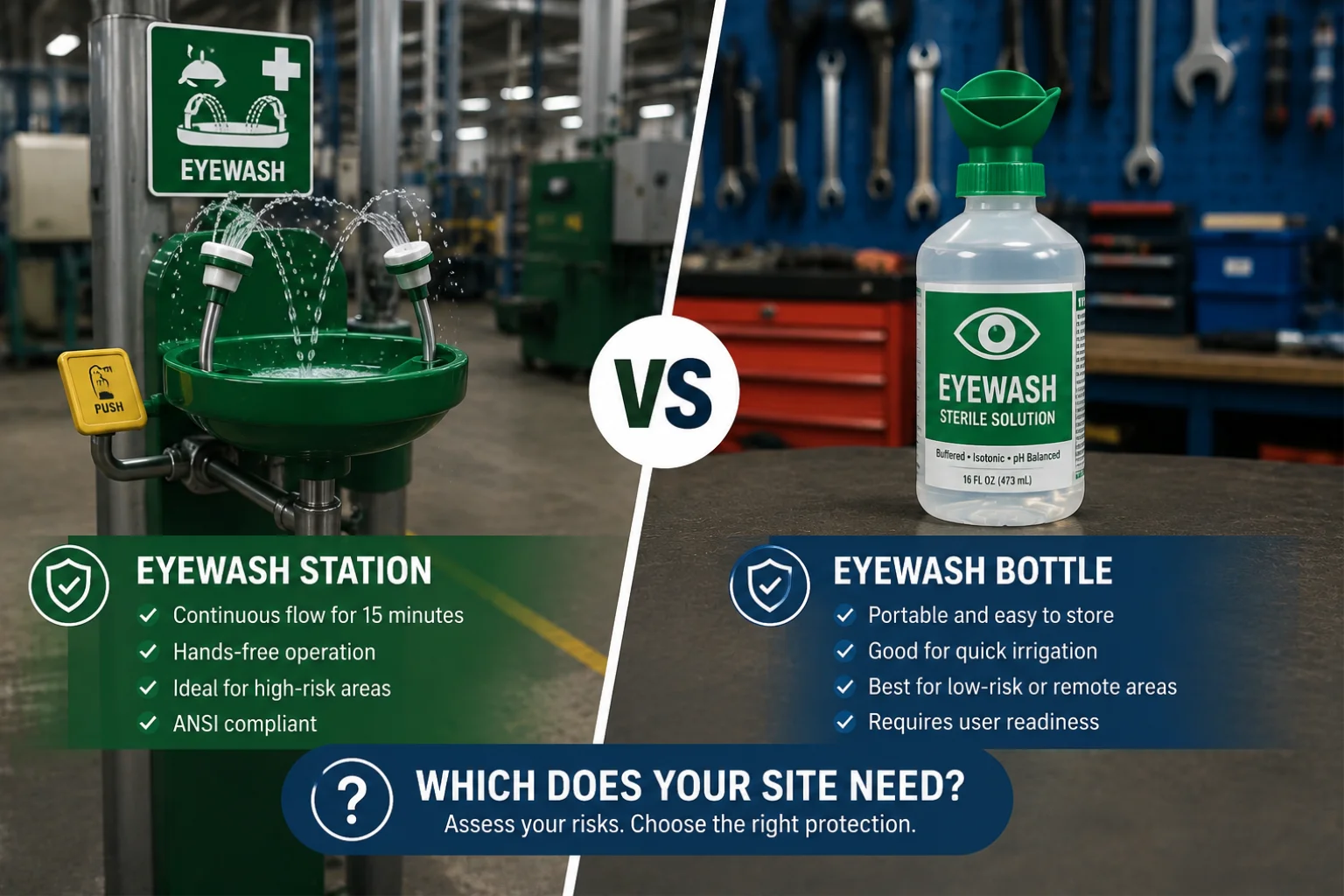
A chemical splash is not the time to decide whether an eyewash station vs bottle is the better option. The right equipment must already be close to the hazard, accessible without delay, and suitable for the type of exposure your team may face. For most industrial sites, eyewash bottles provide immediate supplementary relief, while compliant eyewash stations provide the sustained flushing capability needed for higher-risk work.
The distinction matters to facility managers, EHS teams, and procurement professionals because the wrong choice can leave a gap between a worker’s first response and the level of emergency treatment the site should be prepared to provide. A practical eyewash plan starts with the hazard assessment, not with the smallest or lowest-cost product.
Eyewash Station vs Bottle: The Core Difference
An eyewash bottle is a portable container of sterile eyewash solution, usually designed for an initial flush of the eyes or face. It can be carried to remote work areas, placed in first-aid cabinets, stored in vehicles, or issued for mobile maintenance and field crews. Its strength is speed and portability.
An eyewash station is a dedicated emergency flushing unit that delivers a continuous flow of clean flushing fluid. Stations may be plumbed into a potable water supply or designed as self-contained units with a maintained fluid reservoir. They are intended to support extended irrigation after chemical, particulate, or biological exposure.
In practical terms, a bottle can help someone begin flushing immediately. A station is designed to keep flushing going. These products are complementary in many workplaces, but they should not be treated as interchangeable.
When an Eyewash Bottle Is the Right Choice
Eyewash bottles are useful where the likelihood of eye exposure is low, where staff are highly mobile, or where a fixed water connection is unavailable. They are commonly positioned in service vehicles, temporary work zones, remote storage yards, maintenance toolkits, and low-risk areas where dust or minor irritants may enter the eye.
A bottle also gives an affected worker or nearby colleague a way to start treatment while moving toward a dedicated eyewash station or seeking medical support. This can be particularly useful in large facilities where travel time and obstructions may delay access to a fixed unit.
However, the limitations are clear. Bottle volume is limited, the flow may not be sufficient for prolonged flushing, and the user may struggle to hold the bottle correctly while keeping their eye open. A bottle can also be misplaced, used up, contaminated after opening, or allowed to expire if routine inspections are inconsistent.
For these reasons, portable bottles are best treated as a first-response supplement. They are not normally the sole emergency eyewash provision where corrosive chemicals, strong solvents, acids, alkalis, or other serious eye hazards are handled.
When an Eyewash Station Is Needed
A dedicated eyewash station is the stronger choice when the work area presents a foreseeable risk of harmful eye contact. This includes chemical handling rooms, laboratories, battery charging areas, manufacturing lines, paint and coating operations, waste handling zones, chemical stores, and maintenance areas where cleaning agents or process chemicals are used.
The station should be installed where it can be reached quickly, with a clear and unobstructed path. A worker with impaired vision must be able to reach it without navigating locked doors, stairs, stored materials, or vehicle traffic. The unit also needs to deliver an appropriate flushing stream for the required duration under the applicable standard and your site’s safety procedures.
Plumbed eyewash stations are often the preferred solution for permanent higher-risk locations because they can provide an ongoing supply of flushing water. Self-contained stations are valuable where plumbing is impractical, including remote facilities, temporary installations, and outdoor operations. They require disciplined maintenance, including reservoir cleaning, fluid changes, and checks of activation and flow.
Where there is potential for exposure to the face, body, or clothing as well as the eyes, an emergency shower or combination shower and eyewash unit may be more appropriate. A standalone eyewash station cannot address a full-body chemical splash.
Hazard Assessment Should Drive the Decision
The correct equipment depends on what is being used, how it is handled, and what could realistically go wrong. Safety data sheets, process reviews, incident history, and task observations should all inform the decision.
A site handling mild dust or occasional nuisance particles may reasonably use eyewash bottles in addition to general first-aid provisions. A site decanting corrosive chemicals, changing batteries, mixing treatment chemicals, or transferring solvents needs a more substantial emergency response arrangement.
Consider the following operational questions during the assessment:
- What chemicals, powders, liquids, or biological materials could contact the eyes?
- Could exposure affect both eyes, the face, or the rest of the body?
- How quickly can a worker reach the flushing equipment from the point of use?
- Is the route clear during normal operations and during an emergency?
- Can the equipment provide flushing for the duration identified by your procedures and applicable requirements?
- Who is responsible for inspections, activation tests, replenishment, and maintenance?
These questions help avoid a common procurement mistake: buying a portable bottle because it is easy to place on a shelf, without confirming whether it provides adequate protection for the actual hazard.
Compliance and Performance Considerations
For U.S. workplaces, emergency eyewash equipment is commonly selected and maintained with reference to ANSI/ISEA Z358.1, alongside OSHA requirements, site procedures, and local authority expectations. The applicable requirements depend on the facility, industry, chemicals in use, and risk profile, so buyers should confirm their specific obligations with qualified safety personnel.
The key point is that emergency flushing equipment must be functional when needed, not simply present in the building. A station that has poor flow, excessively hot or cold water, blocked access, or neglected maintenance may fail at the critical moment. Likewise, expired or partially used bottles can create false confidence.
For a fixed station, include regular activation checks in the inspection program to verify operation and help maintain the supply line. For self-contained units and bottles, document expiry dates, solution condition, seal integrity, and replacement needs. Keep records in the same way you would for spill kits, fire equipment, or other emergency response assets.
Placement Matters as Much as Product Selection
An eyewash unit placed inside a locked chemical store is of little value to a worker exposed outside the door. Equipment should sit close to the hazard area, be clearly identified, and remain visible in all working conditions. Signage, adequate lighting, and a clear access path all support faster response.
Portable bottles should be placed where they are easy to see and retrieve, but they should not become an excuse to locate the main eyewash station too far away. In larger operations, it may be appropriate to use bottles at work points and permanent stations at defined hazard zones.
Think through shift patterns as well. A location that is accessible during daytime operations may be blocked by pallets, equipment, or temporary barriers during night shifts or maintenance shutdowns. Routine inspections should assess real access conditions, not only whether the unit remains mounted in its assigned position.
Choosing a Practical Equipment Mix
Many facilities benefit from a layered approach. A plumbed or self-contained eyewash station protects higher-risk fixed areas. Eyewash bottles support mobile teams and provide an immediate first flush. Emergency showers protect areas where larger chemical releases are possible. This approach supports readiness without applying the same equipment solution to every corner of the site.
When comparing units, focus on durability, activation method, installation requirements, maintenance demands, and compatibility with your environment. Outdoor, marine, washdown, and corrosive environments may require materials and configurations that differ from those used in a clean indoor laboratory. Procurement teams should also consider replacement solution availability, spare parts, and whether the supplier can support consistent replenishment across multiple locations.
Cost should be evaluated against exposure risk and downtime, not only against the initial unit price. A properly selected station can be a long-term asset, while a low-cost bottle-only approach may be inadequate for a chemical-handling operation.
Build Readiness Before the Incident
The best eyewash provision is the one workers can find, activate, and use without hesitation. Select equipment based on the hazard, maintain it on schedule, and make it part of drills, induction training, and regular workplace inspections. When an exposure occurs, a fast, reliable flush can make a meaningful difference – and that readiness must be established well before the alarm is raised.