

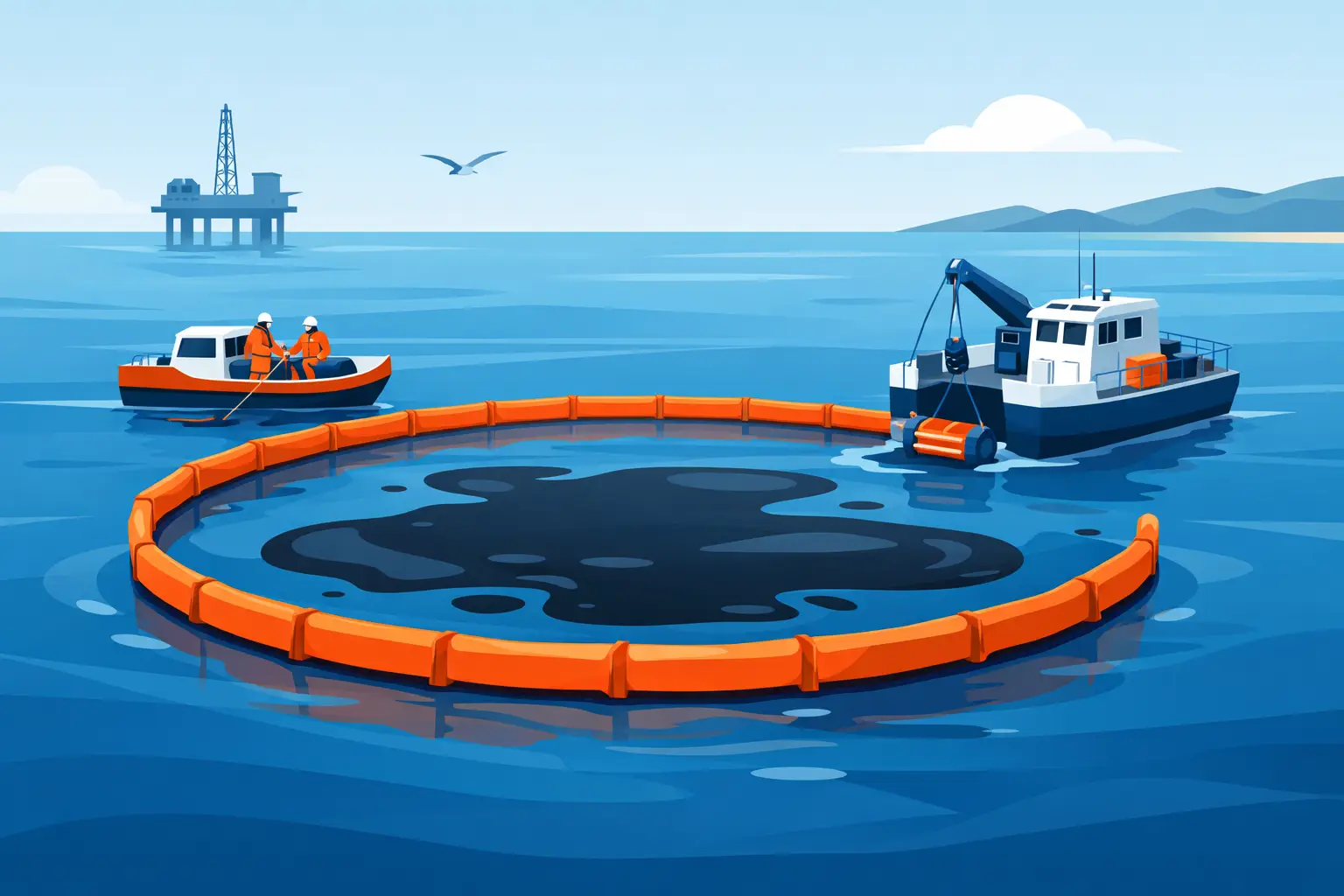
A marine spill can move beyond a berth, vessel, or drainage outfall in minutes. Selecting the best marine pollution barriers before an incident gives response teams a practical way to contain floating oil, deflect debris, and protect sensitive shorelines, intakes, marinas, and working waterways.
For industrial operators, ports, terminals, shipyards, contractors, and emergency response teams, the right barrier is not simply the longest boom available. It must suit the water conditions, pollutant, deployment method, storage constraints, and response plan. A boom that performs well in a sheltered marina may be unsuitable for a tidal channel or exposed coastal area.
What Marine Pollution Barriers Are Designed to Do
Marine pollution barriers, commonly called containment booms, form a physical barrier on the water surface. Their primary role is to contain a spill within a controlled area, divert it away from vulnerable assets, or concentrate it so recovery equipment can work more effectively.
They are most often used for oils and fuels because these products float, but barriers also support debris control, floating waste collection, construction runoff management, and protection around vessels during bunkering or maintenance. In a complete response setup, a boom works alongside oil absorbent pads, socks, skimmers, temporary storage tanks, and spill response personnel.
Containment has limits. Fast currents, high waves, wind, and poorly deployed boom can allow oil to escape beneath or over the barrier. This is why barrier selection and deployment planning should be treated as operational decisions, not as a box-ticking purchase.
Best Marine Pollution Barriers by Application
The best choice depends on the operating environment. Buyers should start with where the barrier will be placed and what conditions it must withstand.
Inflatable Containment Boom for Ports and Open Water
Inflatable containment boom is a strong choice where teams need substantial buoyancy, better wave performance, and compact storage between incidents. It typically uses air-filled flotation chambers, a continuous skirt below the waterline, and ballast to help the skirt stay vertical.
This boom is commonly selected for ports, vessel berths, coastal terminals, offshore support operations, and waterways that experience moderate wave action. It can be deployed from a response vessel or shoreline team, depending on the boom length and site access.
The trade-off is deployment complexity. Inflatable boom requires a compatible blower or inflation system, trained personnel, inspection routines, and sufficient space for cleaning and drying after use. It is highly effective when maintained properly, but it is not always the fastest option for a small spill at a sheltered dock.
Foam-Filled Boom for Ready Deployment
Foam-filled containment boom provides flotation without needing inflation on site. The foam core helps maintain buoyancy while reducing the risk that a puncture will compromise the boom’s ability to float.
For harbors, marinas, inland waterways, and permanent protection around high-risk operations, foam-filled boom offers dependable readiness. It is often preferred where a spill response team needs to deploy a barrier quickly without first locating power, hoses, or inflation equipment.
Foam-filled boom does require more storage volume than deflated inflatable boom. Buyers should check available rack space, container dimensions, and transport arrangements. It is a practical solution when fast deployment and simple handling outweigh the need for compact storage.
Fence Boom for Sheltered Water and Industrial Sites
Fence boom has a relatively flat profile with vertical flotation elements and a hanging skirt. It is widely used in calm or sheltered locations, including marinas, drainage channels, ponds, rivers, industrial basins, and nearshore work zones.
This style is often cost-effective and straightforward to handle, making it suitable for routine preparedness stock. It can also be used as a secondary line of defense around a workboat, construction area, or discharge point.
Its limitation is reduced performance in rough water. Wave action can cause splash-over, while strong current can push oil beneath the skirt. Fence boom should be chosen for controlled environments, not as the primary solution for exposed marine conditions.
Curtain Boom for Deeper Water Control
Curtain boom uses a larger skirt that extends farther below the waterline. This design is intended to improve containment where deeper water, moderate currents, or larger spill volumes are expected.
It is often used around ports, jetties, refueling areas, transfer points, and sensitive shoreline zones. A deeper skirt can improve control, but it also increases drag. In strong current, that drag may pull the boom out of position unless it is properly anchored, tended, or deployed at the correct angle.
For this reason, curtain boom is most effective when paired with a site-specific deployment plan. Teams should understand anchoring points, tide changes, vessel movements, and the safe working limits of the equipment.
Debris and Silt Barriers for Non-Oil Pollution
Not every marine pollution event involves oil. Floating debris barriers help collect plastic, vegetation, packaging, and construction waste before it moves into open water. Silt curtains, while different from oil boom, are used to limit the spread of suspended sediment during dredging, marine construction, shoreline works, and drainage projects.
These products should not be treated as interchangeable. An oil containment boom is designed for floating liquids, while a silt curtain targets suspended particles below the surface. Specify the pollutant and the intended control method when requesting a recommendation.
How to Select the Right Boom Specification
A product description alone does not confirm suitability. Procurement teams should assess the operating conditions and response objectives before selecting boom length, height, material, and accessories.
First, consider water movement. Current speed, tide, wind direction, vessel wake, and wave height all affect containment performance. As conditions become more demanding, stronger construction, greater freeboard, appropriate skirt depth, and reliable anchoring become more important.
Second, determine the required protection area. A boom around a vessel needs enough length to create a secure enclosure with allowance for connection points and movement. Protecting a shoreline, intake, or drainage outlet may require a deflection layout rather than a straight line across the water.
Third, review the spilled material. Diesel, fuel oil, lubricants, crude oil, and hydraulic fluids behave differently on water. A barrier contains the pollutant, but absorbents and skimmers are needed to remove it. For high-viscosity oils, recovery may require specialized equipment and a more controlled collection area.
Finally, account for deployment and recovery. Consider whether the boom will be handled by two people at a dock, a trained vessel crew, or a dedicated spill response contractor. Weight per section, connector type, reel compatibility, towing requirements, and cleaning procedures all influence how useful the equipment will be during an actual incident.
Do Not Overlook Connectors, Anchors, and Storage
The barrier itself is only one part of the system. A response kit that lacks connectors, anchors, tow bridles, repair supplies, and compatible recovery equipment can delay containment when time matters most.
Boom sections should use connectors that provide a secure seal and allow teams to create the required length quickly. Standardized connections are especially useful for sites that maintain several boom types or may coordinate with external responders.
Anchoring needs careful consideration. Fixed anchor points may work at a permanent berth, while temporary anchors or shore attachments may be needed for an emergency deployment. Improper anchoring can create gaps, strain boom connections, or pull a barrier into vessel traffic.
Storage conditions also affect service life. Marine boom should be stored where it is protected from unnecessary UV exposure, physical damage, and contamination. It should remain accessible to trained staff, with enough clearance for inspection and loading. Reels and storage racks can improve deployment speed for longer boom sections.
Building a Practical Marine Spill Response Package
The most effective barrier is supported by equipment that allows teams to act immediately. A typical marine response package may include containment boom, oil-only absorbent booms, pads and rolls, skimming equipment, temporary waste storage, PPE, and tools for securing or towing the barrier.
The correct package depends on the risk. A small marina may require a compact ready-response kit and foam-filled boom. A fuel terminal or shipyard may need multiple containment lengths, a reel system, trained response personnel, and recovery equipment sized for a larger release.
Ocean Safety Supplies supports industrial buyers with marine spill response equipment and practical product guidance for site-specific requirements. For urgent readiness, prioritize stocked equipment that your team can deploy, inspect, and replenish without delay.
When a Barrier Will Not Be Enough
Boom is highly useful, but it cannot overcome every condition. Strong currents can force oil beneath the skirt. Heavy wave action can cause splash-over. In a fire risk scenario, responders may need to prioritize exclusion zones and emergency services over physical containment.
A sound spill plan identifies these limitations in advance. It should define who deploys the boom, who contacts authorities, where recovered material is stored, and when the site must escalate to a specialist response contractor. Drills are valuable because they reveal practical issues such as inaccessible storage, missing connectors, or insufficient personnel.
The right marine pollution barrier gives your team time and control when a spill threatens to spread. Choose equipment based on water conditions and deployment reality, then keep the full response system ready where it will be needed.