

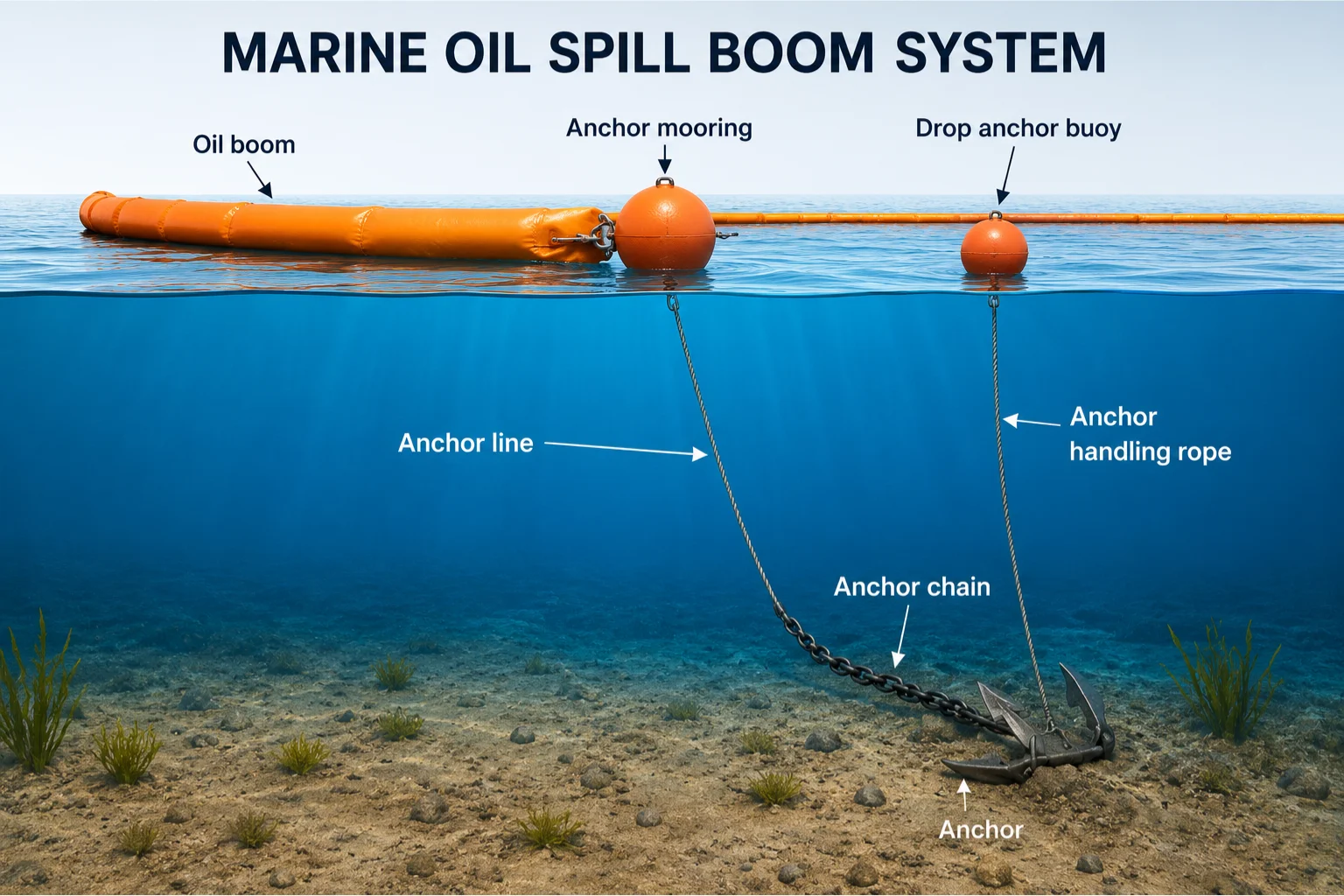
A marine oil spill boom is not a product you want to evaluate after a release has already spread across a berth, channel, or shoreline edge. For procurement teams, EHS managers, and marine operators, the real question is whether the boom you stock can be deployed fast, hold position in local conditions, and support the rest of your spill response plan without delay.
That is where selection matters. Not every boom is built for the same water state, current, or operating environment. A harbor deployment has very different demands from offshore containment, and a calm-water response boom may fail quickly if it is pushed into exposed conditions. Buyers who get this right usually look beyond length and price. They focus on performance, compatibility, and readiness.
What a marine oil spill boom actually needs to do
At a basic level, a marine oil spill boom is a floating barrier designed to contain, deflect, or concentrate oil on water so it can be recovered more effectively. In practice, its job is more demanding. It must float consistently, maintain skirt depth, resist tearing, connect securely to adjacent sections, and stay stable when exposed to wind, waves, and current.
The key point for operational buyers is that a boom is only one part of a response system. If the boom cannot be towed correctly, anchored properly, or matched with skimmers and temporary storage, the overall response slows down. A lower-cost option may look acceptable on paper, but if it twists in current or fails at the connectors, the downstream cost is far higher.
This is why experienced buyers assess the application first and the product second. The right answer depends on where the boom will be used, who will deploy it, and how quickly it must be mobilized.
Marine oil spill boom types by operating environment
The most useful way to compare booms is by intended water condition. This keeps specification decisions tied to real deployment needs rather than generic catalog descriptions.
Calm water booms
These are commonly used in sheltered marinas, small ports, inland waterways, ponds, and protected industrial waterfronts. They are typically lighter, easier to handle, and faster to deploy with smaller teams. For facilities with limited manpower or frequent training drills, that can be a practical advantage.
The trade-off is reduced performance in stronger current or rougher sea states. If your site occasionally faces vessel wash, tidal movement, or monsoon-driven weather changes, a calm-water boom may only suit secondary containment or very short-duration control.
Harbor and nearshore booms
For many commercial buyers, this is the most relevant category. Harbor booms are designed for ports, terminals, shipyards, and exposed coastal areas where conditions are more variable but not fully offshore. They generally offer a better balance of buoyancy, freeboard, skirt depth, and durability.
This category often makes sense for organizations that need one stocked solution for routine readiness across multiple marine locations. It is not always the lightest option, but it is often the most versatile.
Offshore booms
Offshore booms are built for open-water conditions with higher waves, stronger currents, and more demanding towing or recovery operations. They are usually heavier-duty and require more planning for storage, deployment equipment, and trained crews.
For some buyers, offshore specification is essential. For others, it is unnecessary overbuying. If the boom will be stored at a coastal facility but only used inside sheltered waters, the extra weight and handling complexity may work against fast response.
The specifications that matter most
Many procurement decisions get narrowed too early to length, price, and lead time. Those matter, but performance depends on a handful of technical details that should be checked before ordering.
Freeboard and skirt depth affect how well the boom limits splash-over and oil escape beneath the barrier. In low-energy water, a smaller profile may perform well enough. In moving or choppy water, insufficient skirt depth can reduce containment effectiveness.
Buoyancy-to-weight ratio is another practical factor. A boom needs enough buoyancy to stay stable while carrying the load imposed by current and collected oil. If buoyancy is marginal, performance can fall off quickly in real conditions.
Fabric and construction quality also deserve attention. Industrial-grade PVC, polyurethane, and reinforced fabrics are selected for different chemical exposures, abrasion levels, UV conditions, and storage cycles. The right material depends on whether the boom is for emergency stock, repeated deployment, or long-term installation.
End connectors are often underestimated. Standardized, durable connectors simplify extension, repair, and integration with existing response equipment. If your organization already uses specific connector types, maintaining compatibility saves time during an incident.
Ballast system design influences tracking and stability. Chain ballast, cable ballast, or weighted systems each have advantages depending on deployment method and intended water conditions. There is no universal best choice. It depends on whether the priority is fast manual deployment, towing performance, or station keeping.
Deployment planning matters as much as product choice
A high-quality boom can still underperform if deployment planning is weak. This is why commercial buyers should evaluate the whole operating setup before finalizing a purchase.
Start with the response objective. Are you containing a spill at the source, diverting oil away from sensitive assets, or concentrating product for skimming? Each objective can change the boom configuration, required length, and anchoring strategy.
Then look at site conditions. Tidal variation, current speed, prevailing wind, vessel traffic, and access points all affect boom choice. A site with limited launch space may benefit from boom sections that are easier to handle and transport, even if a heavier design offers stronger ultimate performance.
Storage and readiness are just as important. If the boom is packed in a way that slows deployment or requires handling equipment that is not always available, response time suffers. For urgent-use stock, practical packaging and clear deployment procedures often matter more than marginal specification upgrades.
Training should not be treated as separate from purchasing. If site teams are expected to deploy the boom without specialist contractors, the product needs to match their capability. A more manageable system that crews can deploy correctly may be the better commercial decision.
Common buying mistakes
One frequent mistake is buying for best-case conditions instead of actual operating risk. A boom that works well in a product demonstration may not suit a terminal exposed to changing tides and strong vessel movement.
Another is underestimating total required length. Buyers sometimes calculate only the straight-line containment distance and forget the need for overlap, angle adjustments, and contingency stock. That creates a shortfall exactly when flexibility is needed.
A third issue is treating all marine oil spill boom products as interchangeable. They are not. Differences in connectors, ballast, fabric weight, and flotation design affect both field performance and compatibility with existing equipment.
The last common mistake is prioritizing unit cost over readiness. A cheaper boom with long lead times, uncertain stock availability, or limited technical support may create more exposure than savings. For emergency response products, supply reliability is part of product value.
Choosing a supplier for marine oil spill boom readiness
For B2B buyers, product specification is only half of the purchasing decision. The supplier also needs to support readiness. That means stocked inventory, clear technical guidance, practical accessory options, and dependable fulfillment.
A supplier should be able to help you align boom type with use case, whether that is harbor containment, shoreline protection, or offshore support. They should also be able to advise on related equipment such as anchors, reels, skimmers, absorbents, and storage arrangements. If those categories are sourced separately without coordination, response gaps appear quickly.
This is where buyers often prefer a partner that understands both routine safety supply and specialist spill response. Ocean Safety Supplies supports that model by combining industrial safety inventory with marine spill control products for fast-moving operational requirements.
When one boom is not enough
Some facilities try to standardize around a single boom type for every scenario. That can work, but only if the operating profile is narrow. Many sites are better served by a layered approach.
For example, a facility may keep lighter boom sections for immediate first response near transfer points, while maintaining heavier-duty marine booms for extended containment or deployment in more exposed water. This approach improves speed without giving up capability.
There is a cost trade-off, of course. Carrying multiple boom types increases inventory complexity. But for larger sites, terminals, and marine contractors, the improvement in response flexibility often justifies it.
A marine oil spill boom should be selected the same way any critical response equipment is selected – by matching real operating conditions, deployment capability, and supply reliability. If your team can identify the likely spill scenario before you buy, you are far more likely to have equipment that performs when time is tight and conditions are not ideal.