

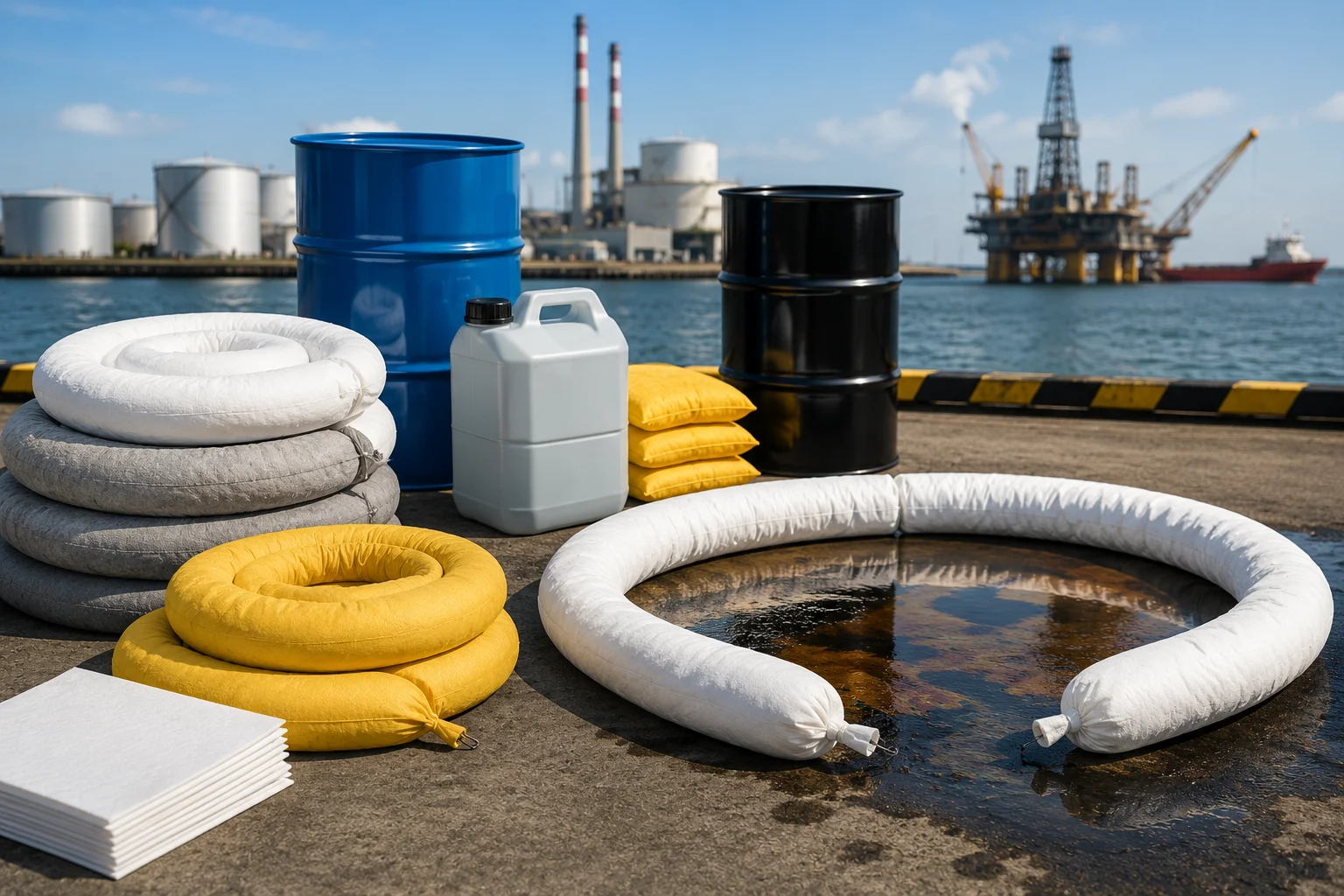
A boom that is too small, made for the wrong liquid, or stored where responders cannot reach it quickly can turn a manageable spill into a costly cleanup. Knowing how to select absorbent booms starts with the likely spill scenario, not the product catalog. The right choice must contain the liquid at the point of release, absorb enough volume to support cleanup, and remain practical for the people who will deploy it.
For facility managers, EHS teams, marine operators, and procurement professionals, absorbent booms are a critical part of spill readiness. They are commonly used around drains, machinery, transfer areas, loading bays, waterfronts, and work zones where oils or hazardous liquids may escape. Selection should balance absorbency, chemical compatibility, deployment conditions, and stock availability.
Start With the Liquid You Need to Control
The liquid determines the boom material. Using an oil-only boom for a solvent spill or a general-purpose boom on open water can reduce performance and create unnecessary disposal costs.
Oil-only booms for petroleum and hydrocarbons
Oil-only absorbent booms are designed for fuels, lubricants, hydraulic oils, diesel, crude oil, and other petroleum-based liquids. Their hydrophobic construction repels water while attracting oil, making them the preferred option for marine response, stormwater ponds, canals, docks, and wet industrial areas.
This matters when oil is floating on water. An oil-only boom can continue to absorb hydrocarbons without becoming saturated by the surrounding water. For a waterfront operation or a site with exposed drainage, specify oil-only material rather than relying on universal absorbents.
Universal booms for routine industrial spills
Universal, or maintenance, absorbent booms are suitable for many common workplace liquids, including water-based fluids, coolants, oils, mild chemicals, and general maintenance leaks. They are often a practical choice near production equipment, warehouses, workshops, and indoor transfer points where the spilled liquid may vary.
The trade-off is straightforward: universal booms absorb water as well as oil. They are versatile, but they may become saturated more quickly in rain or standing water. They are usually best used on dry floors, inside facilities, or in sheltered areas.
Chemical booms for aggressive liquids
For acids, caustics, solvents, and other hazardous chemicals, select a boom rated for chemical spill response. Chemical absorbent products are typically identified by high-visibility color coding and are intended for broad chemical compatibility. Always verify the product specification against the safety data sheet for the liquid handled on site.
Do not assume a boom is suitable for every chemical because it is labeled as an absorbent. Strong oxidizers, highly reactive materials, and unknown substances may require a specific response plan, compatible personal protective equipment, and specialist advice.
How to Select Absorbent Booms by Capacity
Absorbency is not simply a product feature. It determines how many booms are needed at the spill point and whether your response stock can handle a credible release.
Start by estimating the largest foreseeable spill. This may be the contents of a hose, a leaking drum, a day tank connection, a hydraulic line, or the amount likely to escape before isolation. Then consider whether the boom is intended to stop migration, absorb the full release, or support other absorbents such as pads, rolls, pillows, or granules.
A boom placed around a leaking machine may primarily act as a barrier while pads collect the pooled liquid inside the perimeter. In that case, the boom does not need to absorb the entire release on its own. By contrast, a boom deployed around a drain inlet or along a shoreline may need greater total absorbency because replacement can be slower and the liquid may continue spreading.
Manufacturers state absorbency in gallons or liters per boom, bale, or package. Use those figures as a planning baseline, then add a sensible margin for uneven deployment, rain exposure, and the fact that real spills rarely stay neatly contained. For high-risk locations, maintain enough stock for the first response and a second replacement set.
Match Boom Dimensions to the Spill Area
Length, diameter, and connection method affect how well a boom performs in the field. A narrow boom may be easier to position around equipment, while a larger-diameter boom offers more absorbent material for wider leaks and outdoor response.
Measure the perimeter you may need to protect. This could be the circumference of a drain, the edge of a loading area, the base of a tank, or the width of a water channel. Allow extra length for overlapping ends and changes in direction. A boom that only just reaches the target area can leave a gap at the point where liquid is most likely to escape.
For longer runs, choose booms with secure connectors or clips that create a continuous barrier. Weak connections can separate when the boom is moved, exposed to flow, or pulled around corners. If the boom will be used on water, check whether it includes a netted outer cover, internal rope, or other reinforcement to maintain its shape during deployment and retrieval.
Consider Where and How the Boom Will Be Deployed
A boom selected for a controlled indoor environment may not suit a dock, construction site, or outdoor loading bay. The working conditions matter as much as the liquid.
Indoor booms should be flexible enough to sit closely against floors, equipment bases, and uneven surfaces. For facilities with frequent small leaks, lighter booms that are easy for one employee to handle may improve response speed.
Outdoor and marine applications require greater attention to weather, water movement, and anchoring. Oil-only booms used on water should be positioned to intercept oil where it naturally collects or moves, rather than directly in fast current where the product may be overwhelmed. Absorbent booms are not a substitute for a hard containment boom in moving water, tidal areas, or significant marine releases. In those conditions, containment should control the spread first, with absorbent booms used to recover residual oil or protect sensitive points.
For drains and doorways, assess whether a boom is the right first-line product. A drain cover, spill berm, or temporary bund may provide faster sealing, while absorbent booms manage liquid already moving across the surface. A well-equipped spill station often includes both containment and absorbent products because one item rarely solves every spill scenario.
Check Construction, Handling, and Disposal Requirements
Absorbent fill material, outer fabric, and construction quality influence performance. A durable cover helps keep the absorbent material contained during placement, retrieval, and disposal. Netted booms can be particularly useful where the product may be dragged, lifted, or exposed to water movement.
Consider who will handle the boom. Long, saturated booms can become heavy and awkward, especially when loaded with water-based liquids. Smaller sections may be safer to remove and replace than one oversized product. This can also make it easier to isolate contaminated material for disposal.
Disposal requirements should be established before a spill occurs. Once used, an absorbent boom takes on the classification of the liquid it absorbed. Oil-contaminated, solvent-contaminated, or chemical-contaminated materials may require disposal through an approved waste contractor. Keep clean replacement stock separate from used-response waste, and make sure spill kit instructions identify the correct waste route.
Build a Practical Boom Specification for Purchasing
A clear purchasing specification prevents last-minute substitutions that do not match site risks. Record the liquid type, expected release volume, deployment location, preferred boom length and diameter, required absorbency, and any need for connectors or reinforced construction.
For sites with several risk areas, it is often more effective to stock more than one boom type. An indoor maintenance area may need universal booms, while a fuel storage zone or waterfront requires oil-only booms. Chemical handling rooms should have compatible chemical absorbents available at the point of use.
Ocean Safety Supplies can support this approach with industrial spill control equipment suited to routine workplace readiness and specialized oil spill response. Stocking the correct boom alongside pads, drain protection, spill kits, and secondary containment gives response teams more options when the situation does not follow a simple plan.
Avoid the Most Common Selection Errors
The most frequent mistake is buying absorbent booms by price alone. A low-cost product that absorbs the wrong liquid, lacks enough capacity, or breaks apart during recovery creates a higher operational cost when response time matters.
Another error is treating absorbent booms as permanent containment. They are consumable response products. Inspect stored stock regularly, keep it dry and accessible, and replace used or damaged units immediately. Employees should know where booms are stored, which type is intended for each area, and when to use a boom with other spill-control equipment.
The best boom is the one that matches the liquid, fits the location, and is available before the spill reaches a drain, shoreline, or neighboring work area. Review your likely spill scenarios now, then position the right absorbent booms where your team can deploy them without delay.