

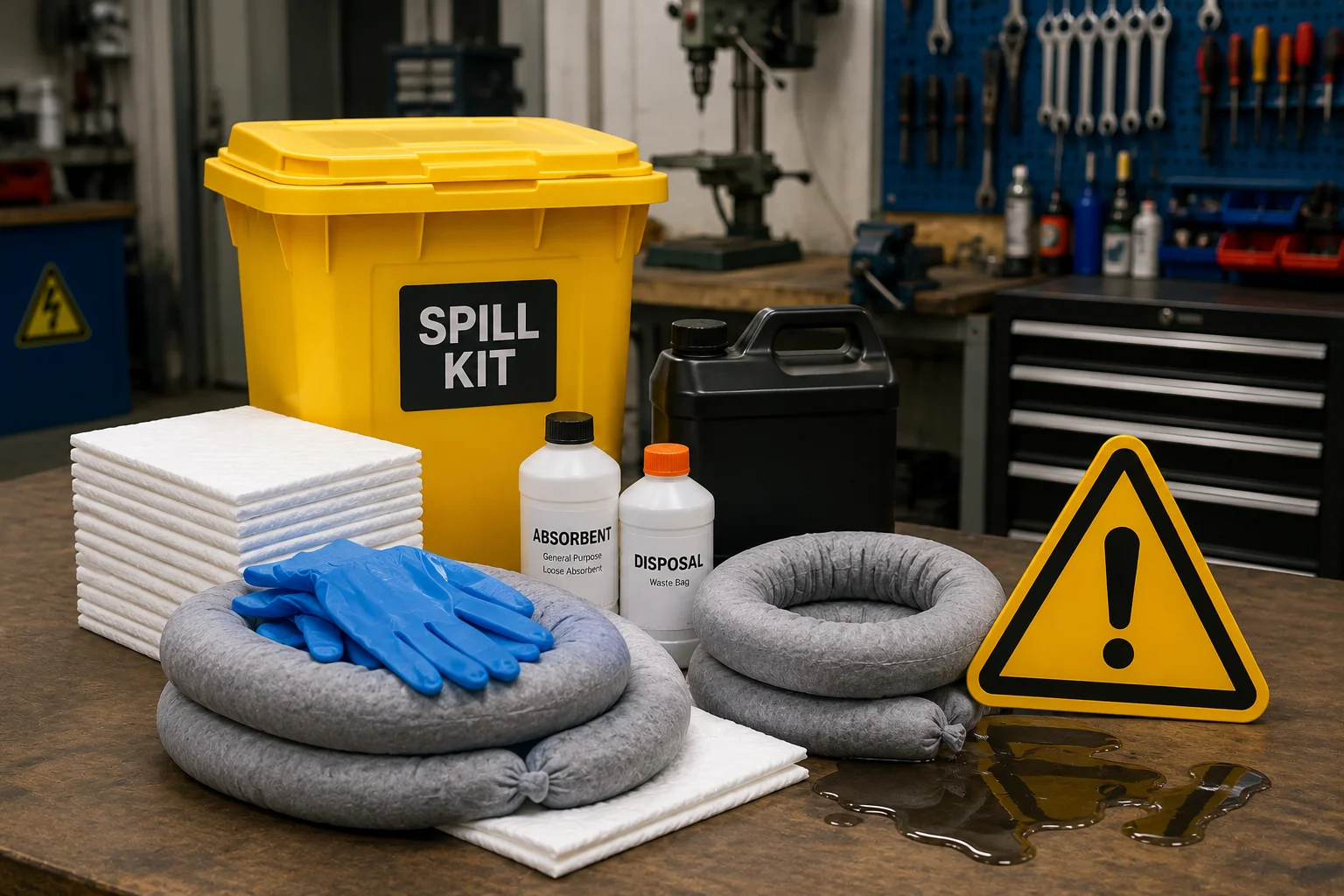
A leaking hydraulic hose, overturned coolant container, or dropped solvent bottle can stop workshop activity immediately. The best spill kits for workshops are not simply the largest kits on the shelf. They are the kits matched to the liquids actually used on site, stored where a response team can reach them in seconds, and sized for the credible spill volume in each work area.
For maintenance bays, fabrication shops, automotive service centers, and industrial workshops, spill readiness protects people, prevents slips, limits environmental exposure, and keeps routine incidents from becoming costly disruptions. A practical selection starts with the spill type, then considers absorbent capacity, container style, placement, and replenishment.
Start With the Liquids in Your Workshop
A workshop may handle several different fluids in one shift: engine oil, hydraulic oil, lubricants, diesel, gasoline, cutting fluids, degreasers, acids, alkalis, paints, and cleaning chemicals. One general-purpose kit may be useful for many common maintenance spills, but it is not automatically appropriate for every liquid.
The first purchasing question should be: what can reasonably spill here? Review chemical inventories, safety data sheets, transfer points, drain locations, machinery, and waste collection areas. Also consider where liquids are moved, not only where they are stored. A drum storage area may have secondary containment, while a technician transferring fluid into a smaller container may create the more immediate spill risk.
The best kit is the one your team can use safely for the materials they encounter. If the workshop handles corrosive chemicals, a dedicated chemical spill kit should be available near that activity. If oil and fuel are the primary concern, an oil-only kit is usually the more efficient choice.
The Best Spill Kits for Workshops by Spill Type
Universal spill kits for mixed workshop fluids
Universal, or general-purpose, spill kits absorb a broad range of non-aggressive liquids, including oils, water-based fluids, coolants, solvents, and many everyday workshop chemicals. Their gray absorbents are commonly used around machinery, maintenance benches, loading areas, and service bays because they give teams one practical response option for routine spills.
For a workshop with varied maintenance work, universal kits are often the core site solution. They are particularly useful where coolant, oil, and water-based cleaning liquids may be present together. However, universal absorbents are not a substitute for chemical-specific absorbents where strong acids, caustics, or unknown hazardous substances are involved.
Oil-only spill kits for fuels and hydrocarbons
Oil-only kits are designed for petroleum-based liquids such as diesel, gasoline, lubricating oil, hydraulic oil, and fuel. Their absorbents repel water while attracting oil, which makes them especially useful outdoors, near drains, or in areas exposed to rainwater.
In an indoor workshop, oil-only products can still be a strong fit for dedicated lubrication stations, vehicle maintenance areas, generator rooms, and fuel-handling zones. Since they do not absorb water in the same way as universal materials, they help preserve capacity when oil is spilled onto a wet surface or outside in poor weather.
Chemical spill kits for corrosives and hazardous liquids
Chemical spill kits use absorbents selected for hazardous chemical response and are commonly identified by yellow packaging or materials. They are intended for acids, bases, solvents, and other aggressive liquids that require a more controlled response.
A chemical kit should be positioned wherever corrosives are stored, dispensed, or used. This may include parts-washing stations, battery maintenance areas, chemical dosing points, laboratories within industrial facilities, and cleaning chemical stores. The kit must be supported by the correct personal protective equipment and a clear escalation process. Absorbents manage the released liquid, but they do not make an incompatible or unknown chemical safe to handle without proper assessment.
Specialty kits for battery acid and specific hazards
Some operations need a more targeted response. Battery charging and electric vehicle service areas may require acid spill supplies or neutralizing agents suited to electrolyte exposure. Paint rooms, plating operations, and process workshops may also need products selected for a particular chemical or waste stream.
This is where a one-kit approach often fails. A facility may have a general-purpose kit in the main workshop, an oil-only kit near vehicle bays, and a chemical or battery acid kit at the relevant workstations. Matching the kit to the task makes the response faster and reduces the risk of using the wrong absorbent during a stressful incident.
Choose Capacity Based on Realistic Spill Volume
Capacity should reflect the credible loss from the equipment or container at each location. A small grab bag may be sufficient beside a bench where technicians use one-quart containers. It will not be sufficient beside a 55-gallon drum, bulk lubricant tank, or mobile fuel bowser.
Do not select capacity based only on total site inventory. Focus on the amount that could be released before a valve is closed, a container is righted, or flow is isolated. For example, a workshop with several 55-gallon drums may need a 20- to 30-gallon kit at a transfer point and a larger wheeled kit or spill response station nearby for a more significant release.
Absorbent capacity figures are useful for comparison, but field conditions affect performance. Uneven floors, rainwater, debris, fast-flowing leaks, and the need to build a containment perimeter can consume pads and socks quickly. Allow a safety margin rather than buying to the exact estimated volume.
Select the Right Container and Layout
Container choice affects whether the kit is available and usable when needed. Carry bags are compact and work well in service vehicles, small maintenance rooms, and low-volume work areas. Wall-mounted cabinets protect contents, improve visibility, and encourage consistent placement. Drum kits are durable and easy to identify, while wheeled bins are better suited to larger workshops, warehouses, loading areas, and locations where a response kit may need to be moved quickly.
A well-equipped workshop does not always need one oversized kit at the entrance. Smaller, clearly marked kits placed close to common spill points usually reduce response time. Position them near fluid storage, maintenance bays, chemical cabinets, waste oil collection points, wash areas, and exterior doors or drains where a spill could travel outside.
Keep kits visible and unobstructed. A spill kit hidden behind stored materials may meet an inventory requirement but offers little operational value. Use clear signage, maintain access space, and include spill kit locations in site inductions and emergency response procedures.
Check What Is Inside, Not Just the Capacity Label
A useful workshop spill kit needs more than absorbent pads. Pads handle pooled liquid on flat surfaces, while absorbent socks help stop the spread and protect doorways, drains, and equipment bases. Pillows provide higher-volume absorption in concentrated areas, and disposal bags help contain used materials for proper waste handling.
For a complete response, confirm that the kit includes compatible gloves, goggles or face protection where appropriate, disposal ties, and clear instructions. Chemical kits may require additional protective equipment or neutralizing materials based on the hazards present. The contents should support the sequence your team will follow: protect people, stop the source if safe, contain the spill, absorb the liquid, package the waste, and report the event.
Avoid buying a kit solely because it contains the highest number of pieces. Ten extra pads are less useful than the right combination of socks, pillows, protective equipment, and disposal materials for your workshop’s likely incidents.
Plan for Drains, Doors, and Spill Migration
Workshop spills rarely stay where they start. Oil can move under racking, coolant can spread across smooth concrete, and rain can carry fuel toward stormwater drains. Drain protection should be part of the spill control plan wherever a release could reach external water systems.
Drain covers, absorbent booms, and containment socks can provide valuable first-line control, but staff need to know where they are stored and when to deploy them. For larger outdoor risks, portable bunds and secondary containment equipment may be more appropriate than relying on absorbents alone.
Review floor gradients and drainage routes during a walkthrough. This often reveals that the most valuable spill kit location is not beside the chemical cabinet, but between that cabinet and the nearest drain or doorway.
Inspect, Replenish, and Train for Fast Response
A spill kit is a consumable emergency resource, not a one-time purchase. Inspect it routinely for missing absorbents, damaged bags, expired protective items, and unclear instructions. Replenish immediately after any use, including small housekeeping spills that may have consumed critical socks or disposal bags.
Training should be concise and practical. Teams need to recognize the difference between a manageable spill and an incident that requires escalation. They should know which kit to use, how to protect drains, where used absorbents go, and who must be notified. A short hands-on exercise can expose issues that a written procedure misses, such as a kit that is too heavy to move or stored too far from the work area.
For busy operations teams, the right approach is simple: place the correct spill kit where the risk exists, keep it fully stocked, and make response steps familiar before an incident occurs. That preparation gives technicians the confidence to act quickly while helping protect the workshop, its people, and the surrounding environment.