

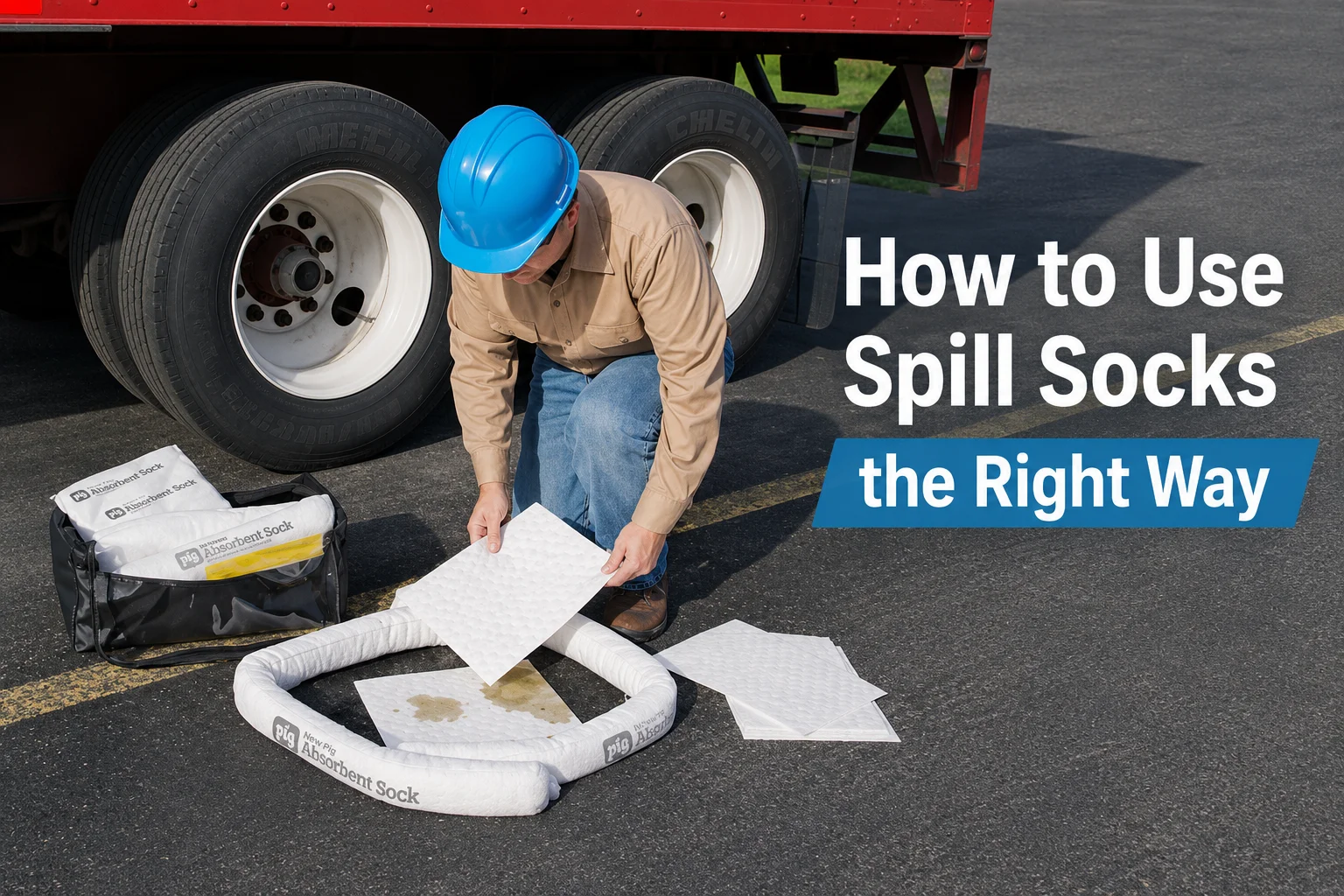
A leaking drum at a loading bay can spread farther in two minutes than most teams expect. That is exactly why knowing how to use spill socks matters. When they are placed correctly, spill socks help isolate the spill, protect nearby drains, and give your team time to absorb and clean up the liquid without losing control of the area.
Spill socks are one of the most practical first-response tools on any industrial site. They are flexible absorbent tubes designed to form a barrier around spills, leaks, and drip zones. You will commonly see them used in warehouses, workshops, chemical storage areas, maintenance zones, laboratories, and marine or outdoor workspaces where liquid movement needs to be contained quickly.
How to use spill socks in real spill situations
The main job of a spill sock is containment first, absorption second. That distinction matters. If a spill is already moving across the floor, the first priority is to stop it from spreading. A sock creates a physical boundary that slows or redirects the liquid so absorbent pads, pillows, or loose absorbents can do the rest of the cleanup.
In most cases, you start by identifying the direction of flow. If the liquid is heading toward a drain, doorway, aisle, or equipment base, place the sock ahead of the leading edge of the spill, not directly in the deepest part. This gives the sock the best chance to intercept the liquid before it reaches a sensitive area. On smooth concrete or sealed warehouse floors, that often means laying the sock in a curve or horseshoe shape around the spill path.
If the spill source is still active, such as a leaking container or hydraulic line, use spill socks to ring the source first. That keeps fresh liquid from escaping while your team isolates the equipment, uprights the container, or transfers product. Once the source is under control, add more socks if needed to extend the containment area.
For larger spills, avoid relying on a single sock. Overlap multiple socks end to end so there are no gaps where liquid can escape. Press the connection points together firmly. On uneven surfaces, expansion joints, or rough ground, this is especially important because liquid will find the smallest opening.
Choosing the right spill sock for the liquid
Not every spill sock is suited to every hazard. The right product depends on what is leaking, where it is leaking, and how much control time your team needs.
General purpose spill socks are typically used for water-based fluids, coolants, solvents, and mixed liquids in maintenance or industrial environments. They are a common choice for workshops, warehouses, and production floors where spills may vary from day to day.
Oil-only spill socks are designed to absorb hydrocarbons while repelling water. They are useful around stormwater-sensitive areas, outdoor equipment, marine applications, and fuel handling zones. If you are dealing with oil on wet ground or water, this type is usually the better fit.
Chemical spill socks are intended for aggressive liquids where higher chemical resistance is needed. In labs, battery areas, chemical stores, and process environments, this is often the safer option. Compatibility always matters. A sock that works for one solvent may not be suitable for another chemical with stronger corrosive properties.
Size also affects performance. A larger diameter sock can hold more liquid and create a stronger barrier, but it may be less practical in narrow aisles or around machinery bases. Smaller socks are easier to position around tight spaces and minor leaks, though they can saturate faster. For busy operations teams, stocking multiple sizes usually makes more sense than trying to use one format for every spill.
Best placement methods for control and speed
Knowing how to use spill socks well is mostly about placement. Teams often lose time by dropping absorbents directly onto the liquid without first building control around it.
For circular containment, place the sock around the perimeter of the spill with enough distance to allow for spread. Do not place it so close that expanding liquid immediately pushes past the barrier. If the spill is flowing in a line, position the sock perpendicular to the flow and curve the ends slightly back toward the source. That creates a catchment area rather than a straight line the liquid can run around.
Around drains, lay the sock in a complete ring if possible. If the area is sloped, place additional socks upslope of the drain cover point. A single ring works for minor releases, but a secondary barrier adds time and reduces the chance of bypass if the first sock becomes saturated.
For doorways, dock edges, and thresholds, use more than one sock for width and redundancy. These transition points are common failure areas because traffic, uneven flooring, and surface gaps can break contact with the ground.
On outdoor surfaces, wind, rain, and rough pavement change the response. Spill socks can still be effective, but they may need support from booms, drain protection, or temporary bunding if the spill volume is significant or the weather is working against you.
What spill socks should not be used for
Spill socks are highly useful, but they are not a complete spill response plan on their own. They are not meant to replace source control, PPE selection, waste handling procedures, or spill kit readiness.
They are also not ideal for every scenario. If the spill is under pressure, continuously feeding, or too large for portable absorbents to manage, your team may need stronger containment measures immediately. The same applies if the liquid is highly hazardous, reacting, or generating fumes. In those cases, containment is only one part of the response, and site emergency procedures should lead.
Another common mistake is trying to use an already saturated sock for ongoing control. Once a sock has reached capacity, it stops being a reliable barrier. It can even release liquid if stepped on or moved. Replace saturated socks promptly and dispose of them according to the waste classification of the spilled material.
Training teams to use spill socks correctly
The best spill product on site is only effective if staff know where it is and how to deploy it. In many facilities, response delays happen because absorbents are stored too far from likely spill points or because teams are not sure which absorbent type to use.
Keep spill socks close to high-risk areas such as chemical storage, drum handling zones, maintenance bays, loading docks, generator areas, and near drains. Include them in spill kits that match the site hazards rather than using a generic setup everywhere. A warehouse that mainly handles oils needs different spill response stock than a lab or process plant handling corrosives.
Short practical drills are often more useful than long classroom sessions. Show staff how to approach safely, assess the direction of flow, protect drains first, and build containment before absorption. That sequence helps reduce panic and improves consistency. It also makes post-incident restocking easier because product usage is more controlled.
For procurement and EHS teams, standardizing spill sock sizes and categories across the site can simplify training and replenishment. It reduces guesswork during an incident and helps ensure your teams are not searching through mixed inventories when time matters.
Storage, inspection, and replacement
Spill socks should be stored in clean, dry, accessible locations. Packaging matters because absorbents exposed to moisture, dirt, or mechanical damage may perform poorly when needed. If kits are kept outdoors or in humid environments, regular inspection becomes more important.
Check stock for torn packaging, visible contamination, and product aging. If a sock has been crushed, soaked, or left exposed, replace it. Response equipment should be ready for immediate use, not assumed to be serviceable because it is still on the shelf.
It is also worth reviewing your incident history. If teams frequently use socks at certain drains, transfer stations, or machine lines, that pattern may justify permanent spill control improvements in those areas. Fast cleanup products are valuable, but repeated spills usually point to a broader operational issue that should be addressed.
For industrial buyers, the practical value of spill socks is simple. They improve first-response control, reduce the spread of liquids, and help protect infrastructure, inventory, and the environment. Used correctly, they give your team a faster, cleaner, and more controlled way to manage spills before a small incident turns into a larger disruption.
If your site handles liquids, do not treat spill socks as optional extras in a kit. Treat them as front-line containment tools, keep the right types close to the risk, and make sure your team can put them down without hesitation when the floor starts moving.