

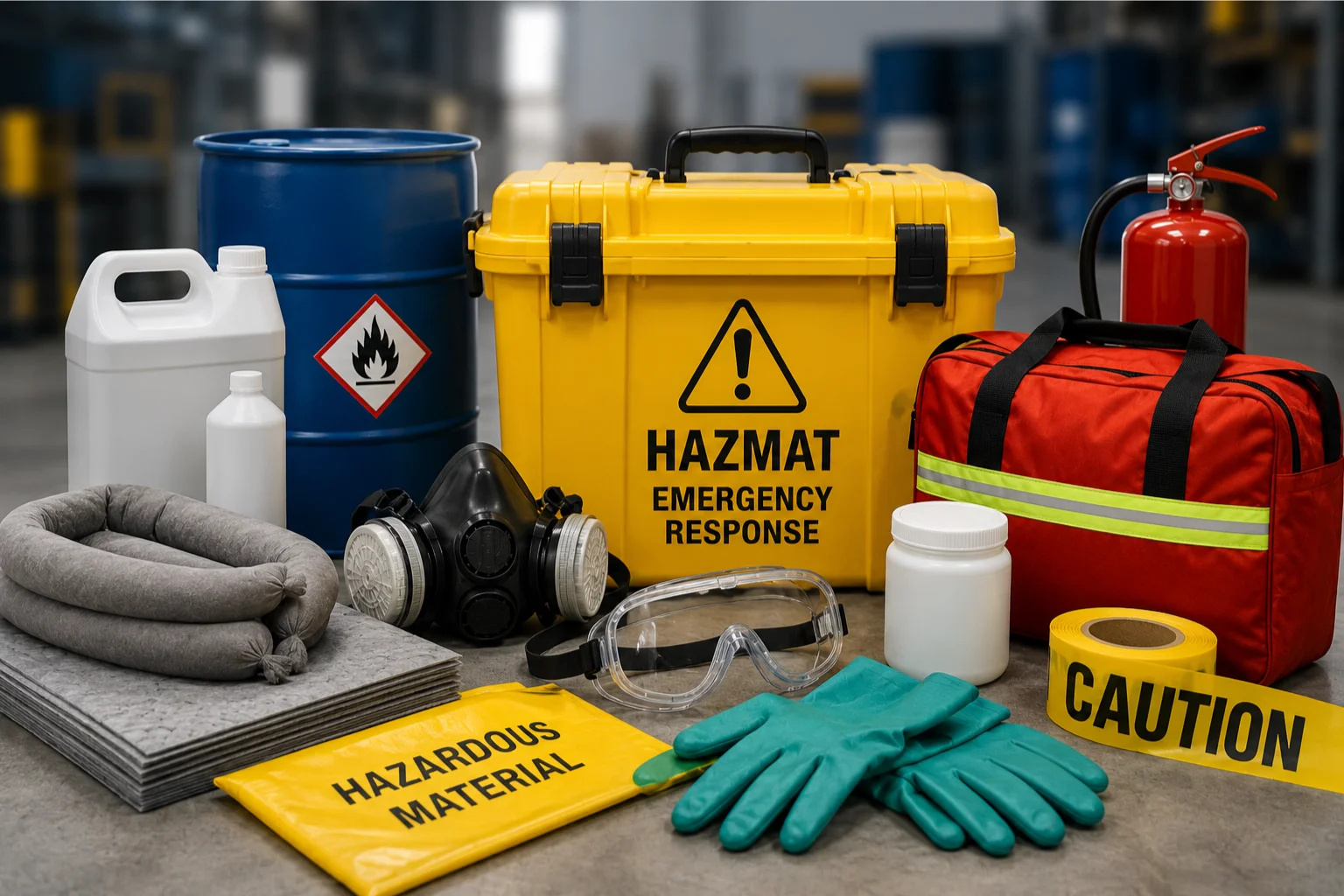
A leaking drum in a warehouse, a solvent splash in a lab, or an oil spill at a dock does not leave time for procurement delays or improvised solutions. The right hazmat emergency response supplies need to be selected before the incident happens, staged where risk exists, and matched to the materials, layout, and response responsibilities at your site.
For most industrial buyers, the challenge is not whether to stock response equipment. It is deciding what to stock, how much to hold, and whether the products on hand are actually suitable for the hazards present. A general spill kit may be enough for minor hydrocarbon leaks in one facility, while another site needs chemical absorbents, overpack drums, emergency eyewash equipment, drain protection, and secondary containment positioned across multiple work zones.
What hazmat emergency response supplies should cover
At a practical level, hazmat emergency response supplies are the products used to contain, control, isolate, and support the safe cleanup of hazardous material incidents. That usually includes spill kits, absorbent pads and socks, chemical-resistant PPE, containment berms, drain covers, disposal bags, overpack drums, decontamination equipment, emergency showers, eyewash stations, and site marking products such as caution tape or barriers.
The exact mix depends on the type of hazard. Fuel handling areas often require oil-selective absorbents and fast deployment containment. Chemical storage rooms may need universal and specialized chemical absorbents, compatible waste containers, and splash response equipment. Marine and waterfront operations often need a different level of preparedness again, with booms, skimmers, temporary storage, and shoreline protection products added to the plan.
This is where many purchasing decisions go wrong. Buyers sometimes select supplies based on a generic category name rather than actual exposure risk. “Spill response” sounds broad enough, but acid, solvent, coolant, and oil incidents do not behave the same way and should not be treated with the same product set.
Start with site-specific risk, not a standard kit
A standard ready-made kit has value because it speeds deployment and simplifies purchasing. But it should be the starting point, not the full strategy. If your facility stores corrosives, transfers flammable liquids, manages waste chemicals, or operates near drains and waterways, your hazmat emergency response supplies should reflect those realities.
A warehouse with forklift traffic and palletized liquid storage may need spill kits near loading bays, absorbent rolls along transfer routes, drain covers near stormwater access points, and overpack drums for leaking containers. A manufacturing line may need smaller point-of-use kits close to process equipment, plus central replenishment stock. A marine operator may prioritize floating booms and dockside response gear because stopping migration is more urgent than floor cleanup.
The better approach is to map likely incident types by location, volume, and exposure. Ask what can spill, how much can spill, where it will go first, who will respond first, and what they can safely handle without specialist escalation. That process usually reveals gaps quickly.
The core categories most sites need
Most facilities do not need every specialized product on day one, but they do need coverage across several response functions.
Spill containment and absorption
This is the first layer. Spill kits, pads, rolls, pillows, and socks help control the spread and begin recovery. Universal absorbents suit mixed maintenance areas, while oil-only products are better for hydrocarbons and outdoor use around water. Chemical absorbents are the safer choice where aggressive liquids are present.
Capacity matters here. A compact kit may be right for a service vehicle or small lab, but inadequate for a bulk storage area. Many sites underbuy capacity because they plan around a minor leak rather than a worst credible spill.
Secondary containment and isolation
Portable bunds, containment pallets, drip trays, and berms help prevent a small incident from becoming a larger environmental problem. They are not just storage accessories. In an active response, they can protect drains, hold leaking containers, and create temporary control zones.
Drain covers and drain protection products are especially important in facilities where spill migration could trigger regulatory consequences or expensive cleanup beyond the original incident area.
Waste handling and damaged package control
After containment comes recovery and disposal. Overpack drums, salvage drums, waste bags, and compatible containers are often overlooked until a team has absorbed the spill but has nowhere safe to place the contaminated materials. That creates delays and increases exposure.
Compatibility matters. The wrong container for recovered waste can create a second hazard. This is one of the clearest examples of why hazmat planning should be tied to the chemicals actually on site.
PPE and decontamination support
Response supplies are incomplete without the means to protect the person using them. Gloves, chemical suits, goggles, face shields, and boots should match the expected splash and contact hazards. Emergency showers and eyewash stations are equally important where corrosives or harmful chemicals are handled.
There is a trade-off here. Higher-spec PPE may provide better protection, but if it is too complex or uncomfortable for likely first responders, deployment can slow down. The right balance depends on whether the site expects incidental response by trained staff or immediate stabilization before a specialist team arrives.
Stocking for speed versus stocking for completeness
Busy operations teams often have to balance readiness with budget and storage space. The answer is usually not to choose one large, all-purpose cache and hope it covers everything. A better model is layered readiness.
Place smaller, task-appropriate kits at high-risk points so the first few minutes are covered. Then maintain larger replenishment stock or specialized equipment in a central location. That approach improves response speed without forcing every work area to hold the same inventory.
It also supports procurement discipline. Fast-moving items such as pads, socks, disposal bags, and gloves can be replenished routinely, while less frequently used products such as overpack drums, containment pools, or marine booms can be held at planned quantities based on risk. For many organizations, a dependable supplier with broad inventory is part of the response plan because availability matters almost as much as the product itself.
Compliance matters, but operations matter just as much
Many buyers begin this process from a compliance angle, and that is reasonable. Hazmat emergency response supplies support workplace safety obligations, environmental protection, and documented preparedness. But compliance by itself is not a useful purchasing filter if the products cannot be deployed quickly or correctly under pressure.
A kit that satisfies an audit checklist but sits too far from the hazard is a weak control. An eyewash unit that is technically present but poorly placed is not real readiness. The same applies to absorbents that are incompatible with the chemicals stored nearby.
Operational fit should drive final selection. Think about access, visibility, labeling, replacement cycles, and whether teams can identify the right product without stopping to interpret a complicated response chart. Clear product grouping by hazard type helps reduce response errors.
How procurement teams can simplify buying decisions
For procurement, the goal is usually consistency, availability, and fewer fragmented purchases. That is why category breadth matters. Buying spill kits from one source, eyewash equipment from another, and secondary containment from a third can create delays and mismatched specifications.
A one-source approach is often more efficient when the supplier understands the relationship between product categories. If a site needs chemical spill response, the conversation should naturally include absorbent compatibility, waste packaging, PPE, storage controls, and replenishment planning. That is more useful than treating each line item as an isolated order.
Ocean Safety Supplies supports this kind of buying model by combining stocked inventory across spill control, containment, emergency response, and workplace safety categories. For buyers managing multiple sites or recurring demand, that kind of supply reliability can reduce both emergency exposure and purchasing friction.
When specialized equipment is the right call
Some incidents are beyond the scope of a standard facility spill kit. Marine fuel spills, larger drum failures, unknown chemical releases, and incidents near sensitive drainage or public areas may require more advanced containment and recovery equipment. In those cases, products such as oil booms, skimmers, portable storage tanks, or larger containment systems become necessary.
The key is recognizing where your internal response limit sits. Not every site should plan for full-scale remediation, but every site should plan for immediate stabilization. The supplies you hold should reflect that boundary clearly.
Good preparedness is not about owning every product. It is about having the right products in the right place, in the right quantity, with a replenishment path you can trust when an incident interrupts normal operations. If your current stock would force your team to improvise, that is usually the clearest sign it is time to review your hazmat response setup.