

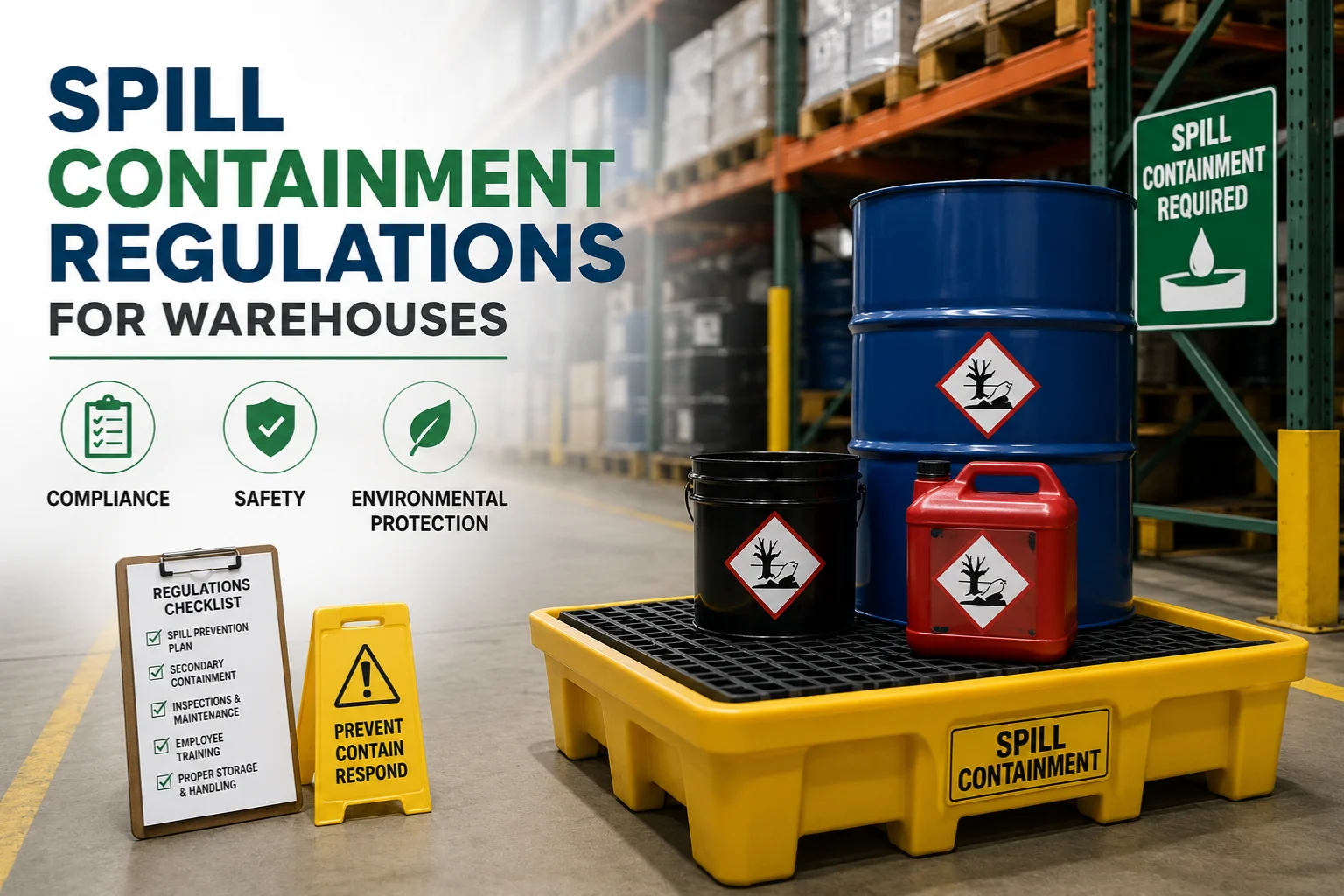
A leaking drum rarely stays a small problem for long. In a warehouse, one failed container can shut down aisles, damage stock, create slip hazards, trigger reporting obligations, and put your team under immediate pressure. That is why spill containment regulations for warehouses matter well beyond paperwork. They affect storage layouts, purchasing decisions, response planning, and the day-to-day reliability of your operation.
For warehouse managers, EHS teams, and procurement professionals, the challenge is that spill control requirements are not always captured in one simple rule. What applies depends on what you store, how much you store, whether materials are hazardous, and where a release could travel. Compliance is usually a combination of environmental rules, fire code requirements, hazardous materials handling standards, and site-specific operating controls. The practical goal is straightforward: prevent spills from escaping, protect people, and ensure your facility can respond quickly when something goes wrong.
What spill containment regulations for warehouses usually require
At a working level, most spill containment regulations for warehouses center on three expectations. First, hazardous liquids must be stored in a way that reduces the chance of release. Second, if a container fails, secondary containment or other controls must stop the liquid from spreading into drains, public areas, or incompatible storage zones. Third, employees must be able to respond safely using the right equipment and procedures.
That sounds simple, but the details depend on the material. Oil, fuels, solvents, corrosives, and waste liquids each carry different risks. Some regulations focus on preventing environmental discharge. Others focus on worker exposure, ignition hazards, or chemical incompatibility. A warehouse storing small volumes of cleaning chemicals faces a different compliance picture than a distribution center holding multiple IBCs of flammable or corrosive product.
For many facilities, the compliance baseline includes compatible storage, clearly identified spill response equipment, protected drainage, routine inspections, and enough secondary containment capacity to manage a realistic worst-case leak. If your warehouse handles regulated substances in bulk, the standard rises quickly.
The main compliance areas warehouse teams should review
The first area is environmental protection. If a spill can reach stormwater, soil, or sewer systems, regulators will care about containment, drainage control, and response procedures. This is especially relevant for oils, fuels, and other polluting liquids. Outdoor storage, loading zones, and washdown areas usually deserve extra scrutiny because releases can spread faster and leave the site boundary more easily.
The second area is occupational safety. Warehouses need to protect workers from chemical exposure, slips, fire risk, and unsafe cleanup practices. That means spill kits should match the liquids on site, access routes should stay clear, and employees should know when a spill is small enough for trained internal response and when it requires escalation.
The third area is fire and hazardous materials storage. Flammable and combustible liquids often trigger stricter controls around approved cabinets, separation distances, ignition sources, and containment methods. Corrosives and reactive chemicals raise a different issue: containment must not simply hold the liquid, it must also be chemically compatible and prevent dangerous mixing.
This is where many facilities get caught out. They buy a general spill kit and assume they are covered. In practice, regulators and insurers look at the full system, including storage equipment, segregation, labeling, emergency equipment, and documented procedures.
Secondary containment is often the make-or-break control
If there is one concept every warehouse should understand, it is secondary containment. Primary containment is the original package: drum, tote, pail, or tank. Secondary containment is the backup barrier that captures leaks if the first layer fails.
For warehouses, that usually means spill pallets, bunded storage, sump pallets, portable berms, or contained dispensing areas. The right choice depends on how product is handled. A static storage area for drums may be well served by drum pallets. A transfer point where liquids are decanted may need a larger bunded work platform. Outdoor or temporary operations may require a portable containment berm that can be deployed where unloading happens.
Capacity matters. A containment unit that is too small may look compliant at a glance but fail during a real release. Facilities should verify the required containment volume based on local rules, container sizes, and the number of units stored together. In many cases, teams work backward from the largest container or a percentage of the total stored volume, but the exact threshold depends on the regulation and site conditions.
Material compatibility matters just as much. A polyethylene pallet may be suitable for many corrosives, while a steel unit may suit certain flammables or industrial liquids. The wrong material can degrade, crack, or create a larger hazard.
Storage layout decisions directly affect compliance
Warehouse compliance is not only about products. It is also about where those products are placed. A well-stocked spill response station does not fix a poor layout.
Liquids should be stored away from floor drains unless drainage controls are in place. Incompatible chemicals should be segregated so that one spill does not become a reaction event. High-risk materials should not be placed where forklift impact is likely, and damaged packaging should be isolated immediately rather than returned to the rack.
Traffic flow also matters. If spill kits, drain covers, or absorbents are blocked by pallets, your response time stretches at the worst possible moment. For fast-moving warehouses, it makes sense to place spill control equipment at receiving, bulk storage, battery charging, chemical storage, and loading dock zones rather than relying on a single centralized cabinet.
This is one of the more practical trade-offs in warehouse design. Centralized storage can simplify inventory control, but distributed spill response equipment improves speed and reduces spread. The right balance depends on floor size, staffing, and the materials handled.
Documentation and training are part of the regulation picture
A warehouse can have the right hardware and still fall short if procedures are weak. Most facilities that handle hazardous materials need documented inspection routines, response instructions, and employee training records. Supervisors should know what is stored on site, what the main risks are, and what response resources are available during each shift.
Training should be practical, not generic. Staff need to know how to identify the spilled material, isolate the area, protect drains, select the correct absorbents or neutralizers, and dispose of cleanup waste properly. They also need to understand limits. Not every spill should be handled internally, and trying to improvise a response to an aggressive chemical release can turn a manageable incident into an injury event.
Inspection records are equally important. Regulators, auditors, and insurers want evidence that containment systems are maintained, not just installed. That includes checking sumps for standing liquid, confirming spill kits are replenished, looking for cracked pallets or degraded berms, and verifying that storage volumes have not quietly exceeded design capacity.
Common warehouse mistakes that create compliance gaps
The most common problem is underestimating volume. A facility adds more drums or swaps pails for larger totes, but the existing containment remains the same. On paper, the area still looks organized. In reality, the risk profile has changed.
Another issue is using one solution for every chemical. Universal absorbents are useful, but they are not always enough for corrosives, aggressive solvents, or specialty materials. The same goes for containment platforms. Product compatibility should always be checked before standardizing across the site.
Drain protection is another frequent gap. A warehouse may have indoor containment but no practical way to stop a spill at a loading dock or near external stormwater paths. For many operations, drain covers, portable berms, and dock-side spill kits close that gap quickly.
The last issue is replenishment. Spill kits are often partially used during minor incidents and never fully restocked. When a larger spill happens, the cabinet is there but the contents are not. That is a purchasing and inspection issue as much as a safety issue.
Building a practical warehouse compliance plan
The most effective approach is to start with a site-specific review. Identify the liquids stored, where they are handled, what could fail, and where a release would travel. Then match containment equipment to those risks. That usually means combining storage containment, transfer-point protection, drain control, and spill kits designed for the actual materials on site.
For procurement teams, standardization helps when it is done carefully. Choosing stocked, industrial-grade containment pallets, absorbents, flammable storage solutions, and emergency response products from a dependable supplier can reduce lead times and simplify replenishment. For multi-site operators, it also makes training easier because response setups stay consistent across locations.
Ocean Safety Supplies supports this kind of practical readiness by helping businesses source the containment and spill response products they need without delay. For busy operations teams, speed matters almost as much as specification.
Regulations set the floor, not the finish line. A warehouse that treats spill containment as an operational control rather than a checklist item is usually the one that recovers faster, protects people better, and avoids expensive disruption when a container eventually fails.