

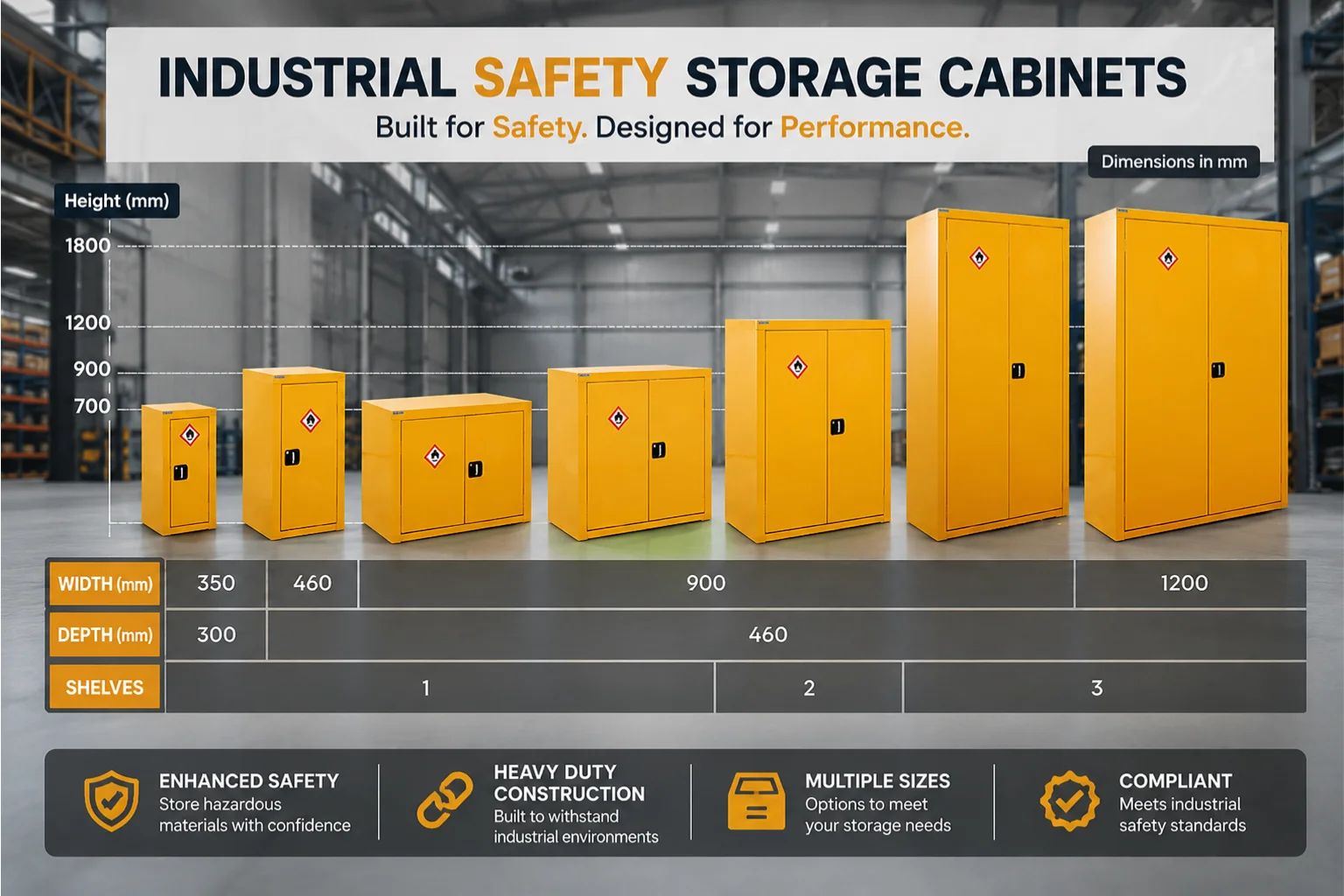
A cabinet that is too small creates overflow and bad storage habits. A cabinet that is too large takes up valuable floor space, increases cost, and often ends up half empty. This flammable storage cabinet size guide is meant to help safety managers, warehouse teams, lab supervisors, and procurement buyers choose a cabinet that fits the actual operation, not just the catalog page.
The right size starts with what you store, how much you store, and where the cabinet will be used. It also depends on how often containers move in and out, whether you need room for future growth, and how much space the site can realistically allocate. For most industrial buyers, cabinet selection is not just a storage decision. It affects compliance, workflow, housekeeping, and fire risk control.
How to use a flammable storage cabinet size guide
Capacity figures look simple at first glance. You will usually see cabinets marketed by gallon capacity, such as 12-gallon, 30-gallon, 45-gallon, 60-gallon, or 90-gallon models. That number is helpful, but it should not be treated as the exact volume of liquid you plan to pack inside. In practice, usable space depends on container shape, shelf spacing, and whether you are storing small cans, safety cans, paint tins, or larger jerrycans.
A 30-gallon cabinet may be appropriate for a small maintenance room with limited quantities of solvents and cleaners. A 90-gallon cabinet may be the better fit for a production area that regularly handles multiple containers across shifts. The mistake is choosing by liquid volume alone. Buyers should think in terms of container count, container dimensions, and access frequency.
If your team stores mostly 1-gallon and 5-gallon containers, shelf flexibility matters as much as total capacity. If you handle taller containers, internal height becomes a deciding factor. If stock rotates quickly, door opening width and shelf reach will affect daily efficiency.
Start with your actual inventory
Before comparing cabinet sizes, list the flammable liquids currently on site and how they are packaged. This step sounds basic, but it prevents underbuying and overspending. A cabinet used for aerosol cans and small maintenance liquids will not need the same internal layout as one used for bulk process chemicals.
Count both routine stock and peak stock. Many facilities size cabinets around average usage, then run into problems when deliveries arrive or when seasonal demand increases. If your site keeps reserve stock for business continuity, that reserve should be included in the sizing decision.
It also helps to separate active-use inventory from backup inventory. Some facilities are better served by one smaller cabinet near the point of use and another larger cabinet in a central storage area. Others prefer one high-capacity cabinet to keep all flammables in a single controlled location. There is no universal answer. The better option depends on movement patterns, available floor space, and internal safety procedures.
Common cabinet sizes and where they fit best
Small cabinets, often around 12 gallons, are usually chosen for tight spaces, benchtop areas, or low-volume storage points. They work well in labs, workshops, and satellite maintenance rooms where only limited quantities are needed close to the task. Their advantage is footprint. Their trade-off is that they fill quickly and leave little room for changing inventory.
Mid-size cabinets, commonly 30 to 45 gallons, are a practical choice for many commercial and industrial settings. They suit operations that use multiple flammable products but do not need large reserve stock at the point of use. For many buyers, this is the balance point between storage capacity and efficient use of floor space.
Larger cabinets, such as 60-gallon and 90-gallon units, are better suited to warehouses, manufacturing areas, chemical storage rooms, and maintenance departments with broader inventory requirements. These sizes support more container types and better centralization, but they require more planning around placement, aisle clearance, and handling access.
The larger the cabinet, the more important it becomes to think about workflow. A high-capacity cabinet can improve control, but only if staff can access it without congestion or unsafe container handling.
Footprint matters as much as capacity
A flammable storage cabinet size guide should never stop at gallons. External dimensions matter because the cabinet has to work in a live facility, not just fit on a specification sheet.
Measure the intended location carefully. Check wall clearance, door swing, aisle width, nearby equipment, and whether staff can remove containers safely without twisting or overreaching. In some spaces, a narrower, taller cabinet is better. In others, a wider unit with easier shelf access is the smarter choice.
Also consider what happens around the cabinet during normal operations. Forklift routes, emergency exits, wash stations, electrical panels, and spill response access should all remain clear. A cabinet that technically fits but disrupts movement or blocks critical access points is the wrong size for the area.
Internal layout can change the right size decision
Two cabinets with similar capacity ratings may perform very differently depending on shelf configuration. Adjustable shelves give you more flexibility when container sizes vary. Fixed layouts can be efficient when inventory is standardized, but less forgiving when product mix changes.
Pay close attention to internal depth and shelf load rating if you store heavier containers. A cabinet may offer enough volume on paper, yet still be a poor fit if the shelves do not support how your products are packaged. This is especially relevant for facilities that handle a mix of cans, bottles, and larger industrial containers.
Door style also influences usability. Manual doors are common and dependable. Self-closing options may be preferred in some environments where automatic closure supports site policy or risk control. The choice is not strictly about size, but it can affect how comfortably a cabinet works in a given footprint.
Plan for growth, but avoid oversizing
Many buyers ask whether they should size for current stock or future expansion. The practical answer is usually somewhere in the middle. If your flammable inventory is stable and tightly controlled, buying far above current need may waste both budget and floor space. If your operation is expanding, adding product lines, or increasing throughput, some extra capacity is sensible.
A good rule is to leave room for orderly storage without treating the cabinet as overflow space for anything that happens to fit. Overstuffed cabinets slow down retrieval, increase the chance of spills, and make inspections harder. But oversized cabinets can also encourage poor stock discipline, with old materials sitting unnoticed on back shelves.
The right cabinet size supports visibility and control. Teams should be able to see what is stored, access it without shifting multiple containers, and maintain clean segregation of products.
One large cabinet or several smaller ones?
This is one of the most common sizing questions. One large cabinet can simplify inventory control and centralize risk management. It may also be more cost-effective per unit of capacity. That said, a single large cabinet is not always the most practical solution.
Several smaller cabinets can improve access across a larger facility, reduce unnecessary transport of flammable liquids, and keep point-of-use quantities closer to the job. This setup can also help separate departments or storage classes. The trade-off is that multiple cabinets require more placement space and more attention to stock control.
For multi-zone facilities, distributed storage often makes operational sense. For compact sites with one main storage point, a larger centralized cabinet may be easier to manage. It depends on your layout, product movement, and internal controls.
Questions procurement and safety teams should ask before buying
A reliable cabinet sizing decision usually comes down to a short set of practical questions. What containers are being stored, and in what quantities? Is the inventory likely to increase over the next 12 to 24 months? Does the proposed location allow safe access, door opening, and routine inspection? Will one cabinet support the workflow, or do separate areas need separate storage?
It is also worth asking who will use the cabinet every day. Procurement may approve the purchase, but operations and EHS teams are the ones who live with the result. A cabinet that meets capacity targets but frustrates daily use often leads to containers being left outside the cabinet, which defeats the purpose.
Choosing the right size for faster, safer operations
The best flammable storage cabinet size guide is the one that reflects how your facility actually runs. Capacity matters, but so do container dimensions, floor space, access, stock turnover, and future demand. A properly sized cabinet supports safer storage, cleaner housekeeping, and faster day-to-day work.
For buyers who need to move quickly, the most efficient path is to match cabinet size to real inventory and site layout rather than defaulting to the biggest unit available. Ocean Safety Supplies supports industrial teams with practical product guidance, stocked solutions, and dependable supply when readiness cannot wait.
A well-sized cabinet does more than hold flammables. It helps the site stay organized, compliant, and ready for the next delivery, the next shift, and the next inspection.