

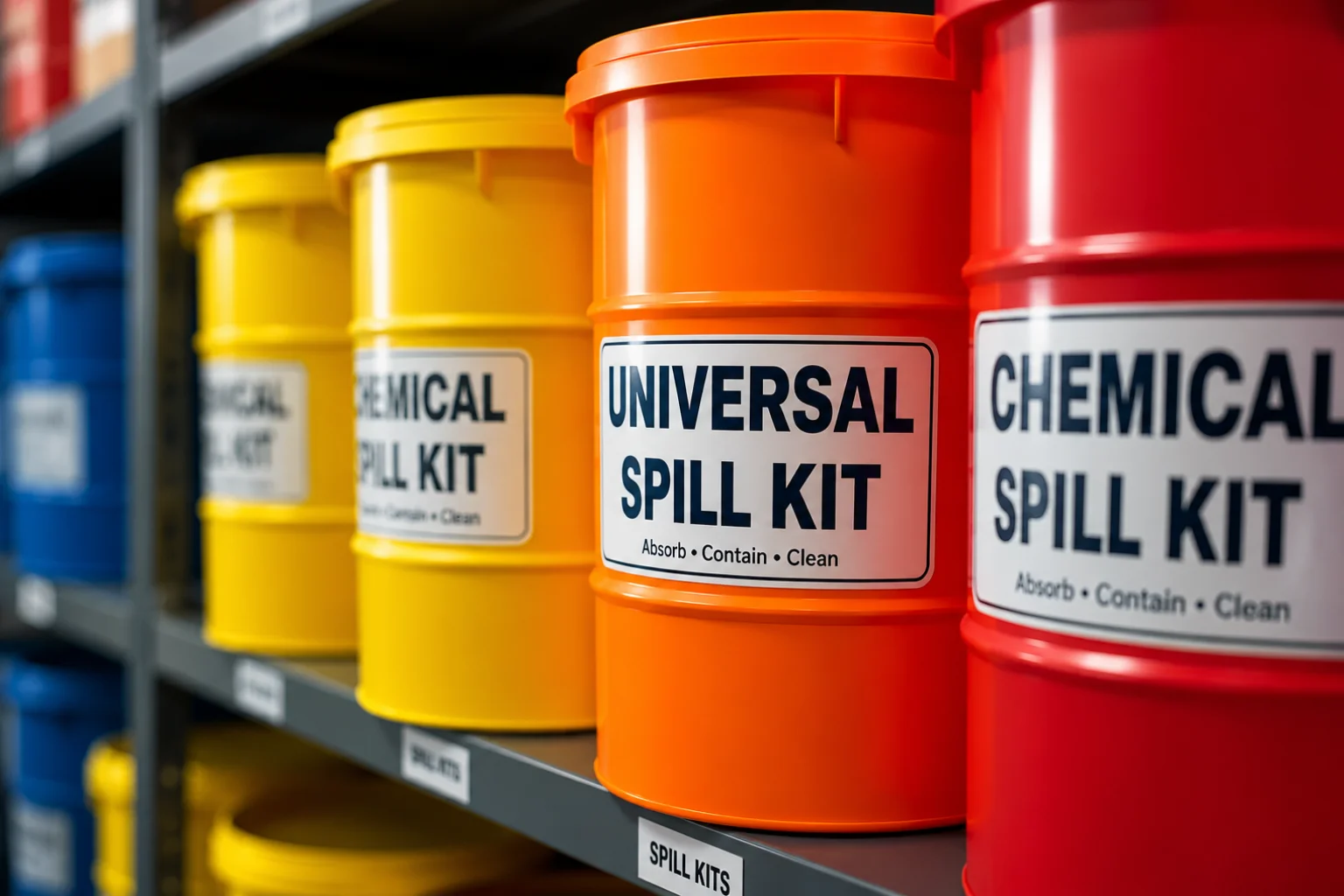
A leaking drum near a loading bay can turn into a slip hazard, stock loss, and reporting issue in minutes. That is why selecting the right spill kit for warehouse operations is not a small purchasing decision. For warehouse managers, EHS teams, and procurement buyers, the right kit supports faster response, cleaner containment, and fewer disruptions when spills happen.
Why a warehouse needs the right spill kit
Warehouses deal with more than one spill type. A site may store oils, coolants, cleaning chemicals, paints, solvents, or battery-related liquids in the same facility. Add forklift traffic, racking, bulk containers, transfer points, and busy dispatch areas, and the risk profile changes quickly from one zone to another.
A spill kit is there to shorten response time at the point of need. That matters for safety, but also for operations. A small hydraulic oil leak can shut down an aisle. A chemical splash near goods-in can create an exposure risk for staff. A spill that reaches a drain can escalate from a housekeeping issue to an environmental incident. The practical value of a warehouse spill kit is simple – it helps teams contain the problem before it spreads.
Spill kit for warehouse areas is not one-size-fits-all
The most common buying mistake is choosing a kit based only on price or general size. In reality, the right specification depends on what is stored, where it is handled, and how quickly employees can reach the kit.
For a warehouse storing mainly oils, lubricants, and fuels, an oil-only spill kit is often the right fit. These absorbents target hydrocarbons while repelling water, which is useful in outdoor loading areas or exposed yards. For mixed-use environments where the liquid could be water-based, oil-based, or unknown, a universal spill kit usually makes more sense. Where corrosives or hazardous chemicals are present, a chemical spill kit is the safer choice because the absorbents and PPE are selected for more aggressive substances.
This is where a site-specific approach matters. A central warehouse may need several different kits instead of one larger unit. A chemical decanting area and a forklift charging station do not present the same spill risk, so they should not rely on the same response setup.
What should be in a warehouse spill kit
A properly specified kit should support the full first response, not just absorption. In most warehouse settings, that means absorbent pads for quick pickup, socks or booms for containment, disposal bags for waste handling, and basic PPE to protect the responder.
The exact contents should reflect the hazards on site. If the warehouse handles chemical products, gloves and goggles need to be suitable for that exposure. If spills may happen around drains or thresholds, longer containment booms become more useful than extra loose absorbent. If there is a risk of repeated minor leaks from machinery or drums, a kit with a strong pad count may deliver better day-to-day value.
The container matters too. A bag or compact carry kit may work for service vehicles or small maintenance points, but warehouses usually benefit more from wheeled bins or clearly marked stations. These are easier to identify, move to the incident, and restock after use.
Choosing the right spill kit size
Capacity is one of the first things buyers look at, but bigger is not always better. A large spill kit stored at one end of a facility is less useful than smaller kits placed where spills are likely to happen.
For many warehouses, a mix of capacities works best. Smaller kits can be placed near workstations, battery charging areas, forklift parking zones, and chemical storage cabinets. Larger wheeled kits are better suited to loading bays, drum storage areas, waste accumulation points, and bulk liquid handling zones.
When deciding on size, think about the largest credible spill, not the worst possible disaster. A warehouse storing several 205-liter drums may not need every spill kit to match full drum failure, but it does need enough coverage around high-risk handling points. The right answer often depends on whether liquids are only stored, or regularly moved, decanted, and repacked.
Where to place a spill kit for warehouse response
Placement is where good planning becomes practical readiness. Spill kits should be close enough to likely incident points that staff can reach them immediately, without crossing the spill zone or losing time searching.
In most facilities, priority areas include loading docks, near drum and IBC storage, maintenance corners, battery charging stations, chemical stores, waste handling zones, and any area close to drains. High-traffic forklift routes also deserve attention, especially where vehicles operate near liquid stock.
Visibility matters. Kits should be clearly labeled and kept accessible at all times. If a spill kit is blocked by pallets or stored inside a locked room, response time suffers. For busy warehouses, wall signage and routine checks help keep kits ready for use instead of becoming forgotten equipment.
Compliance, risk control, and operational reality
Most buyers are not just purchasing a box of absorbents. They are trying to reduce workplace risk and support compliance expectations. A warehouse spill response setup should align with the materials on site, the spill scenarios identified in risk assessments, and the internal procedures staff are trained to follow.
That does not always mean buying the most specialized product for every location. There is a balance between technical suitability and operational usability. A highly specific chemical kit may be correct for one room, while a universal spill kit is more practical in a shared warehouse area where the liquid source may not be immediately clear.
Procurement teams should also consider replenishment. A spill kit that is used once and not restocked quickly creates a false sense of readiness. Standardizing certain kit types across multiple sites can simplify reordering and ensure more consistent stock levels.
Common buying errors to avoid
The first error is underestimating how many spill points a warehouse really has. Buyers often focus on the main chemical store and overlook loading bays, waste skips, maintenance benches, or mobile equipment parking areas.
The second is choosing a kit without matching it to the liquid risk. An oil-only kit will not solve every problem in a mixed warehouse. A universal kit may not be the right answer where aggressive chemicals are handled routinely. The label on the kit should match the actual exposure on the ground.
The third is treating spill kits as a one-time compliance purchase. Warehouses change. Product lines shift, storage layouts move, and new handling processes are introduced. Spill control should be reviewed as part of those changes, not left behind as a fixed item from an old setup.
What commercial buyers should look for in a supplier
For warehouse operations, product quality matters, but availability matters just as much. When a site needs a spill kit urgently, stock on hand and fast delivery can be the difference between immediate readiness and unnecessary exposure.
Commercial buyers should look for a supplier that can support more than one category of spill control product. A warehouse rarely needs only a single kit. It may also need refill packs, absorbent rolls, drain protection, secondary containment, flammable storage, or emergency wash equipment depending on the site profile. Working with one dependable source can simplify purchasing and speed up response when requirements change.
Technical support is also valuable. Many teams know they need a spill kit, but they may be comparing universal, chemical, and oil-only options across several warehouse zones. Practical guidance on capacity, contents, and placement helps buyers avoid overspending in one area while leaving gaps in another. That is where a supplier with real industrial safety experience adds value beyond catalog supply.
Ocean Safety Supplies supports this kind of operational buying decision with stocked inventory, practical product guidance, and supply built around urgent workplace readiness.
Building a better warehouse spill response setup
The best spill control setup is usually a combination of the right kits, the right locations, and the right replenishment plan. A warehouse that stores oils, handles chemicals, and runs constant forklift traffic will almost always need more than one solution. The goal is not to buy the largest kit available. The goal is to make sure the first response is fast, safe, and appropriate to the spill that is most likely to happen.
If you are reviewing spill preparedness across a warehouse, start with the actual work areas where liquids are stored, moved, charged, dispensed, or discarded. Match the spill kit to that risk, make it visible, and make sure used contents are replaced without delay. A well-chosen spill kit does more than absorb liquid – it protects people, stock, uptime, and confidence on the warehouse floor.