

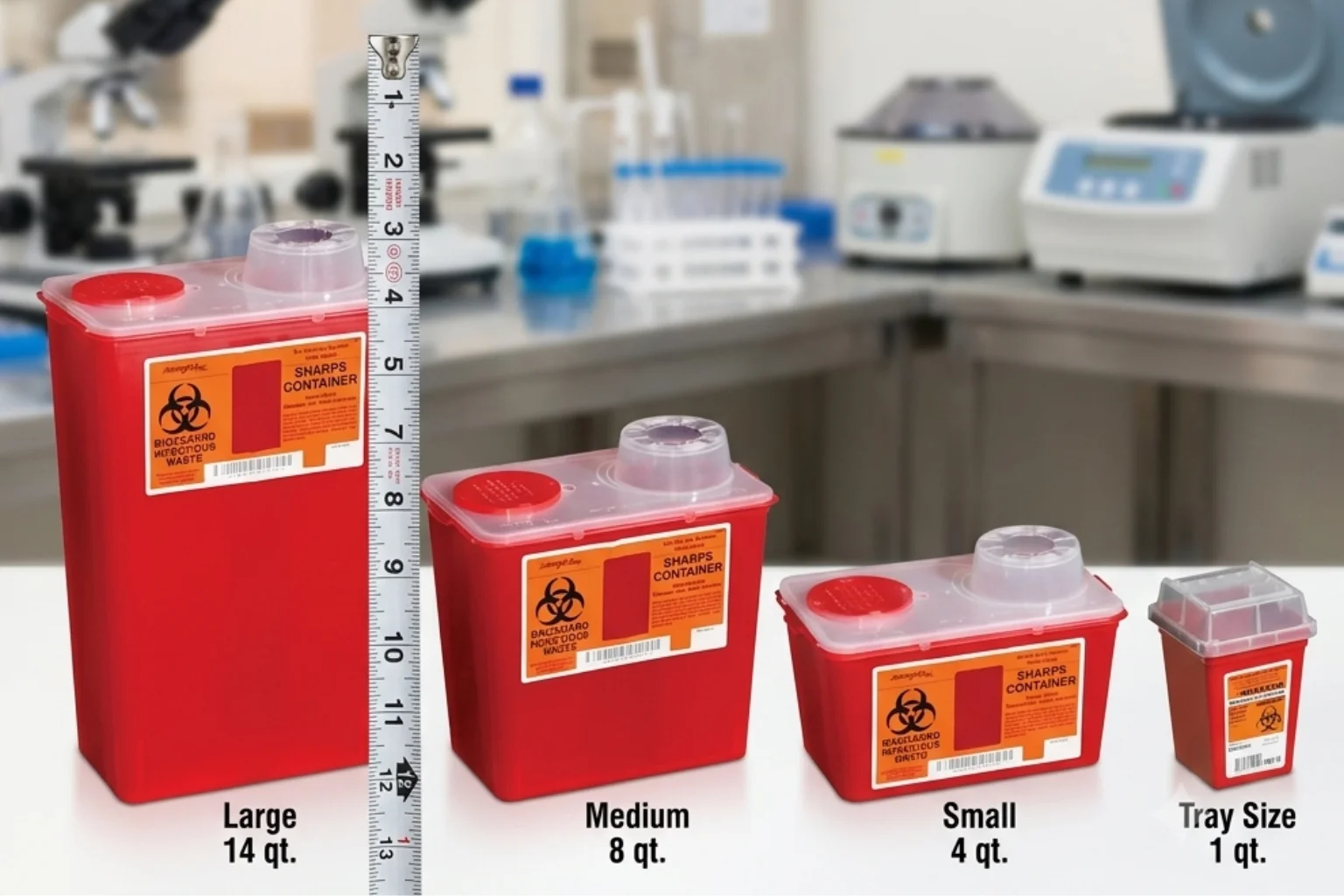
A sharps container that fills too quickly creates workflow problems. One that is too large often gets placed in the wrong area, used longer than intended, or handled less safely. If you are asking what size sharp bin do I need, the right answer depends on where it will be used, how often sharps are generated, and who is responsible for changing it.
For most facilities, bin size is not just a purchasing decision. It affects point-of-use safety, housekeeping, transport, storage, and compliance. A clinic room, laboratory bench, warehouse first aid point, and mobile response unit may all require different sharps container sizes even within the same organization.
What size sharp bin do I need for my site?
Start with the waste stream, not the product catalog. Sharps bins are designed to contain items such as needles, syringes with needles attached, lancets, blades, and other contaminated sharps. The correct size depends on how many of these items are generated in a typical shift, day, or week, and whether disposal must happen directly at the point of use.
Small containers are usually best when sharps are generated in low volumes or in tight spaces. That includes exam rooms, treatment carts, sample collection points, and vehicles. Larger containers make more sense in higher-volume areas such as vaccination stations, busy clinics, laboratories, or industrial medical rooms where frequent change-outs would waste time and increase handling.
There is a trade-off. A larger bin reduces replacement frequency, but it can also become heavy, occupy valuable wall or counter space, and encourage delayed disposal if teams are not monitoring fill levels. A smaller bin is easier to position close to the task, which often improves disposal discipline, but it may need more frequent replacement.
Match the sharps bin size to the application
The fastest way to choose correctly is to think about the application in operational terms.
Small sharps bins
Small bins are a practical choice for low-volume use, local treatment areas, first aid stations, mobile medical teams, and restricted workspaces. They work well where only occasional injections, blood sampling, or minor procedures take place. In these settings, keeping the bin within arm’s reach matters more than maximizing capacity.
This size is also useful when the bin needs to be carried, mounted in a compact area, or assigned to a single workstation. If your team generates only a limited number of sharps each day, a small container often improves placement and compliance.
Medium sharps bins
Medium sizes are often the most flexible option for general clinical and industrial use. They suit workplaces with consistent but not extreme sharps disposal needs, such as occupational health rooms, laboratories, dental settings, and multi-user treatment areas.
If you are unsure where to start, medium capacity is often the safest default because it balances footprint, usability, and service interval. It is large enough to avoid constant replacement but not so large that it becomes awkward to position safely.
Large sharps bins
Large bins are best reserved for high-throughput environments. Mass immunization programs, hospital departments, larger laboratories, and facilities with centralized waste generation often benefit from a bigger container.
That said, a large bin should not replace proper point-of-use disposal. If staff need to walk across a room or down a corridor to discard a used sharp, the size advantage is lost. In many cases, several smaller containers placed correctly are safer than one oversized container placed centrally.
Placement often matters more than capacity
A common buying mistake is choosing size by volume alone. The better question is whether the container can be installed exactly where sharps are used.
If the bin sits on a crowded counter, blocks access, or cannot be wall mounted at the correct height, staff may improvise. That is when used sharps end up on trays, benches, or carts before final disposal. From a safety standpoint, that is a bigger problem than replacing bins more often.
When assessing size, check the available mounting area, clearance for lid operation, visibility of fill lines, and whether the unit can be accessed comfortably while wearing gloves or PPE. In fast-moving environments, a slightly smaller bin in the right location is usually the better choice.
Estimate your waste volume realistically
If you manage multiple departments or are buying for a new site, estimate waste volume using actual activity levels. Look at the number of injections, blood draws, tests, or procedures completed in a shift or week. Then allow for peak periods, temporary campaigns, and backup stock requirements.
Avoid sizing based only on normal conditions if your facility has periodic surges. A vaccination drive, health screening event, or seasonal increase in patient traffic can change your disposal rate quickly. In those cases, standardizing on one size may not be practical. A mix of small, medium, and large bins often gives better coverage and reduces the risk of overfilled containers.
It also helps to consider replacement logistics. If collections are scheduled weekly, daily output matters less than total accumulation before pickup. If internal teams change containers as needed, ease of handling and storage may become the deciding factor.
What size sharp bin do I need for compliance and safe handling?
Compliance is not only about using an approved sharps container. It is also about using one appropriately. The container should be puncture-resistant, clearly labeled, closable, and suitable for the waste being generated. Just as important, it must not be allowed to overfill.
An oversized bin can create a false sense of capacity and lead to delayed replacement. A bin that stays in service too long may approach the fill line before anyone notices, especially in shared-use areas. A smaller or medium-sized option can make monitoring easier and encourage timely change-out.
Weight is another consideration. Large containers may reduce the number of replacements, but once full, they are heavier to handle and move. For teams responsible for internal transport and temporary storage, that can be a genuine operational issue. Safer handling sometimes means selecting a size that fills at a manageable rate rather than the maximum available capacity.
Single room, multi-room, or mobile use
Different operating models usually require different bin sizes.
In a single treatment room or small occupational health station, a compact or medium container is typically enough. In multi-room facilities, it often makes sense to place smaller bins at each point of use and support them with larger central waste handling arrangements behind the scenes.
For mobile operations, portability becomes a major factor. The bin must stay secure during movement, fit within the vehicle or kit layout, and still be easy to access during use. In those cases, smaller units are usually the practical answer, even if they require more frequent replacement.
For laboratories and industrial facilities, the mix of sharps may also affect size choice. If waste includes bulkier items such as syringes with attached components or broken glass sharps handled under specific procedures, usable capacity may be lower than expected. That is another reason to avoid choosing size by external dimensions alone.
When to standardize and when to vary sizes
Procurement teams often prefer standardization because it simplifies ordering, storage, and staff familiarity. There is value in that approach, especially across larger sites. But standardizing too aggressively can create poor fit at the user level.
A practical approach is to standardize within usage bands. For example, use one size for low-volume areas, one for routine clinical or lab use, and one for high-volume operations. This keeps ordering simple without forcing every department into the same container.
For many organizations, that balance delivers better safety performance and fewer urgent replenishment issues. Ocean Safety Supplies works with buyers who need that kind of practical consistency – enough variety to suit the application, without making replenishment complicated.
A simple way to decide
If sharps are generated occasionally and space is tight, choose a small bin. If usage is steady across a room, lab, or first aid area, a medium bin is usually the most efficient fit. If the environment produces high sharps volumes and has proper space, mounting, and handling procedures, a large bin can reduce service frequency.
If you are still unsure, do not size up automatically. First check where the bin will sit, who will use it, how often it will be changed, and whether staff can dispose of sharps immediately after use. That usually gives you the right answer faster than comparing dimensions alone.
The best sharps container size is the one your team will use correctly every time – close to the task, easy to monitor, and practical to replace before it becomes a risk.