

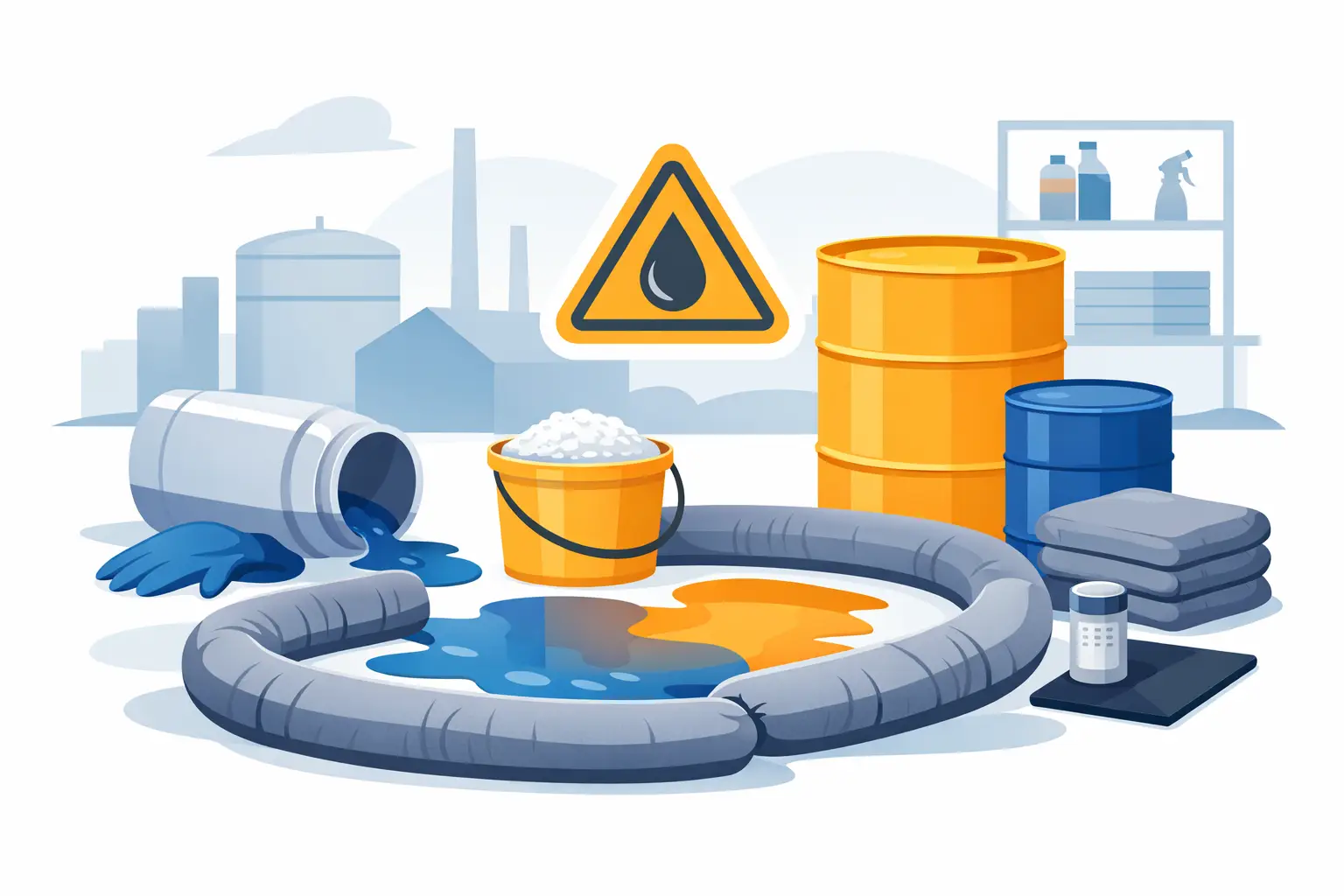
A leaking drum, damaged hose, or overturned container can spread farther than expected in minutes. The practical question, “what are absorbent socks used for,” matters because these flexible spill-control products help teams stop liquid from reaching drains, walkways, equipment, and the wider environment before cleanup begins.
Absorbent socks are long, flexible tubes filled with absorbent material. They are placed around a spill, along its path, or in front of vulnerable areas to contain and redirect liquid. For facilities that handle oils, fuels, chemicals, coolants, or other liquids, they are a core part of day-to-day spill readiness and emergency response stock.
What are absorbent socks used for?
The primary use of an absorbent sock is to create a temporary barrier around a liquid spill. Unlike loose absorbent pads, socks can be shaped around machinery, drums, floor joints, doorways, and uneven surfaces. Their flexibility lets responders form a perimeter quickly, reducing the area that needs to be recovered and cleaned.
In a typical response, a worker places socks around the outside edge of the spill first. This prevents further migration. Pads, rolls, or granular absorbents can then be used inside the contained area to recover the liquid. This sequence is efficient because it prioritizes control before cleanup.
Absorbent socks are also used proactively. A maintenance team may position them below valves during servicing, around equipment with a known drip risk, or beside fluid transfer points. In these situations, the sock provides a first line of defense against small releases becoming larger housekeeping, safety, or compliance issues.
Common workplace applications
Socks are used across warehouses, manufacturing plants, workshops, laboratories, construction sites, marine operations, and vehicle maintenance areas. The correct application depends on the liquid, surface, and route the spill could take.
Containing leaks and drips
Small but persistent leaks from pumps, hoses, hydraulic equipment, IBC valves, and drums can create slippery floors and gradually contaminate surrounding areas. Placing an absorbent sock around the base of equipment or along the likely flow path helps capture the release at its source. For ongoing leaks, it should be checked and replaced before it becomes saturated.
Protecting drains and doorways
Floor drains are a critical control point. If a spill enters a drain, the incident can move from a contained facility issue to a costly environmental response. Absorbent socks can be placed in a curved line upslope from drains or across the likely travel path to slow and absorb liquid. They are useful as a supporting measure, but a dedicated drain cover or drain seal is generally the stronger choice for directly sealing a drain opening.
At loading bays and doorways, socks can also form a temporary threshold barrier. This is especially useful during unloading, refueling, or transfer work when rainwater channels, external pavement, and stormwater systems may be nearby.
Managing spills around irregular equipment
Rigid barriers are difficult to use around pipework, machine feet, tanks, and congested production lines. Socks conform to these shapes. Responders can overlap them to form a continuous line or coil them tightly around a leak point. This adaptability is one reason they are commonly included in spill kits for industrial sites.
Directing liquid away from sensitive areas
A sock does not have to fully surround every spill. In some incidents, the immediate need is to divert a flowing liquid away from electrical equipment, pedestrian routes, storage areas, or drainage points. A curved placement can guide the release toward a safer contained area where pads and other absorbents can be deployed.
Choosing the right absorbent sock material
Not all absorbent socks are designed for the same liquids. Selecting the wrong type can reduce performance and may create unnecessary handling risks. The product label and safety data for the spilled material should guide the decision.
Universal or maintenance absorbent socks are intended for common non-aggressive workplace liquids, such as water, oils, coolants, solvents, and many general-purpose chemicals. They are often suitable for workshops, warehouses, and maintenance departments where the likely spill type varies.
Oil-only absorbent socks are designed to absorb petroleum-based liquids while repelling water. They are particularly useful for fuel, diesel, lubricants, and hydraulic oil spills on land or water. For marine operations, this water-repellent characteristic is essential because it helps preserve capacity for oil recovery rather than absorbing surrounding water.
Hazmat or chemical absorbent socks are used for aggressive chemicals and unknown liquids where chemical compatibility is required. These products are often supplied in high-visibility colors to distinguish them from general maintenance absorbents. They should be selected only after reviewing the chemical involved and the manufacturer’s compatibility guidance.
Capacity, length, and diameter also matter. A larger sock holds more liquid and creates a more substantial barrier, but it can be less convenient for narrow spaces or quick placement. Smaller socks work well around machinery and in compact spill kits. For large releases, multiple socks should be deployed with their ends overlapping so liquid cannot pass through gaps.
How to deploy absorbent socks effectively
Speed and placement determine whether a spill remains manageable. Before approaching a release, workers should assess immediate hazards, including fire risk, vapor exposure, traffic, moving equipment, and the identity of the liquid. Appropriate personal protective equipment must be worn before containment begins.
Start at the lowest point or most vulnerable pathway, especially near drains, thresholds, or water channels. Place the sock on the clean side of the advancing liquid and create a perimeter that is wider than the visible spill. If the floor slopes, build the barrier downhill first. On uneven surfaces, press the sock gently into place so it follows the contours of the floor.
Do not assume one sock will contain a fast-moving or high-volume release. Add a second line of containment when the spill is approaching a drain, when flow is continuing, or when the first sock begins to saturate. Once the source is isolated and the spill is contained, use compatible pads, rolls, or particulate absorbents to recover pooled liquid.
Used socks must be handled as contaminated waste. The disposal method depends on what they absorbed, local regulations, and the site’s waste contractor requirements. Even a universal sock may require hazardous waste handling if it has absorbed a regulated liquid. Never dispose of saturated absorbents in general waste without confirming the correct procedure.
What absorbent socks cannot do
Absorbent socks are highly useful, but they are not a substitute for source control, secondary containment, or a site spill response plan. They cannot stop a pressurized leak, seal a drain as reliably as a purpose-made cover, or safely contain every corrosive or reactive chemical.
They also have a finite capacity. A sock that is fully saturated may allow liquid to pass through or around it, particularly if the release continues. For larger incidents, use socks as the first containment line alongside spill berms, drain protection, overpack drums, containment pallets, and the appropriate emergency response equipment.
For outdoor work, consider weather and ground conditions. Heavy rain can change the direction and volume of runoff, while rough concrete, gravel, and broken surfaces may leave channels beneath the sock. In these settings, additional containment and closer monitoring are necessary.
Stocking socks for reliable spill readiness
Absorbent socks should be stored where spills are most likely to occur, not only in a central storeroom. Position appropriate supplies near chemical storage, maintenance bays, loading areas, fuel transfer points, laboratories, and drainage-sensitive zones. Clear labeling helps workers identify universal, oil-only, and chemical absorbents under pressure.
Review inventory after every incident, drill, or maintenance activity. A spill kit with missing socks, depleted pads, or incompatible products is not a reliable response resource. Operations teams should also train staff on the simple but critical order of action: protect people, stop the source when safe, contain the liquid, recover it, and manage contaminated waste correctly.
The right absorbent sock gives your team valuable time at the moment it matters most. Keep compatible products close to the risk, replace used stock promptly, and make containment the first move before a small release reaches a drain or disrupts operations.