

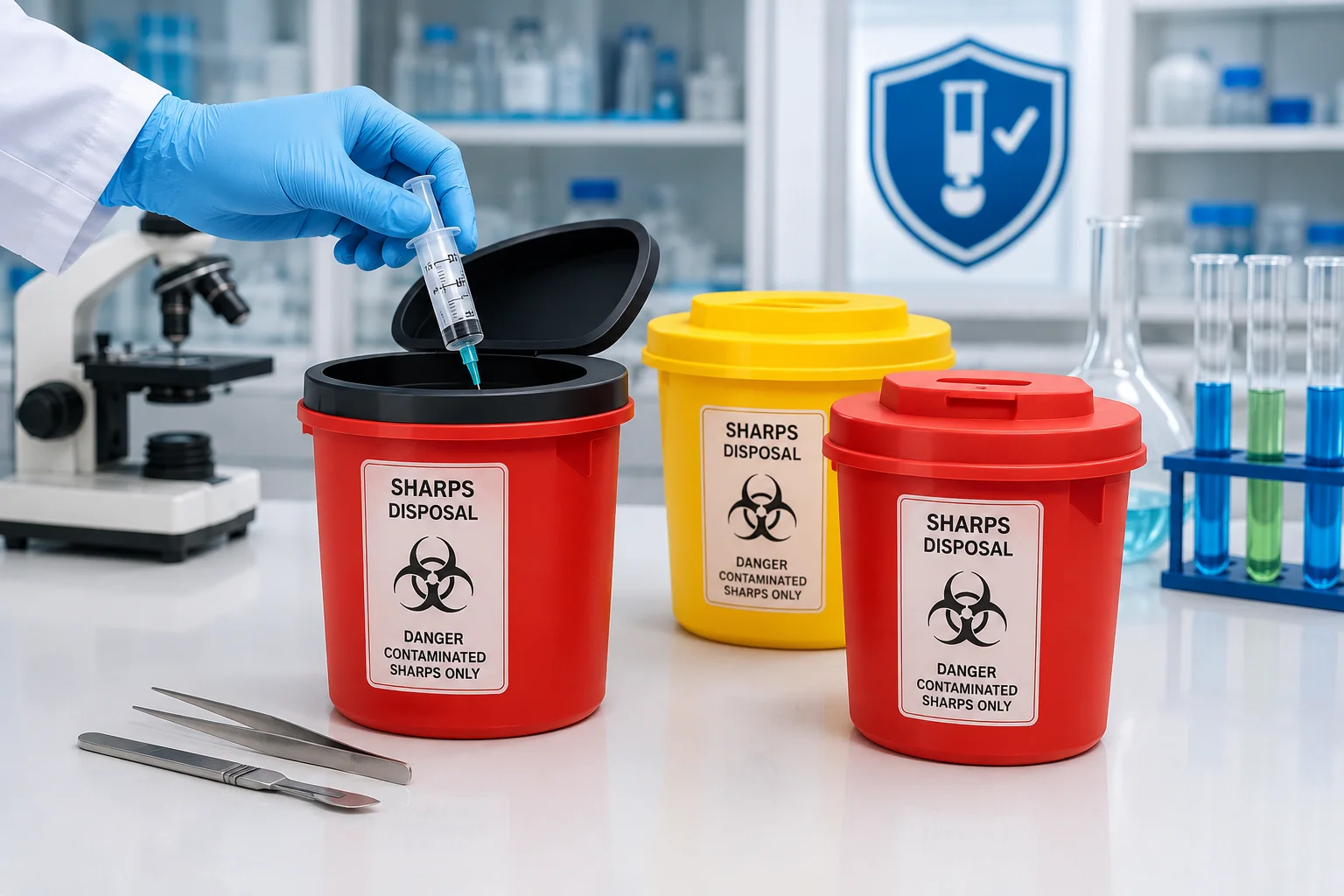
A sharps disposal failure rarely starts at the disposal room. It starts at the bench, treatment cart, or sample-prep station where a used needle, blade, contaminated slide, or broken glass item has no clear destination. Properly selected sharp bins for laboratories give staff an immediate, secure place to discard hazardous items without interrupting the task at hand.
For laboratory managers, EHS officers, and procurement teams, the right bin is not simply a plastic container with a lid. It is a control point within the laboratory’s waste-management process. Capacity, opening design, placement, labeling, closure method, and collection arrangements all affect whether the container supports safe routine work or creates a new exposure risk.
Why Laboratory Sharps Need a Dedicated Disposal System
Laboratories generate sharps in many forms. Needles, syringes, scalpel blades, pipette tips, lancets, capillary tubes, glass Pasteur pipettes, slides, cover slips, and broken contaminated glass may all require controlled disposal. The exact waste stream depends on the work being performed, including clinical testing, microbiology, research, pharmaceutical quality control, and industrial sampling.
Putting these items into a general waste bin, cardboard box, or open tray increases the chance of punctures and unplanned handling. A suitable sharps bin helps isolate the item at the point of use and prevents it from being handled again before final collection. This supports safer housekeeping, cleaner work areas, and more consistent staff practice.
A sharps bin does not replace a laboratory’s waste contractor, decontamination process, or written procedures. It supports them. Teams should confirm their local requirements for infectious, biohazardous, chemical-contaminated, and radioactive waste before selecting containers or establishing disposal routes. One bin type is not automatically appropriate for every sharp generated in the facility.
Selecting Sharp Bins for Laboratories
The best choice begins with the material entering the bin, not with the container size. Procurement teams can reduce purchasing errors by speaking with laboratory users, EHS personnel, and the approved waste-service provider before standardizing a product.
Match the Bin to the Waste Stream
Start by identifying what the container will receive and whether the waste may carry biological, chemical, pharmaceutical, or other hazards. For example, a bin used for contaminated disposable needles may need different labeling, treatment, and collection arrangements than a container for clean broken glass from a teaching laboratory.
Do not assume that every sharp should go into the same container. Glass contaminated with solvent residue, items used with cytotoxic materials, or sharps exposed to hazardous chemicals may require a separate waste route. Segregation at the bench is generally safer and more efficient than asking staff to sort materials later.
Clear labeling is essential. The bin should be recognizable at a glance, with hazard identification that aligns with the facility’s waste plan. Labels should remain visible when the bin is mounted, placed under a bench, or used on a mobile cart.
Choose a Safe Opening and Reliable Closure
The opening must allow staff to discard items without forcing, bending, recapping, or reaching into the container. This is particularly relevant for needles, syringe assemblies, blades, and fragile glassware. An opening that is too narrow slows users down; one that is overly open may increase the risk of accidental contact or allow contents to spill if the bin is tipped.
Look for a design that supports temporary closure during active use and a final closure for transport or disposal. A secure final closure helps protect housekeeping staff, waste handlers, and personnel moving filled containers through the facility. The closure should be simple enough that staff can use it correctly without special tools or excessive force.
Where needle removal is part of an approved laboratory procedure, consider whether a dedicated feature is needed. However, the safest process may be to dispose of the needle and syringe assembly together when permitted by the facility’s procedures. The right approach depends on the device, the task, and local requirements.
Size for the Workload, Not the Storage Room
Oversized containers can be tempting because they appear to reduce replacement frequency. In practice, a large bin at a low-volume bench may sit for too long, while a small bin at a busy sampling station may fill before staff can replace it. Both situations create operational problems.
Select capacity based on the number of procedures, the type of items discarded, available mounting space, and the planned change-out schedule. Compact bins are often practical for point-of-use disposal, while larger containers may suit central collection locations or high-volume laboratory areas. The most effective setup often uses more than one size across the site.
Never rely on a container being filled to its physical limit. Staff need a clear fill line and an established rule for closing and replacing bins before contents obstruct the opening. Overfilled sharps containers can lead to protruding items, dropped waste, and preventable injuries.
Consider Placement and Mounting
A sharps bin should be close enough to use immediately but positioned so it does not interfere with laboratory movement or contaminate clean work areas. At a bench, this may mean a wall-mounted bracket, a stable countertop holder, or a location beside the procedure zone. On a cart, it should be fixed securely and protected from knocks during movement.
Placement should also account for the user. Staff should not need to stretch over equipment, reach across a contaminated surface, or carry an exposed sharp across the room. Review the setup from the perspective of a technician wearing gloves and handling equipment with one hand.
Build the Bin Into Everyday Laboratory Workflow
A well-specified container still fails if it is not supported by a practical process. Laboratory supervisors should define who checks fill levels, who replaces bins, where replacement stock is held, and how closed units are transferred to the designated collection point.
Replacement bins should be available before they are needed. Keeping a small, controlled stock near high-use areas prevents staff from improvising with unsuitable containers when a bin reaches its fill line. This is especially valuable for laboratories operating extended shifts, handling urgent samples, or managing fluctuating workloads.
Training should be brief, task-specific, and repeated when new staff join. Personnel need to know which items belong in each bin, what must never be forced inside, how to identify the fill line, and what to do if a bin is damaged or incorrectly used. A simple visual instruction at the point of use can reinforce formal training without slowing work.
Managers should also inspect sharps-bin use during routine safety walks. Check for bins placed too far from workstations, unsecured lids, missing labels, contamination around the exterior, and containers left beyond their fill line. These observations often reveal a workflow issue rather than a staff compliance issue. Moving a container or changing the capacity can be more effective than repeating a reminder.
Avoid Procurement Gaps and Last-Minute Substitutions
Sharps disposal is a recurring operational requirement, so purchasing should be planned as a replenishment category rather than treated as an emergency order. Record the container sizes, mounting accessories, labels, and expected consumption for each laboratory area. Standardization can simplify training and stock control, provided the selected range still meets the needs of different waste streams.
When comparing suppliers, assess more than unit cost. Confirm material durability, closure design, fill-line visibility, available capacities, compatibility with brackets or carts, packaging quantities, and dependable local stock. A lower-priced bin is not a saving if an unavailable replacement forces a laboratory to use an unsuitable temporary solution.
Ocean Safety Supplies supports industrial and laboratory buyers with practical safety stock, responsive supply, and product guidance across broader workplace safety and hazardous-material control needs. For multi-site operations, consolidating routine safety categories with one dependable supplier can reduce administrative effort and help maintain consistent specifications.
Questions to Settle Before Ordering
Before placing an order, confirm the waste type, expected volume, point-of-use location, mounting requirement, closure method, labeling needs, and collection process. Also consider whether the container must be moved internally, stored temporarily before pickup, or used in areas where space is limited.
The most suitable sharp bin is the one staff can use correctly every time, in the exact place where the sharp is generated. Set up that process well, keep replacement stock ready, and the disposal step becomes a routine part of safe laboratory work rather than a weak point in the safety program.