

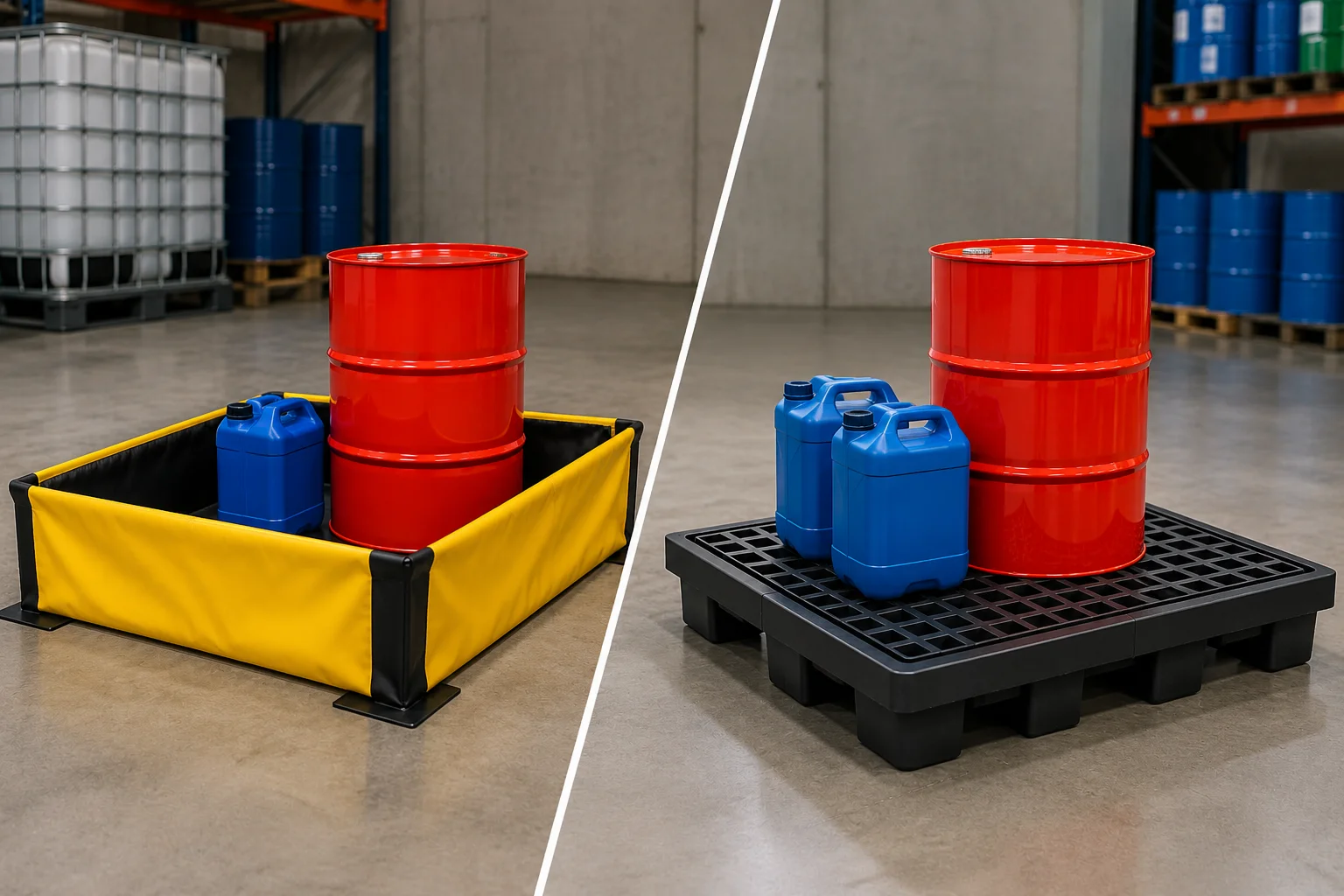
A spill seldom happens where it is most convenient. A leaking drum may be found in a temporary work zone, a mobile maintenance crew may need to refuel equipment outdoors, or an IBC may be stored in a fixed chemical area for months. The portable bund vs containment pallet decision comes down to matching containment to how materials move, where work occurs, and how quickly the area must be protected.
Both products provide secondary containment. Both help capture leaks, drips, and minor spills before they reach floors, drains, soil, or waterways. They are not interchangeable, however. A containment pallet is generally the stronger choice for regular, fixed storage. A portable bund is designed for temporary, flexible containment where a rigid pallet is difficult to transport or position.
For facility managers, EHS teams, and procurement buyers, selecting the correct option helps protect people, operations, and the environment while supporting site spill-control procedures.
Portable Bund vs Containment Pallet: The Core Difference
A containment pallet is a rigid, molded unit with an integrated sump. Drums, pails, or IBCs sit above the sump on a grating or load-bearing deck. If a container leaks, the liquid collects below the stored container rather than spreading across the work area. This makes the pallet a practical, ready-to-use solution for warehouses, chemical stores, workshops, laboratories, and waste accumulation points.
A portable bund, also called a flexible spill berm, creates a temporary contained area on the ground. It is typically made from chemical-resistant fabric or coated material with raised foam, bracket, or collapsible walls. Vehicles, portable tanks, drums, or equipment can be positioned inside the bund to capture fluid released during transfer, maintenance, refueling, washing, or emergency response.
The key distinction is simple: containment pallets are built for stationary storage, while portable bunds are built for adaptable work areas. There is overlap, but choosing based on the task avoids paying for capacity or mobility that the site does not need.
When a Containment Pallet Is the Better Choice
Containment pallets suit operations that store the same containers in the same location day after day. A two-drum pallet under lubricants in a maintenance shop, a four-drum pallet in a chemical store, or an IBC pallet in a bulk dispensing area provides visible and defined secondary containment without requiring staff to assemble equipment before use.
Their rigid construction is a major advantage in busy facilities. Forklifts and pallet jacks can often be used to position compatible pallet models, while molded polyethylene resists corrosion and is easy to clean after a release. Many designs also include removable grates, allowing users to inspect and recover collected liquid without moving the stored drums.
A containment pallet is particularly effective when the primary risk is slow leakage from stored containers. Drum seams, worn bungs, damaged valves, and dispensing drips can be contained continuously. The pallet remains in place as part of the storage setup, making compliance easier to maintain during normal operations.
Capacity and load rating must be checked separately. A pallet must support the full weight of the containers it will hold, including product weight, not just the empty drum or IBC. Its sump must also provide sufficient capacity for the credible spill scenario and applicable site requirements. An IBC pallet may look similar to a drum pallet, but it is designed for a very different load.
When a Portable Bund Is the Better Choice
Portable bunds are made for changing conditions. A contractor servicing a generator, a fleet team performing field maintenance, or an industrial crew transferring liquids in a temporary area may not have a permanent containment point available. A foldable bund can be carried to the work location, deployed before the task begins, and packed away once the site is clean.
This flexibility is valuable for outdoor work, remote facilities, construction projects, marine operations, and planned maintenance shutdowns. Rather than placing absorbents around equipment and hoping they will manage a larger release, the team establishes a defined containment area first. Absorbents can then be placed inside the bund to manage drips and make cleanup faster.
Portable bunds also accommodate shapes that rigid pallets cannot. A large pump skid, a wheeled machine, a vehicle, or several irregularly positioned containers may need a custom-sized containment footprint. Flexible bunds are available in a range of dimensions and can often be selected around the equipment rather than forcing equipment into a fixed pallet format.
The trade-off is that setup matters. The ground should be reasonably level and clear of sharp debris that could damage the bund base. Staff need to understand how the walls operate, how vehicles enter without compromising the edges, and how collected liquid will be removed safely. For frequent permanent storage, that level of handling can be less efficient than using a fixed containment pallet.
Compare the Work Scenario Before You Buy
The fastest way to choose is to start with the material-handling activity, not the product name. Consider where the liquid is normally kept, how it is moved, and what a credible release would look like.
For permanent drum storage, a containment pallet usually offers the most practical solution. It keeps containers elevated, establishes a dedicated storage position, and provides ongoing protection with minimal operator action. For a fixed IBC dispensing point, an IBC containment pallet is often the correct starting point, provided the load and sump capacity are suitable.
For temporary work involving mobile equipment, portable tanks, or changing work locations, a portable bund is usually the stronger fit. It can protect the immediate area during fluid transfers, maintenance, and refueling without requiring a permanent installation.
Some sites need both. A warehouse may use containment pallets in the chemical storage area and keep portable bunds in spill-response equipment for outdoor maintenance or emergency isolation. This layered approach recognizes that routine storage and temporary tasks create different spill risks.
Capacity, Compatibility, and Access Are Not Details
Secondary containment is only useful when it can safely hold the liquid involved. Start by identifying the number and size of containers, the maximum likely release, and the site standard or regulatory requirement that applies. Do not assume a pallet sized for four drums has enough sump capacity for a full drum release, or that a low-wall bund is suitable for all liquid volumes.
Material compatibility also matters. Polyethylene containment pallets are widely used for many oils, fuels, coolants, and chemicals, but buyers should confirm suitability for the specific product stored. Portable bund fabric, wall supports, and seams should likewise be verified against the liquid, anticipated exposure time, and operating environment. Aggressive chemicals, hot liquids, and prolonged exposure can change the specification required.
Access affects whether containment will be used correctly. If drums are frequently handled by forklift, choose a pallet configuration that supports the handling method and loading pattern. If a vehicle must enter a portable bund, specify an appropriate drive-in design or wall system. Forcing a vehicle over a standard bund wall can damage the product and create a spill path at the point of greatest risk.
Drain protection should also be considered. A bund or pallet captures a release at its source, but nearby drains, slopes, and traffic routes can increase the consequences if liquid escapes during transfer. Position equipment carefully, keep spill kits close, and make sure employees know who is responsible for inspection and cleanup.
Avoid Common Selection Mistakes
The most common mistake is using a containment pallet as a general-purpose work mat. A pallet is not designed to contain a vehicle service area, and placing equipment beside rather than inside it provides no real protection. The opposite mistake is deploying a portable bund for long-term drum storage where a rigid, accessible pallet would be easier to inspect and maintain.
Another issue is selecting only by footprint. A product may physically fit the drums or equipment but still fall short on load rating, sump capacity, wall height, or chemical compatibility. Procurement teams should request the technical details before ordering, especially for IBCs, hazardous chemicals, and high-value mobile equipment.
Finally, secondary containment should not replace good container management. Inspect drums, valves, hoses, and fittings regularly. Keep bungs secured, label all containers clearly, and remove accumulated rainwater or spilled liquid from outdoor containment using approved site procedures. A full sump cannot capture the next release.
Build Practical Spill Readiness Into the Site
Containment performs best when it is part of a working spill-control plan. Place suitable absorbents near storage and transfer points, provide drain covers where runoff is a concern, and ensure workers know how to report and contain a release. Inspect pallets for cracks, grates for damage, and portable bunds for tears, punctures, or degraded seams before deployment.
Ocean Safety Supplies can help operations teams match portable bunds, containment pallets, absorbents, and spill-response equipment to their actual work conditions. The right choice is the one that staff can deploy or use correctly every time, whether the risk is a slow drum leak in a warehouse or a sudden release at a temporary work site.