

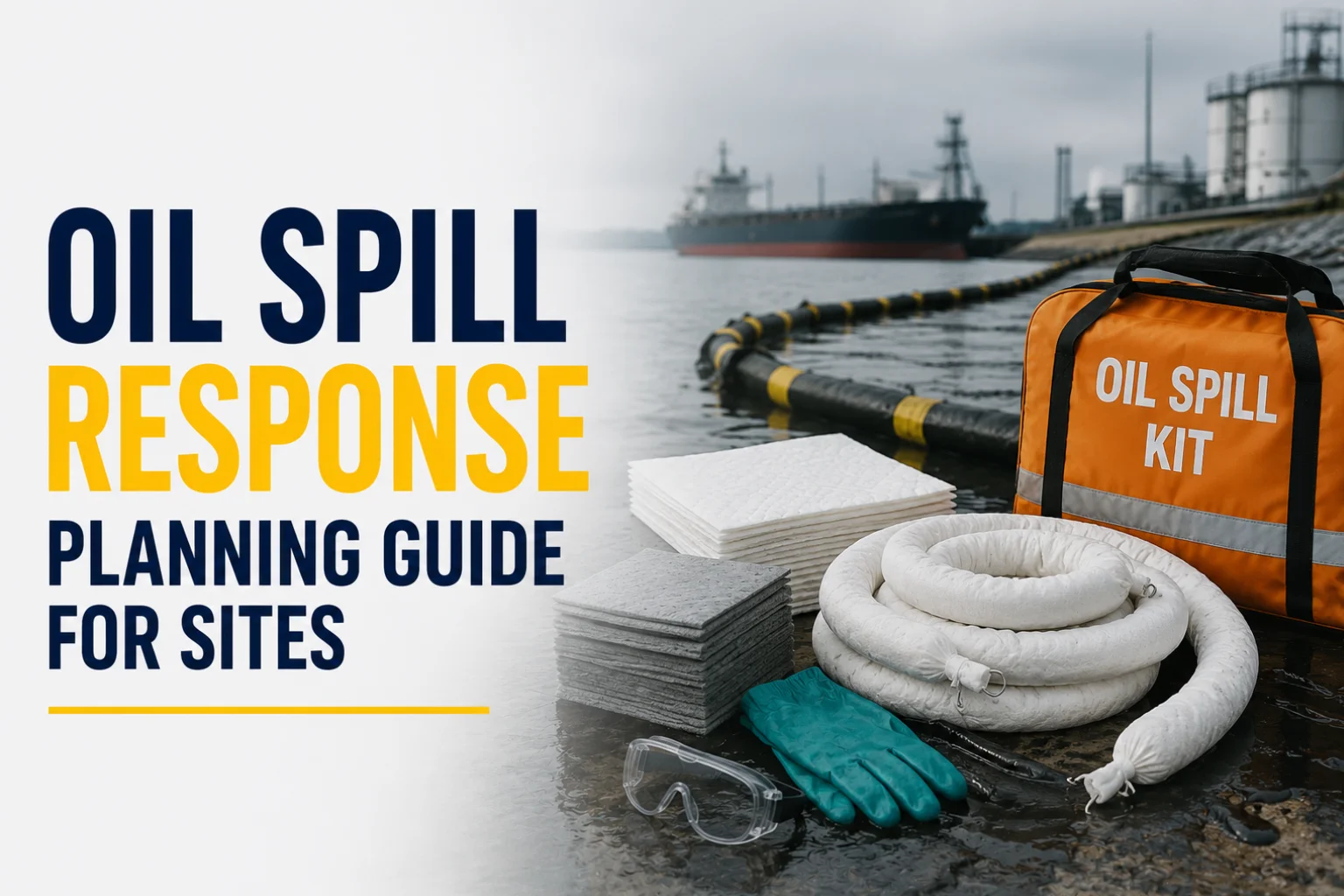
A spill plan that lives in a binder is not a response plan. When oil reaches a drain, shoreline, loading area, or process floor, teams need clear actions, available equipment, and defined authority in the first few minutes. That is where an oil spill response planning guide becomes operational, not administrative.
For facility managers, EHS teams, marine operators, and procurement leads, the goal is straightforward: reduce spread, protect people, contain environmental impact, and get the right equipment to the right place fast. The quality of the plan matters, but so does the practicality behind it. If absorbents are understocked, booms are the wrong size, or nobody knows who can shut down transfer operations, even a well-written document will fail under pressure.
What an oil spill response planning guide should actually cover
A useful plan starts with credible spill scenarios. That means looking at where oil is stored, transferred, transported, or used, then estimating what could realistically be released. A drum puncture in a warehouse, a hydraulic leak on equipment, and a transfer hose failure at a dock do not require the same response strategy.
The plan should define the likely spill types by volume, oil type, and location. Light fuels behave differently from heavier oils. Indoor hardstand areas call for a different containment approach than open water or stormwater-exposed yards. The more accurately the scenarios reflect day-to-day operations, the more reliable the response will be.
Roles and escalation paths need the same level of clarity. Teams should know who assesses the spill, who initiates containment, who isolates drains, who contacts regulators or emergency contractors, and who authorizes site shutdowns if needed. In many incidents, delay comes from uncertainty rather than lack of effort.
Equipment planning is the other half of the document. A plan should specify what is stored on site, where it is positioned, how quickly it can be deployed, and what backup resources are available if the initial spill exceeds internal capacity.
Start with risk, not product lists
Many spill plans are written backward. They begin with a list of spill kits, booms, and pads already on hand, then try to fit those items into every scenario. That approach creates blind spots.
A better method is to map the highest-risk areas first. Bulk tank storage, fueling points, loading bays, workshops, drum decanting stations, generator areas, marine transfer points, and waste accumulation zones usually deserve close attention. Then assess how oil could migrate. On some sites, the critical concern is worker slip hazards and equipment contamination. On others, the real exposure is drains, waterways, or sensitive off-site receptors.
This matters because response equipment should match the path of the spill. If the biggest risk is drain entry, drain covers, absorbent socks, and fast-deploy secondary containment may matter more than large general-purpose spill kits. If the site includes marine operations, floating booms, skimmers, storage tanks, and recovery accessories may be essential. If transfer areas are spread out, one central cabinet of supplies may look efficient on paper but fail in practice.
Build the plan around the first 15 minutes
The first 15 minutes often determine whether a spill remains a controlled site incident or turns into a costly cleanup. A workable response sequence should be simple enough to execute under stress.
First, protect people. If the spill involves flammable liquids, vapors, moving equipment, or confined areas, the immediate response may require isolation before containment. Personnel should know when to stop work, restrict access, and use appropriate PPE.
Second, stop the source if it is safe to do so. That might mean closing a valve, uprighting a drum, shutting off a pump, or isolating a damaged hose. Plans should avoid vague language here. Site-specific shutdown points and control methods should be identified in advance.
Third, contain the spread. This is where placement and product selection matter. Absorbent pads and rolls are useful for small surface spills. Socks and booms help create barriers and protect drains. Portable bunds and overpacks support damaged containers. On water, boom deployment strategy depends on current, wind, access, and the type of oil involved. There is no universal setup, which is why pre-planning is essential.
Fourth, recover and dispose. The plan should explain how contaminated absorbents, recovered liquids, and damaged packaging will be handled. Disposal requirements can affect how much temporary storage capacity the site needs after an incident.
The right equipment depends on the environment
An effective oil spill response planning guide should separate land-based response from marine or waterfront response. Too often, sites assume that a standard spill kit covers both. It rarely does.
For warehouses, factories, workshops, and utility areas, the core requirement is usually fast-access absorbent response. Oil-only spill kits, pads, socks, pillows, drain protection, and secondary containment products cover many common scenarios. Facilities handling drums, IBCs, or mobile equipment may also need overpack drums, drip trays, and portable spill berms.
For ports, shipyards, marinas, terminals, and waterfront facilities, response capability usually needs to go further. Floating containment booms, absorbent booms, skimmers, temporary storage, anchoring accessories, and retrieval tools become more relevant. The trade-off is cost and storage space. Not every site needs full marine recovery capability on site, but every site exposed to overwater transfer should know exactly what can be deployed internally and what must come from external support.
That distinction also affects procurement. Buying broad coverage sounds efficient, but mixed inventory can slow response if gear is not staged by risk area and clearly labeled. Busy operations teams do better with equipment that is visible, site-matched, and easy to replenish.
Training should match real use conditions
A spill plan is only as strong as the people expected to carry it out. Training should focus less on policy language and more on realistic deployment.
Teams should practice finding equipment, moving it to the spill point, protecting drains, stopping the source, and escalating if the event exceeds internal response limits. If the site operates across shifts, the same expectations must apply at night, on weekends, and during reduced staffing periods.
Tabletop exercises are useful for testing communication, but they should be paired with hands-on drills. A team may understand the plan and still lose time if boom connectors are unfamiliar, drain covers are stored too far away, or response carts are blocked by pallets. These are practical issues, not paperwork issues, and they are exactly what drills reveal.
Keep stock levels tied to exposure
One of the most common failures in spill readiness is assuming that once equipment is purchased, the problem is solved. In reality, spill response inventory needs routine review.
Sites should check whether absorbents are being used for minor leaks and not replaced, whether kits remain complete, whether products have degraded in outdoor storage, and whether expansion of operations has changed the risk profile. A new fueling point, additional tank capacity, or a modified loading area can make the original equipment layout outdated.
For procurement teams, this is where supplier reliability matters. Response products are not only emergency items. They are also readiness stock. Delays in replenishment can leave a site exposed after one significant incident or a series of smaller leaks. Working with a supplier that can support both standard spill control items and specialized oil spill response equipment simplifies that process. Ocean Safety Supplies fits well in that role because operations teams often need immediate availability across multiple safety categories, not just one product line.
Documentation matters, but usability matters more
Your plan should include site maps, equipment locations, emergency contacts, notification thresholds, and reporting procedures. It should also be easy to use during an actual event. That means concise instructions, current contacts, clear diagrams, and terminology that matches how the site really operates.
If response teams need to interpret long paragraphs while a spill is spreading, the document is doing too much and helping too little. The best plans support action. They do not compete with it.
How to review your oil spill response planning guide
A formal annual review is a good baseline, but major operational changes should trigger an immediate update. That includes layout changes, new storage areas, revised transfer processes, contractor changes, and any incident that exposes a weakness in response timing or equipment selection.
Review should also consider what the site cannot handle alone. That is not a weakness. It is responsible planning. Some spills require external recovery support, waste handling, remediation, or regulatory reporting expertise beyond internal resources. The plan should define those boundaries clearly so there is no hesitation when escalation is required.
Preparedness is not about having the longest procedure or the largest catalog of equipment. It is about making sure the right response happens quickly, with equipment that fits the risk and teams that know exactly what to do when the call comes.