

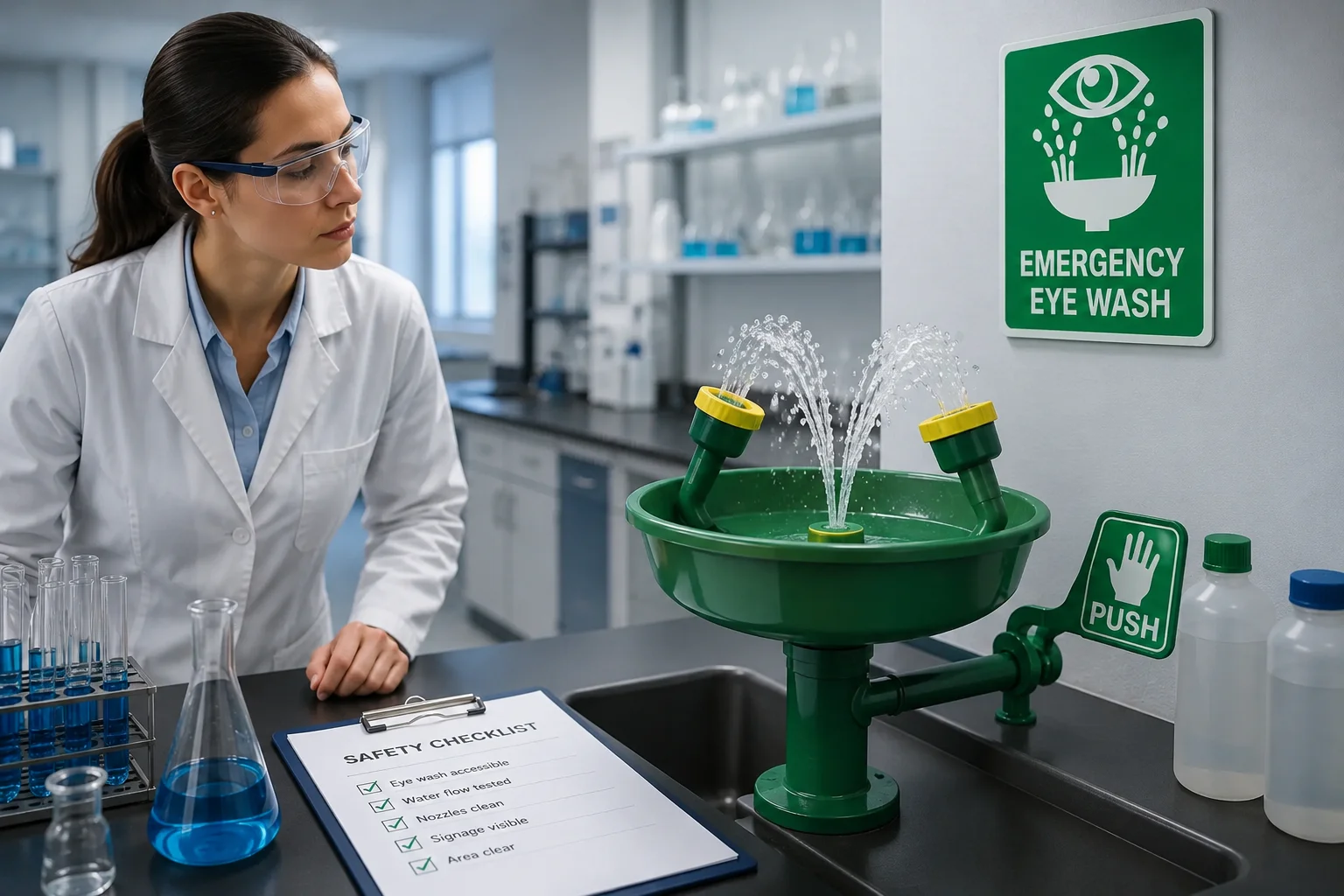
A corrosive splash gives a laboratory team seconds to act, not minutes to locate a key, clear a pathway, or discover that the eyewash station has weak flow. This lab eyewash readiness example shows how a practical facility program turns emergency equipment from a compliance item into a usable response resource when an operator needs it most.
What Eyewash Readiness Looks Like in a Working Lab
Eyewash readiness is more than installing a unit near a laboratory door. It means the equipment is reachable, unobstructed, supplied with suitable water, clean, functional, known to users, and supported by a clear inspection routine. The goal is simple: an exposed worker can begin flushing immediately and continue without assistance from someone searching for instructions or equipment.
For most facilities, the readiness standard should reflect the hazards in the room. A lab handling acids, alkalis, solvents, powders, biological materials, or other eye irritants needs a different level of preparedness than an office-based testing area with sealed samples. Site risk assessments, local requirements, manufacturer instructions, and applicable ANSI/ISEA Z358.1 guidance should all inform the final setup.
The trade-off is not between compliance and convenience. A poorly located station may satisfy a purchasing checklist but still fail the employee who cannot reach it quickly. Equipment selection and placement must follow the actual work, chemical use, and physical layout of the lab.
A Lab Eyewash Readiness Example in Practice
Consider a quality-control lab where technicians transfer concentrated cleaning chemicals from bulk containers into smaller vessels. The bench is located inside a room with storage cabinets, a sink, and two access doors. A plumbed eyewash station is positioned on the same level, along an unobstructed route from the transfer bench. It is highly visible, marked with clear signage, and does not require a worker to pass through a door or around mobile equipment.
The station activates in one motion and remains on without the user holding the control. Its spray heads are protected from dust and contamination, while the surrounding floor area is kept clear and slip risks are managed. Staff know that, following an eye exposure, they must start flushing promptly and notify a supervisor or designated responder for further medical evaluation and incident response.
A facility representative checks the station weekly. The activation is recorded, water flow is observed, drainage is reviewed, and the area is inspected for blocked access, damaged signs, leaks, or missing protective caps. A more detailed review is scheduled at defined intervals in line with the equipment manufacturer, site procedures, and relevant standards.
That is a useful lab eyewash readiness example because it addresses the whole response chain: hazard recognition, access, activation, flushing, inspection, documentation, and replenishment. It does not assume that a wall-mounted unit remains ready simply because it was installed correctly years earlier.
The Equipment Must Match the Hazard and Location
Plumbed eyewash stations are often the preferred solution where fixed water supply and drainage are available. They provide dependable, repeatable access for permanent laboratory areas. However, a plumbed unit still needs regular activation and inspection to help prevent stagnant water, sediment buildup, or unnoticed mechanical issues.
Self-contained eyewash stations can support temporary work areas, remote laboratories, construction testing sites, and locations where plumbing is not feasible. Their readiness depends on disciplined maintenance. Water or preservative solution must be changed as specified, the unit must be cleaned, and expiry dates must be controlled. A portable bottle may be useful for immediate first aid while moving to a proper flushing source, but it is not automatically a substitute for a compliant emergency eyewash arrangement.
Where there is a credible risk of chemicals contacting both the face and body, a combination eyewash and emergency shower may be the appropriate solution. The decision should be based on the specific materials, quantities, exposure routes, and consequences of a delayed response.
The Weekly Check That Prevents Avoidable Failure
A weekly activation check is one of the simplest ways to identify a readiness gap before an incident. It should not be treated as a box-ticking exercise delegated without accountability. The person completing the check needs to know what normal operation looks like and what requires escalation.
A useful inspection includes these distinct checks:
- The route to the eyewash is clear of cartons, carts, furniture, stored drums, and locked doors.
- Signage is visible from the work area, and lighting supports quick identification during a power disruption or low-visibility event.
- The unit activates easily, delivers appropriate flow, and stays running without being held open.
- Spray heads, covers, valves, plumbing connections, drain areas, and floor surfaces show no damage, leaks, blockage, or contamination.
- The inspection log is completed, deficiencies are reported, and corrective actions are tracked to closure.
If the water is discolored, flow is weak, a valve sticks, or drainage causes pooling, the station should be treated as impaired until the issue is resolved. Posting a clear temporary notice and providing an approved alternative arrangement is better than allowing personnel to assume the equipment is operational.
Access Time Is Only Part of the Equation
Facilities often focus on distance alone. Distance matters, but the real question is whether an employee can reach the unit quickly after an eye injury. A route that looks short on a floor plan may be difficult in practice if it crosses a busy aisle, requires navigating around palletized stock, or depends on a door that may be closed.
Walk the route during normal operations. Check it when deliveries are being received, waste containers are awaiting collection, and maintenance work is under way. A laboratory can be ready on a quiet audit day and unready on a typical production shift.
Consider the worker’s likely condition as well. A person with irritated or impaired vision may be disoriented and unable to read small labels. High-visibility signs, clear floor space, familiar equipment placement, and repeated training reduce reliance on perfect decision-making under stress.
Training Makes the Equipment Usable
Eyewash training should be included during onboarding, whenever hazards or layouts change, and through periodic refresher sessions. Employees should know where the nearest station is, how it activates, what to do after activation, and whom to contact. Supervisors should also understand how to isolate an area, obtain the relevant safety data information, arrange medical support, and preserve incident details for investigation.
A short hands-on demonstration is usually more effective than asking personnel to read a procedure. Staff do not need to simulate exposure, but they should physically identify the route, operate the station under supervision, and recognize the difference between an eyewash, a drench hose, and a personal rinse bottle.
Training should be tailored to the site. A research lab with rotating students may need frequent orientation. A controlled industrial laboratory with a stable technical team may focus on shift coverage, contractor awareness, and periodic competency checks. The common requirement is that every person at risk can act without waiting for a specialist.
Records Should Drive Corrective Action
Inspection records are valuable only when they reveal trends and trigger action. If the same eyewash is repeatedly blocked by supplies, the problem is not an individual inspection failure. It is a storage-control and housekeeping issue. If a self-contained unit is frequently overdue for solution replacement, assign ownership to a named role and add the task to the preventive maintenance schedule.
Keep records practical: inspection date, inspector, unit location or asset number, condition observed, action required, responsible person, and completion date. Procurement teams can use the same information to plan replacement parts, protective caps, signs, maintenance tags, and backup eyewash supplies before an urgent shortage occurs.
Build Readiness Into Your Safety Supply Plan
Emergency response equipment needs the same supply discipline as spill kits, absorbents, PPE, and first-aid materials. Identify critical parts and consumables, hold suitable replacement stock, and avoid waiting for a defect to become an emergency order. For larger sites, standardizing eyewash models where appropriate can simplify staff training, maintenance, and spare-part control.
Ocean Safety Supplies supports industrial and laboratory teams with emergency eyewash and shower equipment, spill response products, and practical safety supply solutions for ongoing site readiness. The right setup depends on your hazards and operating environment, but the operating principle remains constant: equipment must be ready before exposure occurs.
A well-maintained eyewash station rarely attracts attention during a normal shift. That is exactly the point. When an incident happens, the route should be clear, the water should flow, and the response should begin without delay.