

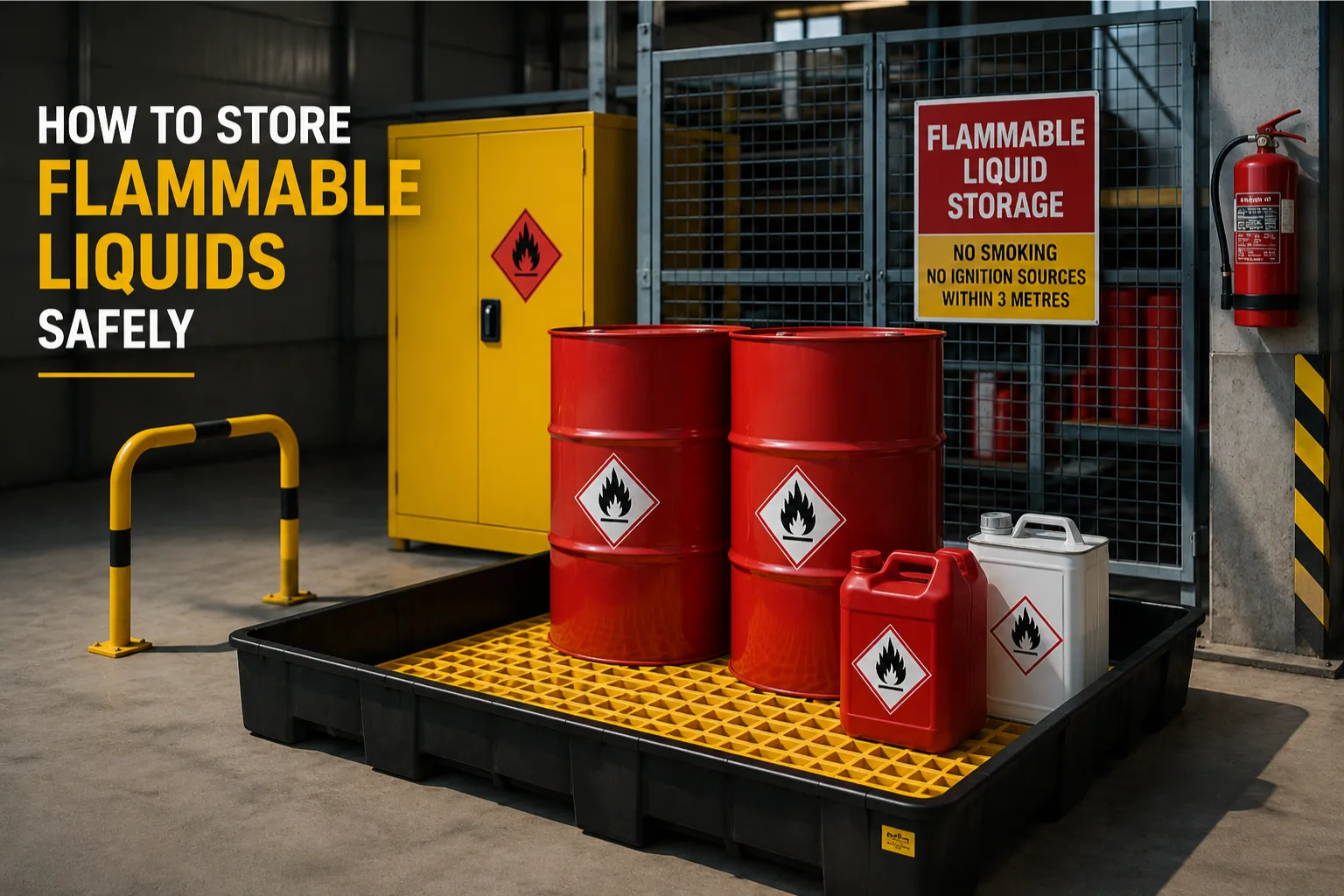
A leaking solvent can turn an ordinary storeroom into a fire hazard faster than most teams expect. If you are reviewing how to store flammable liquids at your facility, the right answer is not just “put them in a cabinet.” Safe storage depends on the liquid, the volume on site, the work area, and the controls around it.
Why flammable liquid storage needs a system
Flammable liquids create risk in three ways at once. They can ignite from sparks, hot surfaces, or static discharge. Their vapors can travel beyond the original container and reach an ignition source some distance away. And if a container fails, the spill itself becomes both a fire risk and an environmental problem.
That is why storage decisions should be made as an operational control, not as an afterthought. Facility managers, EHS teams, and warehouse supervisors need a setup that supports compliance, reduces handling errors, and keeps stock available for daily use without creating unnecessary exposure.
In practice, good storage is built around five controls: approved containers, proper cabinets or dedicated rooms, segregation from incompatible materials, spill containment, and disciplined housekeeping. If one of those is missing, the whole arrangement becomes less reliable.
How to store flammable liquids in the right containers
The first question is whether the liquid is in a suitable container for storage and dispensing. Original manufacturer packaging is often acceptable if it is intact, correctly labeled, and designed for the product. Problems usually start when liquids are transferred into unapproved cans, damaged containers, or temporary bottles used for convenience.
Approved safety cans and industrial-grade containers are designed to reduce vapor release, control pouring, and limit ignition risk. For day-to-day operations, that matters as much as shelf life. A container that drips during dispensing or does not close properly can create a constant low-level hazard that is easy to normalize until an incident occurs.
Size also matters. Larger drums may be efficient for purchasing, but they are not always the safest option at the point of use. Many sites reduce risk by keeping bulk quantities in a controlled storage area and issuing smaller working volumes into approved dispensing containers. That approach lowers the impact of leaks, simplifies handling, and reduces vapor generation in active work zones.
Labels should remain clear and durable. If a liquid is decanted, the secondary container needs immediate identification. Unmarked containers create both a fire hazard and a response problem during emergencies.
Use a flammable storage cabinet when indoor storage is required
For most workplaces, the practical answer to how to store flammable liquids indoors is a compliant flammable storage cabinet placed in a controlled location. Cabinets help contain risk by separating flammables from general operations, reducing exposure to ignition sources, and organizing inventory so containers are less likely to be stacked unsafely or left in open areas.
Not every cabinet setup is equally effective. The cabinet should be sized to the actual volume on site, not the ideal volume on paper. If teams routinely leave containers outside the cabinet because it is full, the storage plan has already failed. It is usually better to match cabinet capacity to real usage patterns and review whether excess stock should be stored elsewhere.
Placement matters too. Cabinets should be located away from direct heat, high-traffic impact zones, and exit routes where they could obstruct egress or complicate emergency response. They should also be close enough to the point of use that workers do not bypass them out of convenience. Safety controls that slow down operations too much are often ignored.
Where sites handle mixed hazards, dedicated segregation is essential. A flammable cabinet is not a general chemical cupboard. Storing incompatible substances together can turn a single incident into a more serious event.
Segregate flammables from oxidizers, acids, and ignition sources
One of the most common storage mistakes is treating all chemicals as if they can share the same space. Flammable liquids need separation not only from open flames and electrical hazards, but also from incompatible materials that can intensify fire or trigger hazardous reactions.
Oxidizers are a clear example. Even if they are stored in sealed containers, keeping them near flammables increases the consequences of a leak or fire. Certain acids and reactive chemicals can create similar problems depending on the materials involved. The exact segregation plan depends on your inventory, so the chemical’s safety data sheet and site risk assessment should guide the layout.
Ignition control should be just as deliberate. Storage areas should be protected from welding, grinding, smoking, hot work, and non-rated electrical equipment where required. In some environments, static is part of the risk profile as well, especially during transfer operations. Bonding and grounding may be necessary when dispensing or moving product between containers.
Ventilation, temperature, and location all affect risk
Vapor control is one reason flammable liquid storage cannot be reduced to shelving alone. Some products release vapors more readily than others, and storage in warm, poorly ventilated spaces can increase accumulation. That does not mean every site needs the same ventilation design, but it does mean enclosed storage areas should be assessed carefully.
Temperature is another variable. Heat can increase vapor pressure and stress containers over time. Storing flammables next to boilers, sun-exposed walls, process equipment, or rooftop heat gain is a preventable mistake. A cooler, stable environment is generally better, provided it still aligns with the product’s storage requirements.
Indoor versus outdoor storage depends on quantity, site layout, and climate exposure. Outdoor storage may reduce indoor vapor concerns, but it introduces weather, security, and secondary containment issues. If containers are exposed to rain, corrosion, or temperature swings, risk may shift rather than disappear.
Do not overlook spill containment
If a container leaks inside a cabinet, room, or storage bay, the immediate issue is not only fire. Liquid can spread under shelving, enter drains, damage surfaces, and increase vapor release. That is why secondary containment should be part of the storage design, not a separate purchase made after a spill.
For smaller container storage, cabinet sump capacity may provide an initial level of containment, but it should be checked and maintained. For drums and larger volumes, spill pallets, containment decks, and bunded systems are often the more appropriate solution. The right choice depends on the container type, quantity stored, and whether dispensing happens in the same location.
Response readiness matters as well. Storage areas should have appropriate spill kits nearby, with absorbents selected for the liquids in use. Teams should not have to search another building for spill response equipment while vapors are accumulating around a leak. This is where a supplier with broad stocked inventory can make operations easier – one source for cabinets, secondary containment, and spill response equipment reduces gaps between planning and implementation.
Control the amount stored and the way it is used
A good storage program is not just about where flammables sit. It is also about how much is kept on hand and how quickly stock moves. Excess inventory increases exposure without improving safety. In many facilities, the safest adjustment is simply reducing on-floor quantities and storing only what operations genuinely need for the shift, day, or production cycle.
That requires coordination between procurement, operations, and EHS. Buying in bulk may reduce unit cost, but it can create storage pressure if the facility is not designed for larger volumes. There is a real trade-off here. The lowest purchase price is not always the lowest operational cost when storage controls, fire protection, and spill risk are considered.
Rotation should be managed so older product is used first and damaged or outdated containers are removed promptly. Temporary storage habits, like leaving half-used cans on benches or in maintenance carts overnight, should be addressed through routine inspections and supervisor follow-up.
Train people on how to store flammable liquids consistently
Even the best equipment cannot compensate for inconsistent practices. Workers need clear rules on receiving, labeling, transferring, storing, and disposing of flammable liquids. Supervisors need to know what acceptable storage looks like so issues are corrected early rather than tolerated until audit time.
Training should be practical and site-specific. Teams should know which cabinet or storage area to use, what not to store together, how to report damaged containers, and what to do if a spill occurs. If contractors bring flammables on site, the same controls should apply to them.
Routine inspections help keep standards from slipping. Check container condition, cabinet contents, label visibility, housekeeping, spill supplies, and signs of overstocking. A short, regular inspection is usually more effective than an occasional major cleanup.
What a compliant setup usually includes
For many industrial, marine, warehouse, and laboratory sites, a dependable setup includes approved storage containers, a properly sized flammable storage cabinet, dedicated secondary containment for larger volumes, nearby spill response materials, and clear segregation from incompatible chemicals. The exact combination depends on your process and inventory, but the goal stays the same: reduce ignition potential, limit spill impact, and make correct storage the easiest option for the people doing the work.
If your current arrangement relies on spare shelving, mixed chemical storage, or containers kept near the work area for convenience, it is worth correcting before a near miss becomes a real event. The best storage systems are not complicated. They are visible, practical, and built for daily use.
A safer site usually starts with one straightforward question: if a container leaked or ignited here today, would your storage setup help contain the problem or make it worse?