

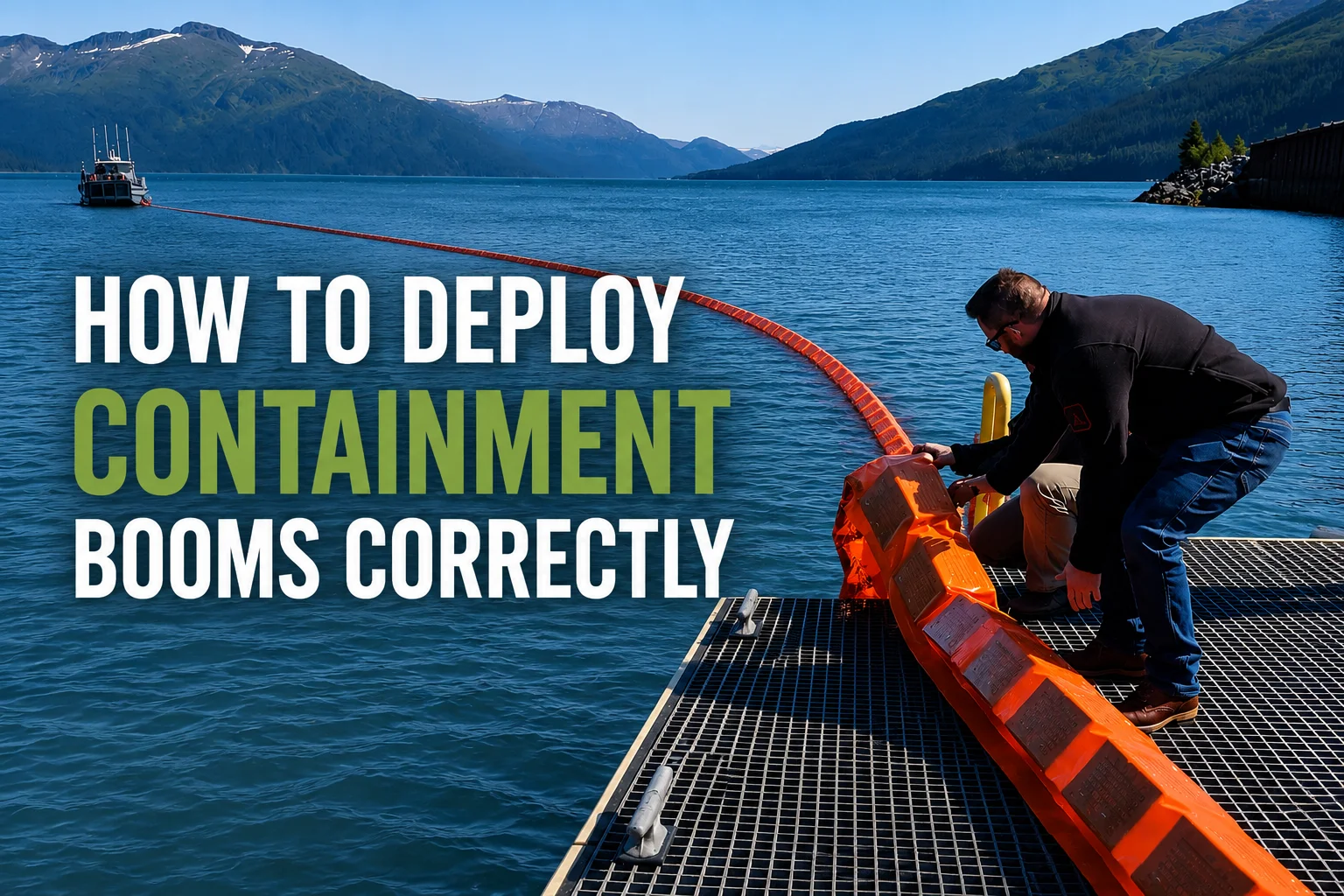
A boom in the wrong position can turn a manageable spill into a wider cleanup, a longer shutdown, and a more expensive response. If your team needs to know how to deploy containment booms, the key is not just getting a barrier on the water. It is choosing the right boom, setting the right angle, and securing it for the actual conditions on site.
For operations teams, marina managers, contractors, and EHS personnel, boom deployment is a practical field task with very little room for guesswork. Current, wind, vessel traffic, tide, and shoreline access all affect performance. A good deployment plan reduces spread, protects assets, and gives recovery equipment a better chance to work efficiently.
How to deploy containment booms for real conditions
Containment booms are designed to control and concentrate floating pollutants, most commonly oil and fuel. They do this by combining flotation above the surface with skirt depth below the surface. That sounds straightforward, but performance depends heavily on matching the boom to the environment.
In calm harbors, ponds, or sheltered industrial waterways, a lighter boom may be enough. In tidal channels, ports, or open water near active traffic, you need a boom with the right freeboard, skirt depth, ballast, and tensile strength. A boom that is too light may ride poorly, dive under current, or fail at connection points. A boom that is oversized for a confined site can also slow deployment and make handling harder than it needs to be.
Before deployment, confirm the spill type, estimated spread area, water movement, weather, and access points. That first assessment determines whether your goal is full containment, diversion away from sensitive areas, or concentration toward a recovery zone. Those are not the same setup, and treating them as interchangeable often causes problems later.
Start with site assessment, not product handling
The first decision is where the boom should sit relative to the spill source and water movement. In moving water, trying to place a boom straight across the flow often creates too much pressure on the skirt. Product can escape underneath, or the boom can strain at anchors and connectors. In those conditions, an angled deployment usually performs better because it guides the spill toward a collection point rather than trying to stop the whole flow head-on.
You also need to check for hazards that affect positioning. Pilings, seawalls, rocky shorelines, intake points, drains, and vessel routes all matter. If the spill is near infrastructure, protect the highest-risk assets first. If the source is ongoing, containment near the source may be necessary, but only if the team can work safely and maintain control of the boom.
This is where many buyers underestimate the value of having the right equipment on hand before an incident. Deployment is faster and more consistent when boom sections, connectors, towing bridles, anchors, reels, and recovery gear are already matched and ready.
Choosing the right boom before deployment
Not every containment boom is built for the same job. Calm water booms are often used for marinas, ponds, sheltered ports, and industrial basins. Fast water or offshore booms are designed for higher loads and more dynamic conditions. Inflatable booms can provide strong buoyancy and compact storage, while foam-filled booms are often favored for simpler readiness and lower maintenance.
The right choice depends on where it will be deployed, how quickly it must be launched, and who will handle it. A trained marine response crew can manage larger and more specialized systems. A facility team responding to an initial spill may need equipment that can be deployed quickly with minimal assembly.
Length matters as much as type. If you do not have enough boom to create the right angle, overlap, or protection perimeter, deployment quality drops immediately. It is also wise to account for spare sections. Connectors can be damaged in storage or in use, and real incidents rarely fit the exact dimensions drawn on paper.
Key deployment patterns
There are three common boom arrangements used in the field. A containment pattern surrounds or partially surrounds the spill to limit spread in calmer conditions. A diversion pattern places the boom at an angle to redirect product away from a vulnerable area. A deflection pattern is similar, but it is focused on steering the spill toward a shoreline access point or skimming zone.
The best pattern depends on water speed and the response objective. Full encirclement may look ideal, but in moving water it can become unstable. A controlled angled setup often performs better than an ambitious containment ring that cannot hold position.
Step-by-step deployment in the field
Begin by preparing the launch area and staging all sections in deployment order. Check connectors, ballast chain, end fittings, and towing points. If the boom has been stored for a long period, inspect for tears, abrasion, stiff sections, or damaged flotation. Small faults at the dock can become major failures once the boom is under load.
Position the crew and support craft before the first section enters the water. Good communication matters here. One person should direct the operation so deployment speed, anchor placement, and line handling stay coordinated.
Launch the boom from the upwind or up-current side when possible. That gives the team more control and reduces the chance of the boom drifting back over itself. As each section is fed out, keep tension steady but not excessive. Twisting, slack loops, and abrupt pulls can reduce flotation performance and stress the connection points.
If the deployment uses anchors, place them based on expected load, not just on available attachment points. Anchor lines that are too short can pull the boom down. Lines that are too loose can allow the boom to swing out of position. In tidal areas, allow for water level changes so the boom remains effective through the response window.
Once the boom is in place, adjust the angle. In current, a shallow angle usually works better than a perpendicular barrier. This reduces pressure on the skirt and helps move floating product toward the desired collection area. If sheen or oil is escaping beneath the boom, the current may be too fast for that setup, or the angle may need to be reduced.
Common deployment mistakes
The most common mistake is expecting one boom layout to work everywhere. Water movement changes everything. Another frequent issue is under-anchoring, especially near exposed edges or high-traffic zones where wake adds extra stress. Teams also lose performance by connecting incompatible sections, rushing deployment without inspection, or setting the boom too close to a source where turbulence is strongest.
There is also a trade-off between speed and precision. In an emergency, rapid placement matters. But a fast deployment that needs to be rebuilt twenty minutes later usually costs more time overall. A controlled first setup is often the better operational choice.
After deployment, monitoring is part of the job
A deployed boom is not a set-and-forget barrier. Conditions shift. Tide changes, wind picks up, wake increases, and the product itself weathers and spreads differently over time. Someone should monitor freeboard, skirt behavior, anchor loads, and any signs of product escape.
If the boom is collecting large volumes of oil, plan the recovery step early. Containment without skimming, pumping, or absorbent recovery only delays the next problem. Product can overtop in rough conditions or spread again if the boom has to be moved without a clear recovery plan.
For longer operations, inspect connection points regularly. Debris buildup, abrasion against structures, and repeated wave action can reduce effectiveness even when the boom still appears to be in position.
Training, readiness, and procurement considerations
Knowing how to deploy containment booms is partly a technical question and partly a readiness issue. The best equipment still depends on trained users, clear procedures, and enough stock to respond without waiting for additional supply. For industrial sites and marine operators, that means reviewing boom inventory before an incident, not during one.
Procurement teams should look beyond unit price alone. Deployment speed, storage method, compatibility with existing connectors, and suitability for local water conditions all affect value. A lower-cost boom that is difficult to launch, hard to repair, or poorly matched to current conditions can become the more expensive option in actual use.
For many organizations, the practical answer is to keep a response mix. That may include primary containment boom, absorbent boom for smaller hydrocarbon spills, anchors and lines sized for site conditions, and supporting recovery products. Ocean Safety Supplies supports buyers who need that kind of operational readiness, especially where fast availability and consistent product matching matter.
If your team is responsible for spill control, the strongest deployment plan is usually the simplest one that fits the site, the water movement, and the response objective. Get the angle right, secure the boom properly, and treat monitoring as part of deployment, not an afterthought.