

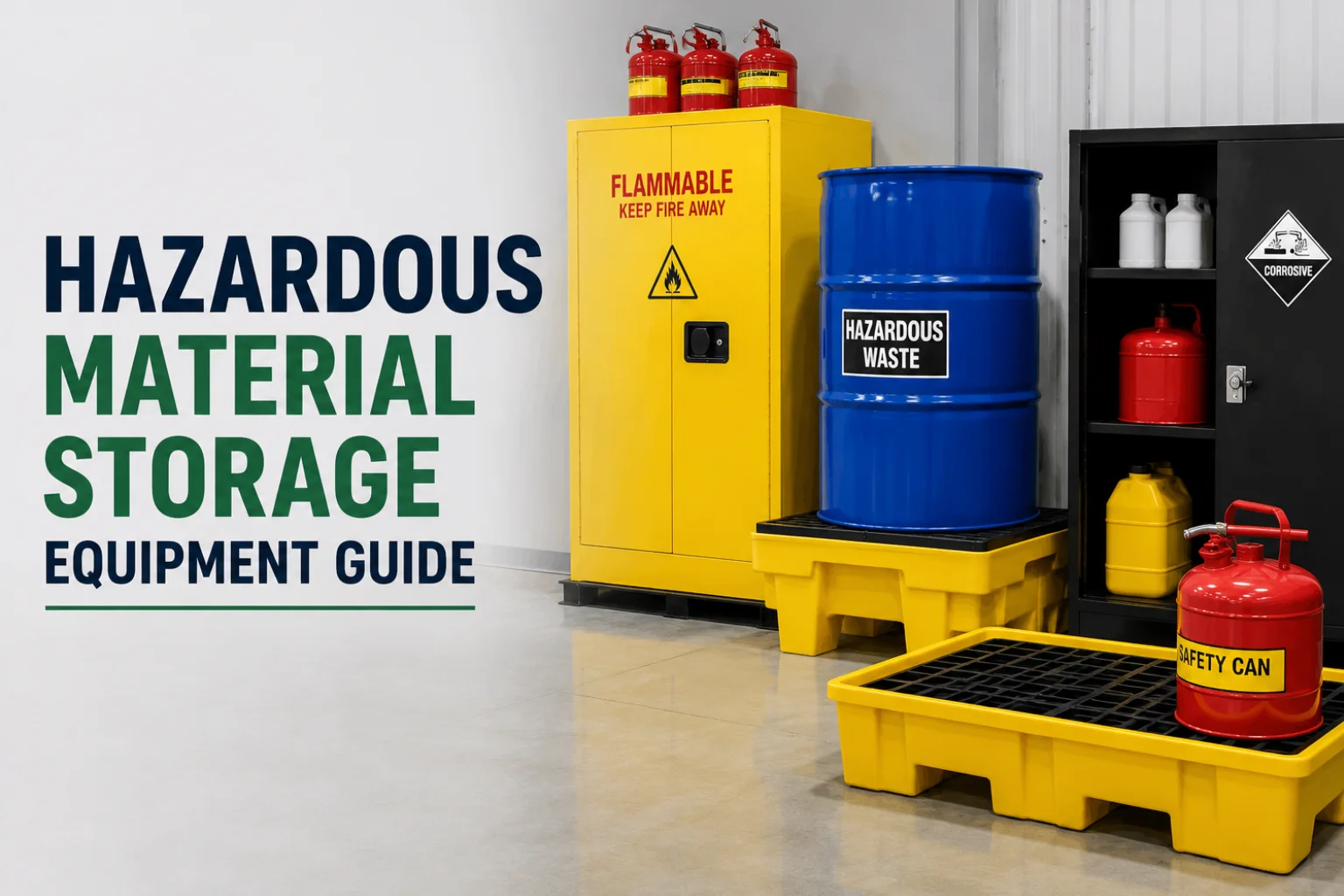
A leaking drum, an incompatible chemical stored on the wrong shelf, or a missing eyewash station can turn a routine shift into a reportable incident fast. This hazardous material storage equipment guide is written for facility managers, EHS teams, warehouse supervisors, and procurement buyers who need practical answers – what equipment to use, where to use it, and how to choose products that support safe storage and faster response.
For most sites, hazardous material storage is not one product category. It is a system. Flammable liquids need secure cabinets. Drums and IBCs need secondary containment. Transfer points need spill control nearby. Areas with corrosives may also require emergency showers and eyewash stations. The right setup depends on the material, the container size, the volume on hand, the frequency of handling, and the risk profile of the work area.
What a hazardous material storage equipment guide should help you decide
The main job of storage equipment is simple: reduce the chance that a small failure becomes a larger safety or environmental problem. In practice, that means separating incompatible materials, containing leaks at the source, supporting compliant storage practices, and making emergency response equipment immediately available.
That is why buyers should avoid treating all hazardous storage products as interchangeable. A flammable storage cabinet and a containment pallet may both support safer operations, but they solve different problems. Cabinets manage controlled storage for smaller containers and day-to-day access. Containment pallets and portable bunds manage spills from larger containers such as drums and IBCs. Spill kits handle the response phase after a release has already happened.
Start with the material, not the catalog
Before selecting equipment, identify exactly what you are storing. Flammable liquids, corrosives, oils, solvents, and mixed industrial chemicals each create different storage demands. Some products are mainly a fire risk. Others are more likely to damage floors, contaminate drains, or injure workers during handling.
Container format matters just as much. A site storing small laboratory bottles has very different needs from a warehouse holding 55-gallon drums or 275-gallon IBCs. The amount of movement also matters. Static storage in a dedicated room usually calls for a different setup than an active decanting or transfer area where spills are more likely.
If your operation includes multiple material classes in one zone, the answer is rarely a single product. It is usually a combination of segregation, containment, and response equipment placed where exposure is most likely.
Flammable storage cabinets for controlled indoor storage
Flammable storage cabinets are often the first product buyers consider, and for good reason. They provide a defined location for storing flammable liquids in smaller containers while reducing exposure to ignition sources and limiting unauthorized access. In maintenance shops, factories, labs, and warehouses, they help organize stock and improve day-to-day control.
The key trade-off is capacity versus accessibility. A small cabinet near the point of use improves efficiency, but it may not hold enough inventory for a busy operation. A larger centralized cabinet can reduce clutter across the site, but it may slow down routine access if teams need frequent withdrawals. Buyers should look at both storage volume and workflow, not just cabinet dimensions.
Construction quality also matters. Industrial buyers should prioritize durable designs, clear labeling, secure doors, and shelves suited to the actual container sizes in use. If containers are frequently handled, door swing and shelf spacing make a real difference over time.
Secondary containment pallets for drums and IBCs
When hazardous liquids are stored in drums or intermediate bulk containers, secondary containment becomes central to risk control. Containment pallets are designed to capture leaks, drips, or full container failures before they spread across the floor or enter drains.
This is where many facilities underestimate the importance of matching the pallet to the application. A drum pallet used for static storage may not be the best choice for areas where containers are loaded and unloaded regularly by forklift. IBC spill pallets need sufficient sump capacity, structural strength, and practical access for handling. If the area is tight, footprint can be as important as containment volume.
Material compatibility is another factor that should not be skipped. The pallet itself must be suitable for the liquid stored above it. A pallet that performs well for oils may not be the right fit for certain chemicals. For mixed-use sites, standardizing around a few proven containment formats can simplify procurement, but only if compatibility and capacity are checked first.
Portable bunds for temporary work and transfer zones
Not every hazardous liquid storage need is permanent. Construction sites, maintenance shutdowns, marine operations, and temporary transfer points often require flexible containment that can be deployed quickly and removed when the job is done. Portable bunds are a practical answer in these situations.
Their value is speed and adaptability. They can create a contained zone for drums, pumps, hoses, or fueling equipment without requiring fixed infrastructure. That said, portable bunds are not a direct substitute for permanent containment in every facility. They are best where mobility matters and where temporary operations create short-term spill exposure.
Buyers should pay attention to wall design, chemical resistance, and how easily the bund can be entered if wheeled equipment or containers need to move in and out. A low-profile bund may be easier to use, but it can involve a trade-off in containment configuration or edge protection.
Spill kits and absorbents are storage support, not an afterthought
Storage equipment reduces the likelihood and spread of a release. Spill kits and absorbents help when a release still occurs. They belong near storage areas, transfer points, loading bays, maintenance zones, and any location where hazardous liquids are handled.
The mistake many sites make is choosing one generic kit for everything. Oil-only absorbents, chemical spill kits, and general-purpose kits each serve different spill types. If your facility stores both hydrocarbons and aggressive chemicals, one kit category may not cover all scenarios. The closer the kit matches the material risk, the faster and safer the response will be.
Placement matters as much as product selection. A well-stocked spill kit is less useful if it is stored too far from the likely incident point. For larger facilities, multiple smaller kits often outperform one large centralized unit.
Emergency showers and eyewash stations for exposure risk
A hazardous material storage equipment guide should not stop at containment. If workers are handling corrosives or other harmful liquids, emergency showers and eyewash stations are part of the storage safety picture. They do not store product, but they reduce the consequence of splashes and accidental exposure.
The right choice depends on the task and the hazard. In some locations, a plumbed unit is the strongest long-term solution. In others, a self-contained station may be more practical due to site constraints or temporary use. Accessibility, visibility, and routine inspection are what determine whether the equipment performs when needed.
For procurement teams, this is one of the clearest examples of why speed of supply matters. Exposure-response equipment should not be delayed because it sits outside the core storage budget. If hazardous materials are already on site, the supporting safety equipment should be ready as well.
How to choose the right setup for your facility
The best equipment mix usually comes from a simple site-based review. Look at what is stored, how much is stored, where it is stored, and what happens around that storage area. A quiet indoor stock area may need cabinets and containment pallets. An active decanting station may also need absorbents, drain protection, and emergency wash equipment within immediate reach.
It also helps to think in layers. The first layer is secure storage. The second is secondary containment. The third is spill response. The fourth is worker protection. When one of those layers is missing, the overall system becomes weaker.
Buyers should also weigh standardization against specialization. Standardizing a few cabinet sizes, pallet formats, and spill kit types can make repeat ordering easier and support faster site rollouts. But highly specialized operations, especially in marine, chemical, or industrial processing environments, often need equipment tailored to specific hazards and operating conditions.
Procurement considerations that affect long-term performance
Price matters, but industrial buyers already know the cheapest option can become expensive if it fails early, slows operations, or creates replacement issues. Storage equipment should be evaluated for durability, availability, and suitability for repeat use in real site conditions.
Lead time is another practical concern. If a new hazardous storage area is being commissioned or a site finding needs quick correction, stocked inventory can matter more than a marginal price difference. For many organizations, dependable delivery and knowledgeable product guidance are part of the product value, not an extra.
This is where working with a supplier that understands spill control, containment, emergency response, and workplace safety as connected categories can save time. Ocean Safety Supplies supports buyers who need that joined-up approach, especially when urgent delivery and broad product access are both priorities.
Hazardous material storage works best when equipment is selected for the real conditions on site, not just the spec sheet. If your storage plan makes spills easier to contain, exposures easier to respond to, and routine handling easier for your team, you are much closer to a safer and more reliable operation.