

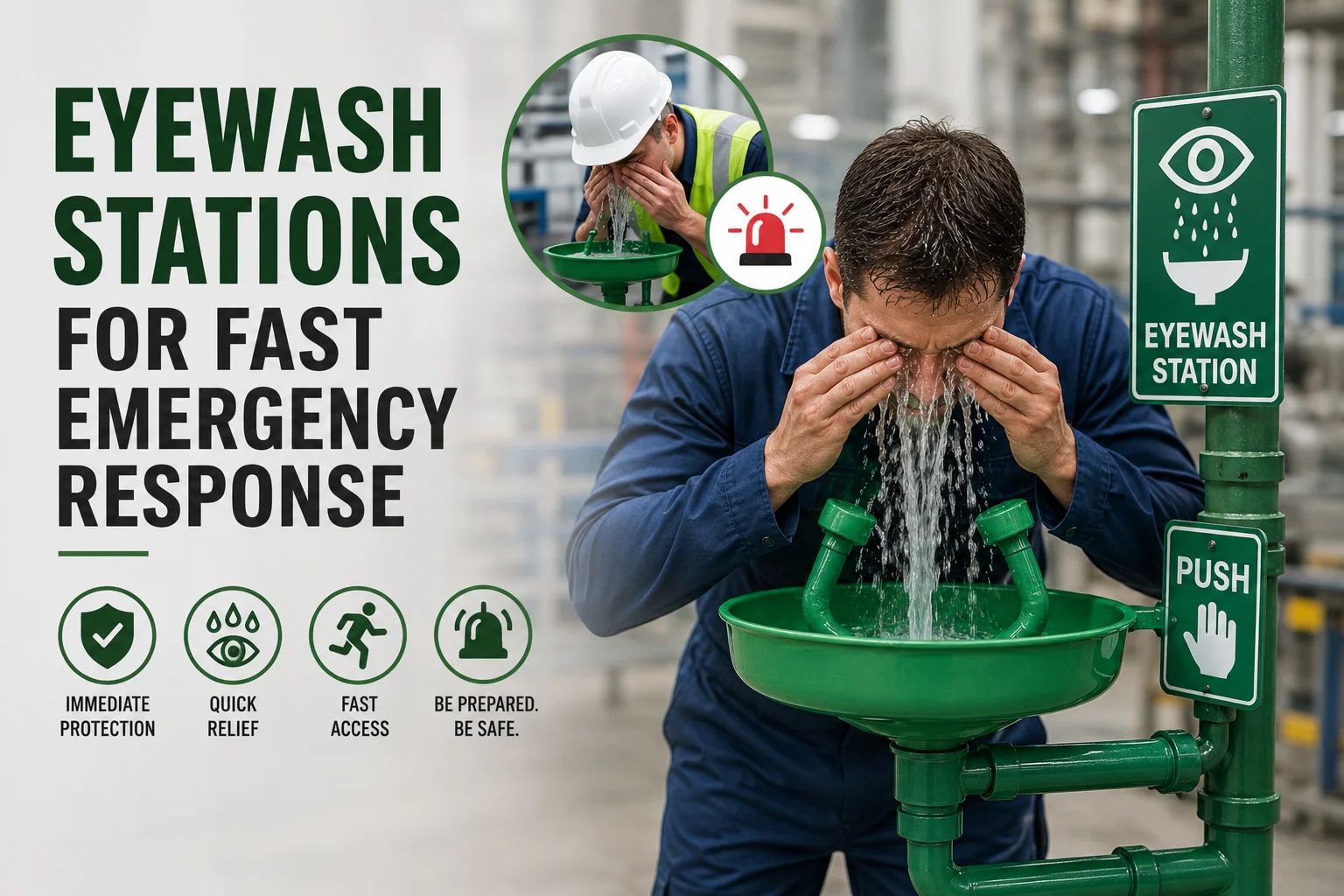
A chemical splash gives you seconds to respond, not minutes. That is why eyewash stations are not a secondary purchase for industrial sites, labs, workshops, and warehouses. They are frontline emergency equipment that can limit injury severity, support compliance, and give teams a practical way to act immediately when eyes are exposed to hazardous substances, dust, or debris.
For procurement teams and safety managers, the real question is not whether an eyewash unit is needed. It is which type fits the hazard, how quickly it can be reached, and whether it will perform properly when someone is under stress and needs instant flushing. A unit that is poorly placed, difficult to activate, or not maintained consistently can leave a site exposed both operationally and legally.
Why eyewash stations matter on active worksites
Eye exposure incidents happen across more environments than many teams expect. Chemical processing areas are the obvious example, but risk also exists in battery charging zones, paint and coating operations, marine maintenance, manufacturing lines, janitorial chemical storage areas, laboratories, waste handling points, and construction support facilities. Even a relatively small splash can become a serious incident if flushing is delayed.
Eyewash stations are designed to provide immediate irrigation to help remove contaminants before damage worsens. That speed matters. When workers need to move across multiple rooms, unlock access points, or search for equipment, the response window is already being lost.
From a site readiness perspective, eyewash equipment also supports a wider safety system. It works alongside emergency showers, chemical storage controls, spill kits, PPE, and hazard communication. Buyers who treat eyewash units as part of a complete risk-control setup usually make better placement and specification decisions than those who treat them as a box-checking item.
Choosing eyewash stations by hazard and location
Not every site needs the same configuration. The right selection depends on the materials handled, the layout of the facility, available plumbing, ambient conditions, and whether the exposure risk involves only the eyes or the face and body as well.
Plumbed eyewash stations are often the preferred option for fixed facilities with a defined hazard area. They provide a continuous water supply and are well suited to laboratories, processing plants, manufacturing sites, and maintenance rooms where regular exposure risk exists. For facilities with stable layouts and permanent workstations, this is usually the most dependable long-term choice.
Portable or self-contained units can make more sense where plumbing is not available or where hazards shift by task or zone. Remote work areas, temporary project sites, loading areas, outdoor operations, and marine environments often benefit from portable eyewash capacity. The trade-off is that portable units require disciplined servicing, refilling, and inspection. If maintenance routines are weak, a portable solution can create a false sense of readiness.
Wall-mounted, pedestal-mounted, and combination shower-and-eyewash models each solve different operational needs. A compact wall unit may be sufficient in a small lab where splash hazards are controlled and space is limited. A combination emergency shower and eyewash station is more appropriate where corrosive liquids or larger-volume splash risks are present. For higher-risk industrial settings, buying the larger solution upfront is often more cost-effective than correcting an undersized setup later.
Placement is where many facilities get it wrong
A high-quality unit will not compensate for poor placement. Eyewash stations need to be located where personnel can reach them fast, without climbing stairs, opening difficult doors, or navigating around pallets, drums, or equipment. This sounds straightforward, but in live industrial environments, layouts change. Storage creeps into access paths. Temporary barriers become permanent. The station stays on the wall, but the route to it no longer works in an emergency.
Visibility matters just as much as distance. Stations should be clearly identified and easy to spot under normal and low-visibility conditions. In loud or high-pressure work environments, workers do not have time to interpret signage or search around corners.
Temperature is another practical factor. Water that is too cold can discourage full flushing time. Water that is too hot can create additional risk. In hot outdoor environments or exposed utility areas, this becomes a product selection issue as much as a maintenance issue. Buyers should think beyond purchase price and consider whether the operating conditions demand a more specialized unit or protective accessories.
What buyers should look for before purchasing
For commercial buyers, the best purchasing decisions usually come from matching site hazards to product performance rather than selecting the lowest-cost model in the category. That means reviewing activation method, flow performance, build quality, materials of construction, valve reliability, bowl or basin durability, and installation requirements.
Ease of use is essential. In an eye exposure event, the injured worker may have impaired vision, panic, and limited dexterity. Activation should be simple and immediate. Units that require awkward force or multiple steps are harder to use when seconds matter.
Material selection also affects lifecycle cost. Corrosive environments, washdown areas, marine applications, and chemical handling zones can quickly wear down lower-grade components. Stainless steel or corrosion-resistant construction may carry a higher upfront cost, but in the right environment it often delivers better value through longer service life and reduced replacement frequency.
Maintenance access should not be overlooked. If a station is difficult to inspect, test, drain, or refill, it is less likely to stay in reliable condition. Procurement teams should involve maintenance personnel early, especially when evaluating plumbed versus self-contained models.
Eyewash stations and compliance expectations
Most buyers are balancing two priorities at once: protecting workers and meeting compliance obligations. Eyewash stations help support both, but compliance is not just about having a unit on site. It depends on suitability, accessibility, condition, and ongoing inspection.
This is where many organizations face avoidable gaps. A site may have installed equipment years ago, but process changes, chemical substitutions, expanded floor space, or revised storage layouts can make the original setup inadequate. A periodic review is often necessary, especially in facilities that have grown quickly or adapted operations over time.
Inspection and testing routines are part of that picture. If stations are not checked consistently, blocked nozzles, low flow, contamination, or drained portable tanks may go unnoticed until an incident occurs. For operations teams, reliability is the standard. The equipment has to work on demand, every time.
Integrating eyewash stations into broader emergency readiness
Eyewash equipment works best when it is supported by training, clear procedures, and compatible site controls. Workers should know where the nearest unit is, when to use it, and who to notify immediately after first response begins. This is especially important for contractors, temporary staff, and multi-shift operations where not everyone is equally familiar with the facility.
There is also a purchasing advantage in sourcing eyewash units as part of a wider emergency response plan. Sites that are simultaneously reviewing emergency showers, spill response products, chemical storage, PPE, and signage can reduce delays and specification mismatches by aligning these categories together. That approach is often more efficient for procurement and more practical for the end user.
For organizations with multiple facilities, standardizing eyewash stations across similar hazard areas can simplify training, maintenance, and spare parts planning. Full standardization is not always possible because hazards vary by site, but a consistent approach where practical can reduce friction for both safety and operations teams.
When a basic unit is enough, and when it is not
Some environments genuinely only require a straightforward eyewash solution. A controlled indoor workspace with limited splash exposure, low personnel traffic, and easy plumbing access may not need an advanced configuration. In these cases, a durable standard unit can be the right commercial decision.
Other environments need more. If there is a chance of body exposure, if corrosives are handled routinely, if the station will sit in a harsh outdoor area, or if access conditions are challenging, the specification should move up accordingly. Trying to save budget on emergency equipment in a higher-risk area often creates more expense later through upgrades, downtime, or incident response consequences.
This is where a solution-driven supplier adds value. Ocean Safety Supplies supports buyers who need eyewash stations that match real operating conditions, not just product descriptions on a page. For busy EHS teams, maintenance managers, and procurement professionals, that kind of practical guidance can shorten the buying process and improve confidence in the final selection.
The most useful question to ask is simple: if an eye exposure happened in your facility today, would the nearest station be visible, accessible, functional, and right for the hazard involved? If the answer is anything less than yes, it is time to review the setup before an emergency makes the decision for you.