

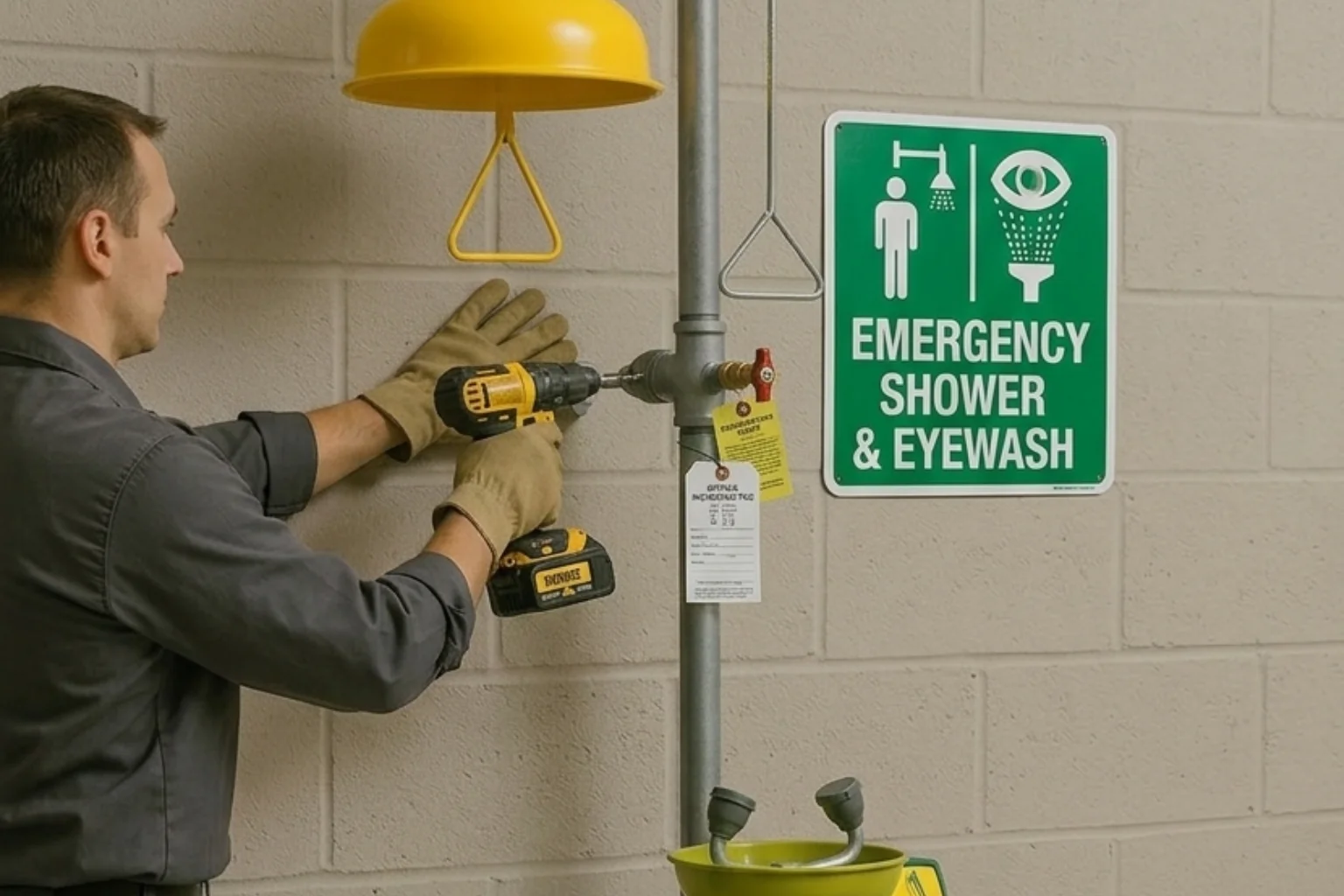
A safety shower that is five meters too far away, poorly drained, or fed by unstable water pressure can fail when it matters most. That is why any emergency shower installation guide has to start with one point: placement and site conditions are just as critical as the product itself.
For facility managers, EHS teams, maintenance supervisors, and procurement buyers, emergency shower installation is not just a plumbing task. It is a compliance, response-time, and operational-readiness decision. The right unit in the wrong location creates risk. The right location with poor utility support creates a different kind of failure. A good installation plan closes both gaps.
What this emergency shower installation guide should help you solve
Most buyers are trying to answer a practical set of questions. Does this area need a full body shower, an eyewash, or a combination unit? Can the water supply maintain the required flow? Is there enough clearance around the station? Will the drainage create slip hazards or disrupt nearby operations?
Those questions need to be resolved before purchase and again before commissioning. In chemical handling areas, laboratories, battery rooms, loading zones, and manufacturing lines, the installation standard is not just about putting equipment on a wall or floor. It is about making sure an exposed worker can reach, activate, and use the unit immediately, without obstruction or hesitation.
Start with hazard location, not product preference
The first decision is not whether you want a freestanding, wall-mounted, or portable unit. The first decision is what kind of exposure risk exists in the area. If employees are handling corrosive chemicals, solvent blends, acids, alkalis, or other hazardous substances with splash potential, a drench shower or combination shower and eyewash may be required. If the main risk is limited to the eyes or face, an eyewash station may be the more appropriate fit.
This is where many installations go wrong. Teams sometimes standardize around one product type because it is easier to buy in volume. In practice, site hazards vary. A warehouse decanting point, a laboratory dosing bench, and a chemical transfer skid may all need different configurations. Matching the product to the exposure scenario avoids under-specifying the station or overspending on features the location does not need.
Placement rules are where response time is won or lost
An emergency shower needs to be close enough for immediate access after exposure. That means the route to the unit must be direct, visible, and free of doors, stored materials, pallets, hoses, or equipment that can slow movement.
The ideal position is in the same hazard zone but far enough from the source to avoid secondary contamination or blocked access during an incident. In active industrial environments, that balance matters. If a shower is too close to the chemical process, the injured person may have to move through the hazard to reach it. If it is too far away, valuable seconds are lost.
Visibility also matters more than many sites expect. Good installations make the station easy to identify from the work area, supported by clear signage and suitable lighting. In low-light, high-noise, or high-traffic environments, workers should not have to search for the unit.
Water supply is the most common installation weak point
A station can look fully installed and still be operationally unreliable if the water supply is not properly assessed. Emergency showers and eyewash units require a stable water source that can deliver the correct flow and pressure for the required duration.
Before installation, check whether the facility’s supply line can support the unit without starving nearby services or dropping below performance requirements. This is especially relevant in older buildings, temporary work areas, remote yards, and marine or industrial sites where water pressure can fluctuate.
Water temperature also needs attention. Extremely cold water can discourage full flushing during an emergency. Excessively hot water creates its own safety issue. Tempered water may be necessary depending on the work environment, local conditions, and risk assessment.
This is one of those areas where it depends on the site. A controlled indoor facility may support a plumbed tempered system without difficulty. A remote outdoor installation may need freeze protection, heat tracing, insulated lines, or an alternative self-contained setup. The right answer is not universal. It depends on climate, utilities, maintenance capability, and hazard severity.
Drainage needs to be planned before the unit is fixed in place
A full-flow drench shower releases a significant volume of water. If that discharge has nowhere to go, the emergency response area can become slippery, flooded, or contaminated within minutes.
Drainage planning should consider both routine testing and real incident use. Some sites can connect directly to a suitable drain system. Others need a bermed area, a collection sump, or a controlled runoff plan to prevent contaminated water spreading into work zones or external drainage systems.
This is especially important where chemicals, fuels, or process residues may be washed from a person’s clothing or body during use. In those environments, discharge water may need containment and controlled disposal rather than simple floor runoff.
Floor, wall, and structural conditions affect long-term reliability
An installation is only as stable as the surface supporting it. Freestanding units need a level, durable floor capable of handling anchor loads and repeated use. Wall-mounted units need structural support that matches the product design and operating forces.
Corrosion exposure should also be part of the decision. In coastal, marine, washdown, or aggressive chemical environments, material selection matters. Stainless steel may justify the higher initial cost when compared with painted or lower-grade alternatives that deteriorate faster under harsh conditions.
For procurement teams, this is where a lower purchase price can become a higher ownership cost. The unit that is cheapest to buy is not always the one that is cheapest to keep compliant, serviceable, and ready over time.
Activation, access, and user practicality matter in real incidents
A compliant installation is not automatically a practical one. The user must be able to activate the shower quickly, often while in pain, disoriented, or with impaired vision. Pull rods, push plates, and valve mechanisms should be easy to reach and operate without fine motor effort.
Clearance around the unit matters for the same reason. If the station is boxed in by pipework, shelving, process equipment, or stored goods, response quality drops. Good installations protect access space and treat the area as safety-critical, not spare floor space.
Privacy can also be a consideration in some workplaces, especially where workers may need to remove contaminated clothing while flushing. That does not mean isolating the station or making it harder to access. It means planning the area so the station remains visible and reachable while still supporting worker dignity where possible.
Testing and commissioning are part of installation, not an afterthought
The emergency shower installation guide should not end when the plumber leaves. Once installed, the unit needs to be flushed, flow-checked, inspected, and documented before it is handed over for service.
Commissioning should confirm that the water pattern is correct, activation is immediate, valves stay open as intended, and no obstructions interfere with use. Signage should already be in place, and the surrounding floor area should be safe under wet conditions.
Just as important, the site team needs an owner. Someone should be responsible for routine activation tests, visual inspections, maintenance records, and corrective action if anything changes around the station. Many failures happen after installation because nearby storage creeps in, valves are isolated, or testing becomes irregular.
Training and site readiness complete the installation
Even the best hardware depends on worker awareness. Employees in exposed areas should know where the nearest station is, when to use it, and how to activate it without delay. That training should be practical, brief, and repeated often enough to stay useful.
Contractors and temporary staff should not be overlooked. In many industrial settings, they are working in the same hazard zones but may be less familiar with the layout. A station that exists on a drawing but not in worker memory is not much help during an actual splash incident.
For organizations managing multiple hazard areas, consistency helps. Standard signage, predictable placement, and regular checks reduce confusion and support faster response across the site.
Choosing the right supplier support saves time later
Emergency shower installations often involve more than one decision-maker. EHS may define the requirement, maintenance may review utilities, operations may control the location, and procurement may finalize the order. Delays usually happen when product selection and site conditions are reviewed separately.
A supplier that understands industrial safety applications can help narrow the specification early, flag likely installation issues, and support faster ordering with the right accessories or compatible station type. For buyers who need dependable stock, practical guidance, and fast turnaround, Ocean Safety Supplies supports that process with a product range built for operational readiness.
The best emergency shower installation guide is the one that helps you make fewer assumptions before the unit arrives on site. If the shower is correctly matched to the hazard, properly located, fully supported by water and drainage, and kept ready through testing, it stops being a box to tick and becomes what it is supposed to be – immediate protection when every second counts.