

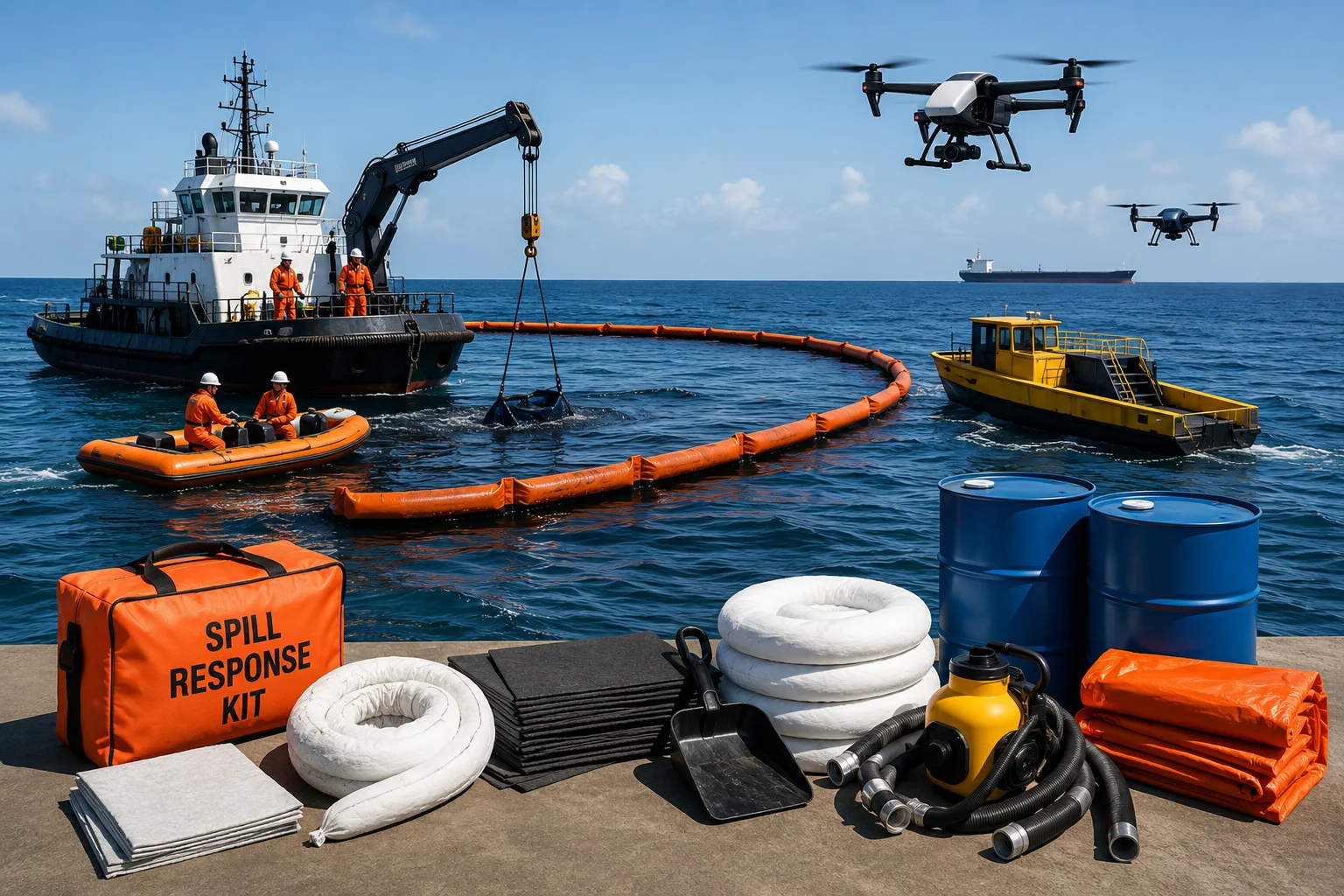
A diesel sheen can spread well beyond the point of release before a crew has finished locating the source. That is why the best marine spill response tools are not selected as isolated products. They are specified as a working system that contains the spill, protects sensitive areas, recovers product, and keeps recovered waste under control.
For ports, terminals, vessel operators, shipyards, and waterfront industrial sites, readiness comes down to matching equipment to the likely spill scenario. Water conditions, oil type, access, current, storage space, and available trained personnel all affect the right response setup. A compact harbor spill requires a different approach from a bunker-fuel release at a berth or a spill moving toward a drain outfall.
What Makes the Best Marine Spill Response Tools Effective?
Speed matters, but equipment suitability matters just as much. A boom that is too light for local current can allow oil to escape underneath. A skimmer with the wrong recovery method can collect excessive water and reduce the efficiency of storage and disposal. Absorbents may be effective for final polishing, yet they should not be the primary containment method for a spreading surface spill.
The most reliable marine response programs use layered control. Containment equipment establishes a boundary. Recovery equipment removes free-floating oil. Absorbents manage residual sheen and protected edges. Temporary storage maintains control of recovered liquids and contaminated materials until authorized disposal can be arranged.
When selecting equipment, operations teams should consider the maximum credible spill volume, typical water movement, berth geometry, vessel traffic, deployment crew size, and where equipment will be stored. Stock availability and delivery speed should also be part of the decision. Emergency equipment that cannot be replenished quickly after use leaves a facility exposed to the next incident.
1. Oil Containment Boom
Containment boom is the foundation of most marine spill response plans. It creates a physical barrier that slows and concentrates floating oil, allowing crews to protect shorelines, vessel hulls, drains, intakes, and other sensitive locations.
For sheltered marinas, calm ports, and inland waterways, lightweight inflatable or foam-filled boom can be practical because it is easier to deploy and store. In exposed water, higher freeboard, deeper draft, and stronger tension members are needed to limit splash-over and underflow. Permanent harbor boom may suit locations with recurring risk, while rapidly deployable boom is better for vessel-side response and temporary protection.
Boom performance depends on correct deployment. It should be placed at an angle to the current where possible, rather than directly across fast-moving water. This guides oil toward a collection area and reduces pressure against the barrier. Teams should also stock connectors, anchor points, reels, repair materials, and towing lines. A boom section without compatible accessories is not a complete response solution.
2. Inflatable and Portable Spill Berms
A marine incident often creates a secondary land-side challenge. Drums, hoses, pumps, recovered waste containers, and contaminated equipment need controlled staging areas at the dock or onboard a support vessel. Portable spill berms provide temporary secondary containment for these activities.
Drive-over foam-wall berms are useful where forklifts or response vehicles need access. Foldable, pop-up, and self-supporting designs are well suited to hose connections, equipment washdown, and short-term storage of leaking containers. The right size should account for the equipment footprint plus enough capacity to retain foreseeable leakage or wash water.
Berms are particularly valuable during transfer operations, where a small hose or coupling failure can reach the water through dock gaps or drainage paths. Positioned before work begins, they offer a simple layer of prevention that reduces cleanup time and potential environmental impact.
3. Marine Oil Skimmers
Once oil is contained, a skimmer removes free product from the water surface. Choosing the right model depends on oil viscosity, expected recovery rate, water conditions, and available pumps and storage capacity.
Weir skimmers are versatile and commonly used for a range of oil types. Their adjustable intake allows floating product to flow over a controlled edge, although they can recover a significant amount of water if not carefully operated. Oleophilic skimmers use materials or surfaces that attract oil and repel water, which can improve selectivity. Drum, brush, disc, and belt skimmers each have applications depending on the oil and operating environment.
For heavy oils, a brush or drum skimmer may provide better pickup than a system designed for lighter fuels. For a thin sheen, skimming may not be economical until boom has concentrated the oil. Procurement should consider the full recovery train: skimmer, hydraulic or power pack, transfer hoses, pump, generator where required, and a compatible storage solution. Recovery capacity is limited by the weakest component in that system.
4. Oil-Only Absorbent Booms and Socks
Oil-only absorbent boom and socks are designed to float and absorb hydrocarbons while repelling water. They are highly useful around vessel hulls, stormwater outfalls, dock edges, and contained spill areas where crews need to capture residual oil after mechanical recovery.
Absorbent booms are not a substitute for containment boom in moving water or large spills. They can become saturated quickly, lose shape, and be difficult to recover if exposed to strong current or wave action. Their strength is precision work: polishing a contained area, protecting a vulnerable drain, or managing small leaks during refueling and maintenance.
Stock multiple diameters and lengths. Smaller socks are easier to place around machinery and in tight spaces, while larger absorbent booms provide greater capacity along the waterline. Response teams should also have bags or overpacks ready for saturated materials, because used absorbents must be contained and disposed of according to local waste requirements.
5. Oil-Only Pads, Rolls, and Pillows
Oil-only pads and rolls give crews the flexibility to respond to drips, splashes, deck contamination, and light sheens near shore. Rolls can be cut to fit irregular spaces, while pads are easy to distribute among response personnel. Pillows are better suited to collecting pooling oil in scuppers, bilges, corners, and other confined areas.
These products are essential in marine spill kits because not every release begins on open water. A leak at a hydraulic fitting, fuel transfer point, or waste oil container can often be controlled before it reaches the harbor. Keeping absorbents close to high-risk work zones supports immediate action without requiring a crew to retrieve supplies from a distant store.
Use oil-only materials for hydrocarbon response on water. General-purpose absorbents may take up water as well as oil, reducing capacity and increasing disposal volume. This distinction affects both response performance and operating cost.
6. Temporary Storage Tanks and Recovery Drums
Recovered oil, oily water, contaminated absorbents, and debris require secure containment after collection. Without sufficient storage, skimming operations can stop even when the crew and equipment are ready to continue.
Collapsible temporary storage tanks are valuable for larger incidents because they provide high capacity while remaining compact in storage. Rigid drums, overpack drums, and intermediate bulk containers can serve smaller responses and support the segregation of different waste streams. For vessel operations, storage equipment must be selected with deck loading, lifting arrangements, access restrictions, and stability in mind.
Compatibility is essential. Storage should be suitable for the expected oil, chemicals, and waste mixture, and it must be positioned within secondary containment where practical. Clearly labeled containers and a documented chain of custody also help teams maintain control during transfer and disposal.
7. Spill Response Kits for Docks and Vessels
A purpose-built marine spill kit puts essential first-response materials in one accessible package. Typical contents include oil-only pads, socks, absorbent boom, disposal bags, protective gloves, goggles, and basic tools. Larger kits may add drain covers, temporary plugs, overpack containers, and more substantial containment materials.
The best kit size depends on risk, not convenience. A small kit may be suitable at a low-volume maintenance point, but it is unlikely to manage a credible fuel release during bunkering. Facilities should place kits where spills are most likely to occur: transfer areas, fuel docks, workshops, loading points, onboard machinery spaces, and near stormwater pathways.
Inspect kits routinely. Missing gloves, depleted pads, damaged packaging, and expired protective equipment can turn a stocked cabinet into a false sense of preparedness. After every use, replenish immediately and record what was consumed. This provides useful data for improving future stock levels.
8. Personal Protective Equipment and Site Control Supplies
Marine response equipment protects the environment, but responders also need protection from splash exposure, vapor hazards, slippery surfaces, and manual handling risks. Chemical-resistant gloves, protective eyewear, suitable footwear, coveralls, and flotation devices should be selected for the substances and working conditions involved.
Site control supplies are equally practical. Safety cones, barrier tape, warning signs, portable lighting, and communication equipment help keep nonessential personnel out of the response area. For night operations or severe weather, lighting and clear coordination can be as important as the absorbents themselves.
A site may also need emergency eyewash capability, decontamination supplies, and fire protection based on the materials being handled. Fuel and solvent spills can create multiple hazards, so response planning should not focus on oil recovery alone.
Build a Response Package Around Real Operating Conditions
The right marine spill equipment package is rarely the largest one. It is the one that a trained team can access quickly, deploy correctly, and replenish without delay. Start with credible spill scenarios, map likely flow paths, and confirm that containment, recovery, storage, absorbents, and PPE work together.
Ocean Safety Supplies supports industrial and marine operators with practical spill-control equipment for routine readiness and emergency response. Review your stock before the next transfer operation, vessel call, or heavy-weather period – the most useful tool is the one already on site when the first drop reaches the water.