

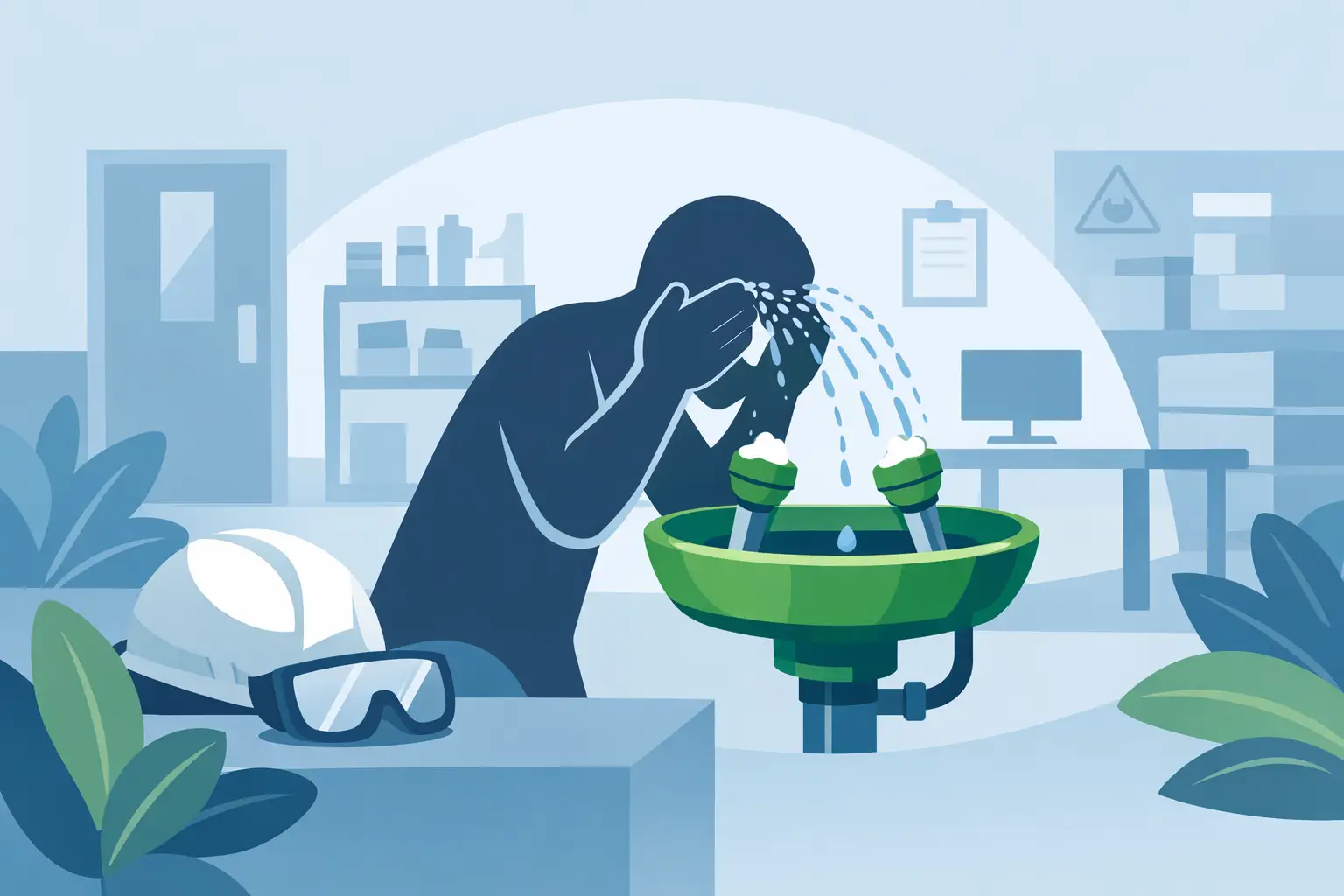
A worker who gets a corrosive splash in the eyes cannot afford to search for emergency equipment, wait for a door to be unlocked, or navigate around stored materials. Knowing where to place eyewash stations is a site-planning decision that directly affects response time, injury severity, and compliance readiness.
For facilities handling chemicals, cleaning agents, fuels, batteries, dusts, or other eye hazards, an eyewash station must be selected and located as part of the overall risk-control plan. The correct location is not simply the nearest open wall. It must be reachable quickly, easy to operate under stress, supplied with suitable flushing water, and kept available every shift.
Place Eyewash Stations Within Immediate Reach of Hazards
The starting point is the hazard assessment. Identify every area where employees could be exposed to materials that may injure or irritate the eyes, including liquid chemicals, corrosives, fine powders, pressurized fluids, metalworking fluids, and airborne particles.
ANSI/ISEA Z358.1 is widely used as the benchmark for emergency eyewash equipment in the United States. Its general expectation is that an eyewash station should be reachable within 10 seconds of the hazard, usually interpreted as roughly 55 feet on an unobstructed path. This is a useful planning rule, but distance alone is not enough.
A 40-foot route that requires opening a heavy door, walking around a production line, crossing forklift traffic, or climbing stairs may not provide a realistic 10-second response. Place the unit on the same level as the hazard and along the normal path of travel. The route should remain clear during routine operations, not only during inspections.
Where workers use highly corrosive chemicals, facilities should consider placing the eyewash even closer than the maximum guidance. Strong acids and alkalis can cause serious damage quickly. In these areas, immediate access matters more than conserving floor space.
Map Placement by Work Area, Not by Building Size
A single centrally located eyewash station is rarely adequate for a large facility. Coverage should follow the locations where exposure can occur. A warehouse may need units near battery charging, chemical decanting, maintenance bays, and cleaning chemical storage, even if those activities take place in the same building.
Chemical Storage and Dispensing Areas
Install eyewash equipment near chemical transfer points, drum pumps, mixing stations, washdown areas, and locations where containers are opened or repackaged. The highest risk often occurs during manual handling rather than while chemicals are in closed storage.
Do not place the unit inside a chemical storage cabinet, behind a locked cage, or within an area that could become inaccessible after a spill. The employee must be able to reach it without first retrieving a key, moving containers, or entering the release area.
Laboratories, Quality-Control Rooms, and Workshops
Laboratories require close eyewash coverage near benches where reagents are used. In machine shops and maintenance workshops, assess exposure from coolants, degreasers, compressed air, grinding dust, welding residues, and battery electrolyte.
A plumbed eyewash may be the most dependable solution for a fixed laboratory or workshop because it supports extended flushing. However, a self-contained unit can be appropriate where plumbing is unavailable, provided it is maintained correctly and delivers the required flushing performance.
Battery Charging and Electrical Service Areas
Lead-acid battery charging presents a clear electrolyte splash risk. Eyewash equipment should be positioned outside the immediate charging zone but close enough for prompt use. Keep it clear of chargers, cables, battery racks, and vehicle movement.
For lithium-ion battery work, the hazards vary by process. Evaluate electrolyte exposure, damaged battery handling, thermal events, and the cleaning materials used by the team. Equipment placement should reflect the actual work being performed, not just the type of battery stored.
Manufacturing Lines and Washdown Stations
Production lines can create multiple localized hazards. If operators handle chemicals at several points along a line, one station at the line entrance may leave workers too far from assistance. Consider separate units or strategically placed combination shower and eyewash stations for each risk zone.
Washdown stations also need careful planning. Water, hoses, pallets, and floor drains can turn the route into a slip or trip hazard. Position the eyewash where it remains accessible without sending an injured worker through the wettest part of the area.
Keep the Path Unobstructed at All Times
Emergency equipment loses value when it becomes part of the storage plan. A station may be correctly installed on day one and gradually blocked by cartons, spill pallets, waste bins, racking, or temporary work materials.
Mark the approach area clearly and establish it as a no-storage zone. High-visibility signage helps workers identify the equipment quickly, while floor markings can reinforce the clearance requirement in busy industrial spaces. Good lighting is equally practical, particularly in warehouses operating extended shifts or outdoor work areas.
Avoid placing eyewash stations where forklift routes, swinging doors, mobile equipment, or stacked inventory can restrict access. If traffic cannot be avoided, provide physical protection for the unit without creating a barrier for the user. Bollards, for example, may protect plumbing and equipment in a vehicle area but must be positioned so the activation zone remains open.
Choose the Right Equipment for the Location
Placement and equipment type must work together. A plumbed eyewash station is generally suited to permanent hazard areas with a reliable potable water supply. It offers consistent availability but requires proper installation, drainage planning, testing, and temperature management.
Self-contained eyewash stations provide flexibility for remote work areas, temporary projects, warehouses, and sites without nearby plumbing. Their trade-off is maintenance. The fluid must be changed according to the manufacturer’s instructions, and the unit needs routine checks to confirm it is ready for immediate use.
Portable personal eyewash bottles can support first response, but they are not a replacement for an emergency eyewash station where a compliant flushing unit is required. Their capacity is limited, and they do not provide the sustained flow needed for serious exposures.
Where there is a risk of exposure to both the face and eyes, an eye/face wash unit may be more appropriate than an eyewash-only station. For hazards involving substantial body exposure, use a combination emergency shower and eyewash station. The safety data sheet for each chemical, along with your task-specific risk assessment, should guide this decision.
Provide Tepid Water and Suitable Drainage
Workers may need to flush their eyes for 15 minutes or longer after an exposure. Water that is too cold can discourage a person from continuing, while water that is too hot can worsen an injury. Emergency equipment should deliver tepid flushing fluid within the temperature range required by the applicable standard, local code, and manufacturer guidance.
This is particularly relevant in unconditioned warehouses, outdoor areas, and facilities in regions with temperature extremes. A unit installed near a hot process line, or a portable station left in direct sun, may not be usable when needed. Conversely, freezing conditions can damage plumbing and stop water flow entirely.
Drainage also deserves attention. A floor drain can help manage runoff from testing and emergency use, but facilities must consider whether contaminated water can enter the drainage system. Review chemical hazards, environmental procedures, and local discharge requirements before finalizing the location.
Test Locations Under Real Operating Conditions
A drawing review is useful, but a practical walk test exposes problems that plans can miss. Ask a worker to stand at the farthest likely point of exposure and move to the proposed station. Check the route during a normal shift, with doors closed, equipment operating, and typical inventory in place.
During the test, confirm that the station is visible, immediately operable, and not dependent on someone else for access. Consider whether a worker with impaired vision could find it by following signs and whether a supervisor could reach the area quickly to provide assistance.
Review the placement whenever processes change. New chemicals, relocated machinery, added racking, construction barriers, and revised traffic patterns can all make a formerly suitable eyewash station inadequate. Include emergency equipment access in monthly safety inspections and after any spill, near miss, or injury investigation.
A Practical Placement Checklist
Before approving an eyewash station location, verify these operational points:
- It is within approximately 10 seconds of the identified eye hazard, with a direct, unobstructed route.
- It is on the same level as the hazard and does not require stairs, a lift, or access through a locked door.
- It remains outside the likely spill or fire-affected area while still being close enough for immediate use.
- It is clearly signed, well lit, protected from vehicle damage, and kept free from stored materials.
- Its water supply, fluid condition, temperature, drainage, testing schedule, and maintenance plan support reliable use.
The best eyewash station location is the one a worker can reach and activate without hesitation when seconds matter. Build that access into your facility layout early, protect it through routine housekeeping, and reassess it whenever the work changes.