

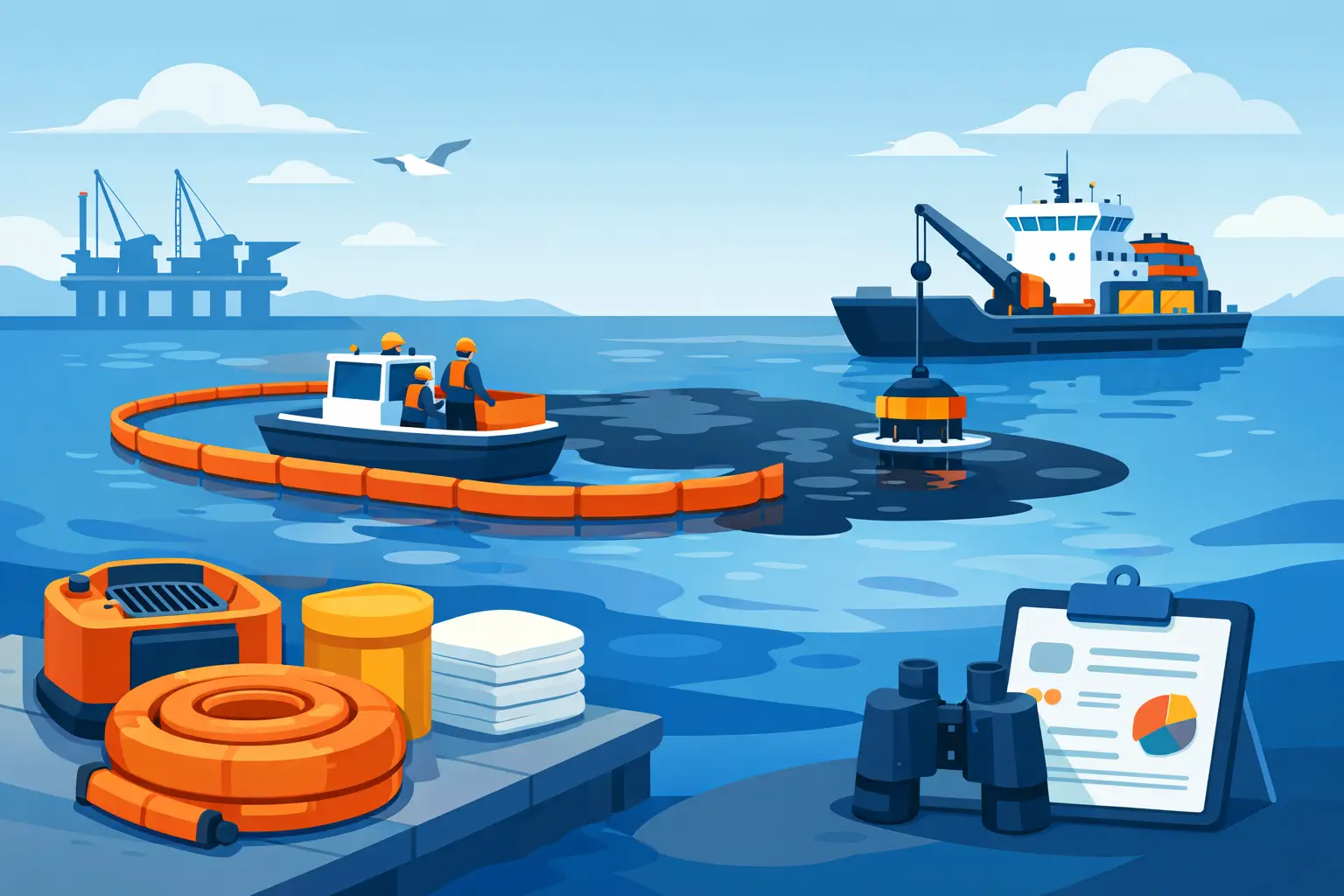
A fuel sheen beside a berth can become a larger containment problem within minutes. Tidal movement, wind, vessel traffic, and limited access to the waterline all affect how quickly oil spreads and how difficult recovery becomes. This marine spill response equipment guide helps procurement teams, marine operators, and EHS managers specify equipment that can be deployed quickly and perform under actual site conditions.
The right response package is not simply the largest boom or the highest-capacity skimmer. It is a coordinated system that matches the likely spill type, water conditions, available manpower, storage constraints, and response plan. Equipment must be accessible when needed, not stored in a location that delays deployment or leaves critical components exposed to damage.
Start With the Spill Scenario
Before selecting products, define where a spill is most likely to occur and what could be released. A marina fueling area, cargo terminal, shipyard, offshore support vessel, and industrial waterfront each require different priorities. Diesel and marine gas oil can spread rapidly but are generally easier to recover than heavy fuel oil. Hydraulic fluid, lubricants, and some chemicals may require specific absorbents and disposal procedures.
Consider the water environment as closely as the product itself. Sheltered harbors and calm inland waters allow for lighter containment systems and straightforward anchoring. Exposed coastlines, strong currents, wake zones, and tidal channels place much greater load on boom sections, connectors, anchors, and towing arrangements. A boom that works well around a dock may not hold its position in an open-water response.
Your plan should also identify who will deploy the equipment. A compact kit may be appropriate where two trained personnel need to act immediately. Larger incidents may require a staged response with vessels, towing gear, temporary storage, and specialist recovery equipment. Buying for the likely first hour of an incident is usually more practical than trying to stock every possible contingency at one location.
Marine Spill Response Equipment Guide: Core Categories
A capable marine response inventory normally combines containment, recovery, absorption, transfer, and temporary storage. These categories work together. Containment without recovery only delays the spread, while absorbents alone can be overwhelmed by an uncontained slick.
Containment booms
Oil containment boom is the first line of defense for many on-water spills. It creates a barrier that directs oil away from sensitive areas, surrounds a vessel, or concentrates the slick for recovery. Common options include foam-filled boom, inflatable boom, curtain boom, and fence boom.
Foam-filled boom is a practical choice for ports, marinas, and industrial waterfronts because it is ready for rapid deployment and does not depend on inflation equipment. Inflatable boom can provide efficient storage and strong freeboard when properly deployed, but it requires pumps, hoses, and trained operators. Curtain boom generally offers better performance where water movement is moderate, while fence boom can be easier to handle in calmer conditions.
Specify the boom length based on realistic deployment routes, not just the size of the vessel or berth. Allow for overlap, anchoring points, tidal movement, and the need to form a recovery pocket. Check connector compatibility, ballast chain condition, reel or storage requirements, and the availability of anchors, lines, and towing bridles. These supporting items are often what determine whether the boom can be used quickly.
Skimmers and recovery systems
Once oil is contained, a skimmer removes it from the water surface. The best choice depends on oil viscosity, debris levels, access, and the required recovery rate. Weir skimmers are commonly used for a range of oils and can achieve low water pickup when correctly adjusted. Oleophilic drum, brush, or disc skimmers attract oil while rejecting much of the water, making them useful for thinner sheens and certain operational settings.
Higher stated recovery capacity is not always the deciding factor. A skimmer must be matched with sufficient pump capacity, hoses, power supply, and temporary storage. If recovered liquid has nowhere to go, recovery stops. For smaller harbor incidents, a portable skimmer with a compatible transfer pump and hose set may provide a more usable solution than a large system that needs specialized handling equipment.
Oil absorbents
Marine-grade absorbents provide fast control at the edge of a spill, around drains and shoreline structures, or in areas where a skimmer cannot operate effectively. Oil-only pads, rolls, pillows, and socks repel water while absorbing petroleum-based fluids. They are especially useful for polishing residual oil after bulk recovery.
Sorbent boom can supplement primary containment boom in calm water or protect localized areas such as quay walls and vessel hulls. It should not be treated as a substitute for a properly specified containment boom in moving water. Its role is absorption, not heavy-duty control of a spreading slick.
Procurement teams should consider packaging and access. Pads and socks stored in sealed, clearly marked marine spill kits can be issued immediately to dock crews. Loose absorbents stored far from likely release points create unnecessary response time. Plan for used-sorbent bags, compatible waste containers, and approved disposal arrangements as part of the same purchase decision.
Pumps, hoses, and temporary storage
Recovered oil, oily water, and contaminated debris must be transferred and held safely. Diaphragm pumps, trash pumps, transfer hoses, camlock fittings, and suction strainers should be compatible with the expected fluids and the response equipment already on site. A pump that cannot handle viscous oil or a hose that does not fit the skimmer connection creates an avoidable failure point.
Temporary storage may include portable tanks, flexible bladders, overpack drums, or secondary containment systems. Selection depends on anticipated volume, space on the vessel or dock, lifting capability, and waste contractor requirements. Flexible tanks are space-efficient when empty, but they need a protected, level location and personnel who understand setup limits. Drums are familiar and easy to segregate, though they become inefficient for larger recovery volumes.
Personal protection and response support
Marine spill response exposes personnel to slippery surfaces, moving vessels, fumes, contaminated water, and manual-handling risks. Equipment packages should include the appropriate gloves, protective footwear, eye protection, coveralls, and flotation equipment for the operating environment. If there is a credible risk of chemical exposure beyond petroleum products, review the safety data information and select PPE accordingly.
Operational support items matter too: spill response bags, caution tape, handheld lights, communication equipment, shovels, scrapers, recovery nets, and waste labels can make a response more controlled. These are modest-cost items, yet they reduce confusion when teams are working under time pressure.
Specify for Deployment, Not Catalog Appearance
A practical purchasing review should test whether the selected equipment can be deployed in the first 15 to 30 minutes. Ask where it will be stored, who has access, how it reaches the waterfront, and whether it can be moved without a forklift or crane. Confirm that boom sections connect to each other, pumps connect to skimmers, and hose fittings match the transfer and storage setup.
Training and inspection are equally necessary. Boom fabric, connectors, valves, inflation equipment, pumps, and absorbents should be checked on a scheduled basis. A response drill may reveal that storage racks are blocked, batteries are flat, anchors are missing, or a team lacks a safe launch method. These findings are far less costly during a drill than during an actual release.
For operations with multiple berths or facilities, standardizing key connections and equipment types can simplify training and replacement purchasing. It also allows teams to share inventory during an emergency. Standardization should not mean using one boom or skimmer for every condition. Keep the core system consistent, then add specialized equipment where the site risk requires it.
Build a Scalable Response Package
Most organizations benefit from a tiered inventory. The immediate-response level should be positioned at the point of risk and include absorbents, small containment resources, PPE, and waste-control supplies. A larger site-level package can include additional boom, skimmers, pumps, hoses, and temporary storage. For major incidents, pre-arranged external response support may be more appropriate than holding rarely used high-capacity equipment.
Ocean Safety Supplies supports marine operators with practical spill-control equipment across containment, recovery, absorbents, and emergency readiness. The value of a single-source supply approach is not only purchasing convenience. It helps teams align compatible products, maintain replacement stock, and reduce the delay caused by sourcing critical components from multiple vendors during an incident.
The best time to test marine spill equipment is when the water is calm, the berth is clear, and the team has time to learn. Stock equipment that fits your actual risks, keep it accessible, and make every component part of a deployment-ready system.