

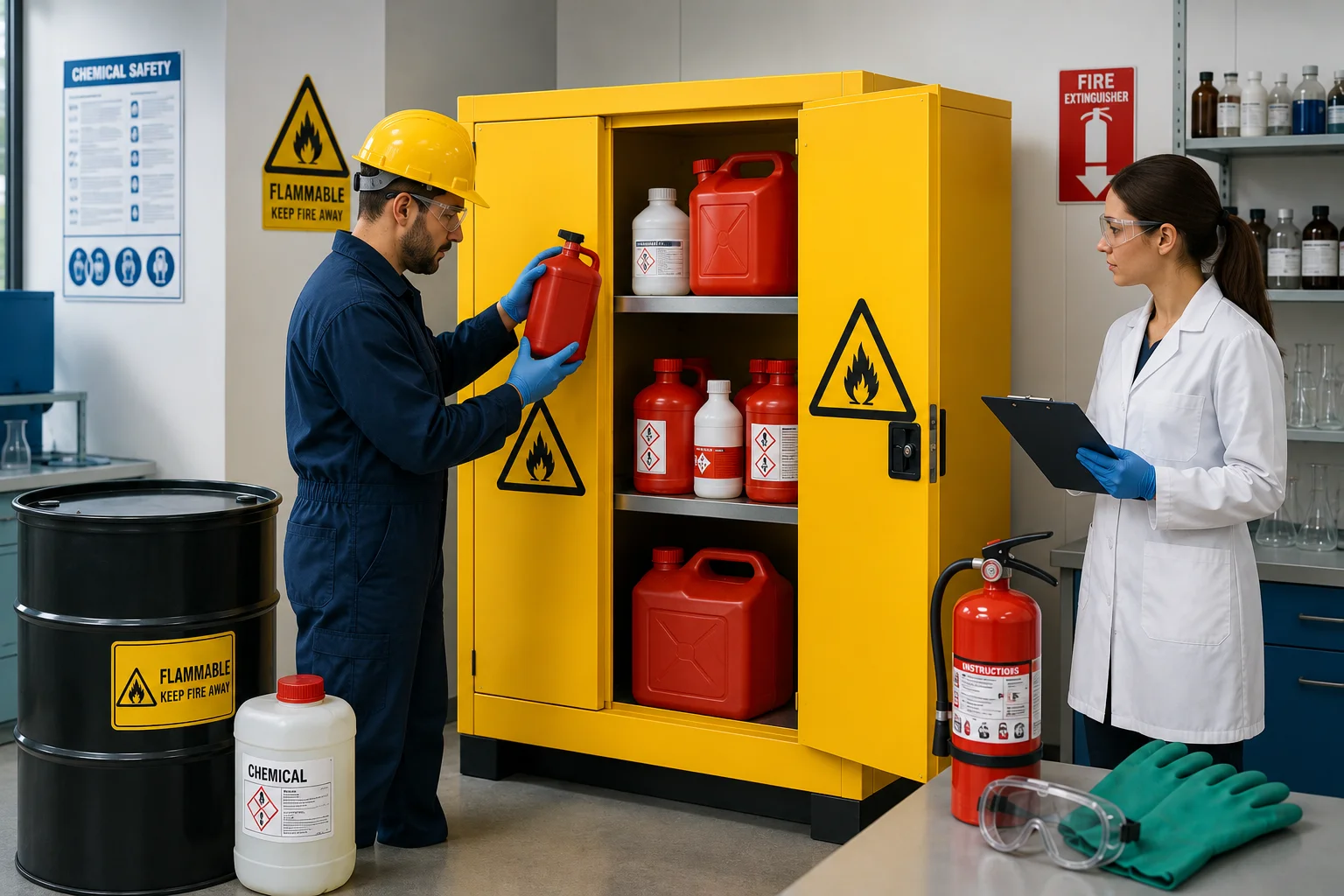
A few gallons of solvent stored beside a workbench can turn a small ignition source into a serious facility emergency. That is the practical answer to why use flammable safety cabinets: they put a controlled barrier between ignitable liquids, the people working nearby, and the conditions that allow a fire to spread.
For warehouses, workshops, laboratories, maintenance areas, manufacturing plants, and marine operations, flammable liquid storage is not simply a housekeeping issue. It affects fire exposure, spill response, inspection readiness, and the continuity of daily operations. A properly selected cabinet gives teams a designated, secure location for commonly used flammable liquids without treating storage as an afterthought.
Why Use Flammable Safety Cabinets?
Flammable safety cabinets are designed to store containers of flammable and combustible liquids in a way that limits their exposure to external heat and helps contain leaks. Their double-wall steel construction, insulated air space, self-closing or manual-close door options, secure latching, and leak-tight sump all serve a practical purpose: buying time and reducing the chance that a local incident becomes a larger event.
The cabinet does not make hazardous liquids harmless, and it is not a substitute for good handling practices. Workers still need correct labeling, compatible containers, ventilation where required, ignition control, and access to suitable spill response equipment. What the cabinet does is create a stronger first line of defense when those liquids are not in use.
This matters especially where solvents, fuels, thinners, paints, adhesives, alcohols, or cleaning chemicals are used repeatedly throughout a shift. Leaving these products on open shelving, under benches, or in general-purpose cupboards exposes them to accidental impact, unauthorized access, and nearby heat or sparks. A purpose-built cabinet establishes a clear storage point that is easier to control and inspect.
Reduce Fire Exposure Around Daily Operations
Flammable liquids can release vapors that travel beyond the immediate container. In a busy work area, ignition sources may include electrical equipment, hot work, static discharge, vehicle engines, battery charging, heaters, and even routine maintenance activities. A safety cabinet helps isolate stored liquids from these conditions when they are not actively being used.
The fire protection value is not only about the cabinet itself. It is also about reducing clutter and creating separation. When flammable containers have a fixed home, supervisors can keep storage away from exits, walkways, emergency equipment, and incompatible materials. That makes the space safer before an incident occurs.
Cabinets also support better control of container quantities at the point of use. Rather than allowing a work area to accumulate half-used cans and bottles, teams can return them to secured storage at the end of a task or shift. This reduces exposed inventory and makes it easier to identify when stock levels are excessive.
Contain Small Leaks Before They Become Spill Events
Drips, damaged caps, and poorly sealed containers are common sources of small chemical spills. Without secondary containment, a minor leak can spread across a floor, enter a drain, contaminate stored goods, or create a slip and vapor hazard.
Flammable safety cabinets typically include a built-in bottom sump to retain leaks from containers stored inside. This gives the facility time to identify the issue and respond with the right absorbents, disposal containers, and personal protective equipment. It also prevents a leak from becoming invisible until it has already migrated beyond the storage area.
The sump is not a reason to ignore inspection. Cabinet interiors should be checked regularly for corrosion, pooled liquid, damaged shelving, and deteriorated labels. Spill kits should be positioned close enough for a fast response but not so close that they become inaccessible during a fire or chemical release.
For sites handling larger drums or bulk containers, a flammable cabinet may not be the appropriate primary solution. Those applications often require dedicated chemical stores, safety cans, drum storage systems, or larger secondary containment arrangements. Cabinet capacity and the quantity limits applicable to the facility should guide the decision.
Improve Organization, Accountability, and Inspection Readiness
A cabinet turns scattered containers into a managed chemical storage area. That sounds simple, but it makes a meaningful difference to facility management. Operators can see what is on hand, remove expired or unknown products, and avoid duplicate purchasing caused by poor visibility.
A well-managed cabinet should contain only the materials it is intended to store. Do not use it as a general storage locker for rags, tools, cardboard, aerosols of unknown classification, or unrelated maintenance supplies. Keep safety data sheets accessible through the site’s established system, and ensure every container is labeled with its identity and applicable hazard information.
During internal audits or external inspections, designated storage shows that the facility has considered chemical hazards as part of routine operations. Inspectors and EHS teams can quickly verify that containers are closed, segregated appropriately, within capacity, and protected from obvious physical damage.
Compliance requirements vary by jurisdiction, building occupancy, industry, and the type and volume of liquids stored. A cabinet should be selected and installed in line with applicable fire codes, workplace safety requirements, and the manufacturer’s instructions. Procurement teams should avoid assuming that one cabinet type suits every chemical or every location.
Choosing the Right Cabinet for the Job
The best cabinet is not necessarily the largest one. It needs to match the liquid classification, container sizes, available floor space, and working patterns of the area. A small countertop unit may suit a laboratory bench with limited quantities, while a larger floor-standing cabinet may be more appropriate for a maintenance workshop or production department.
Capacity is the first consideration, but it should not be the only one. Check shelf load ratings, sump capacity, door configuration, locking needs, and whether a manual-close or self-closing door design is required for your operation. Self-closing doors can be useful where personnel may forget to shut the cabinet after removing materials, while manual-close models may suit controlled areas with established procedures. Local requirements and site policy should determine the final choice.
Vent connections are another area where assumptions can create problems. Some cabinets include vent bungs, but venting is not automatically required or beneficial in every installation. Improper venting can compromise the cabinet’s intended performance or create a route for vapors to travel. Confirm the approach with the relevant safety authority, facility engineer, or qualified EHS professional before connecting a cabinet to an exhaust system.
Placement matters as much as product selection. Position the cabinet on a stable, level surface in an area that remains accessible for authorized users but is away from direct heat, ignition hazards, and emergency exit paths. Where site rules require it, anchor the cabinet to prevent movement or tipping. Leave enough clearance for doors to open fully and for staff to retrieve containers without creating an obstruction.
Make the Cabinet Part of a Complete Safety System
Flammable storage works best when it is linked to everyday controls. Train staff on what belongs inside the cabinet, how to close containers properly, and what to do if they find a leak. Include cabinet checks in housekeeping and inspection routines. Keep suitable absorbents, waste containers, and fire response measures available according to the hazards present and site emergency procedures.
It is equally important to manage chemical compatibility. A cabinet intended for flammable liquids should not become a mixed-chemical storage point simply because there is spare shelf space. Oxidizers, corrosives, toxics, and reactive chemicals may need separate storage arrangements. When in doubt, review the safety data sheet and consult the person responsible for chemical safety at the site.
For procurement and operations teams, stocked, industrial-grade flammable safety cabinets provide a practical way to standardize storage across multiple work areas. Ocean Safety Supplies can support this process with cabinet options alongside spill control, secondary containment, and emergency response equipment, helping sites build a more complete readiness plan.
The most useful cabinet is one that fits the actual work being done, is easy for staff to use correctly, and is supported by regular inspection. Put storage controls in place before the next delivery of solvent, fuel, or paint arrives – not after a leak, near miss, or inspection exposes the gap.