

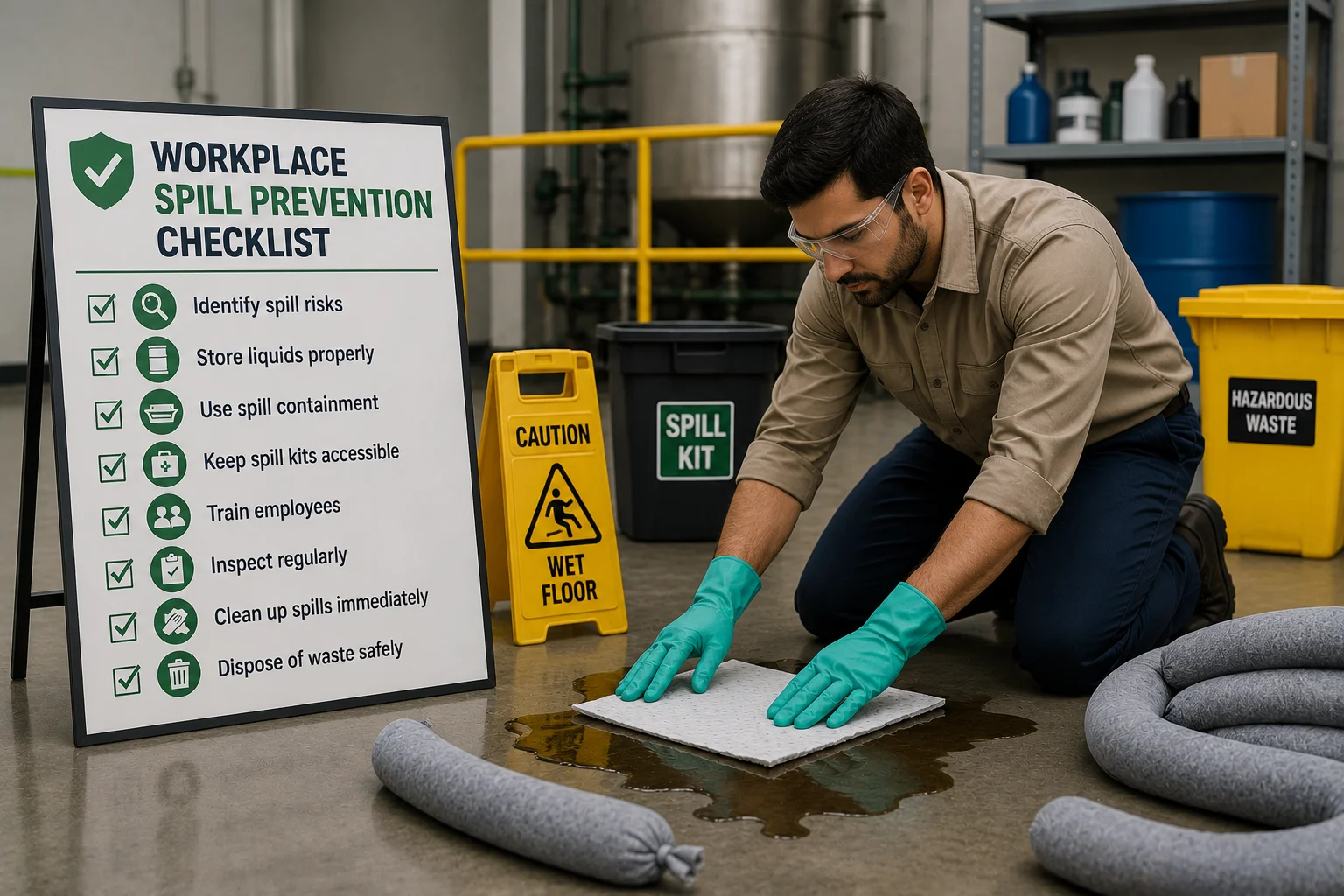
A small leak at a drum station can become a costly cleanup when it reaches a floor drain, loading bay, or neighboring work area. A workplace spill prevention checklist gives supervisors and EHS teams a practical way to identify weak points before a release affects people, production, or the environment. The goal is not simply to keep absorbents on hand. It is to control liquids at the source, provide the right containment, and ensure staff can respond without delay.
For warehouses, workshops, laboratories, manufacturing plants, construction sites, and marine operations, prevention starts with routine checks that match the materials and activities on site. The following checklist is designed for operational use and can be adapted by area, shift, or risk level.
Start With a Clear Spill Risk Assessment
Before selecting spill control equipment, identify what could spill, where it is stored, and where it is moved. Record the type of liquid, expected volume, container sizes, frequency of handling, and nearby pathways such as drains, doorways, channels, and watercourses.
Not all liquids require the same response. Oil, fuel, solvents, corrosives, coolants, and general-purpose industrial liquids have different compatibility requirements. A universal absorbent may be suitable for routine oils and water-based fluids, while aggressive chemicals require chemical-rated absorbents and compatible containment. For marine or waterside locations, oil-only absorbents, booms, and drain protection may be the appropriate control.
Review high-risk activities as part of the assessment. Common examples include decanting from drums, refueling equipment, transferring chemicals from intermediate bulk containers, changing hydraulic lines, and unloading deliveries. These are the points where a minor handling error is most likely to create a release.
Workplace Spill Prevention Checklist for Storage Areas
Storage controls should prevent a container failure from becoming a site-wide incident. Inspect storage areas regularly, particularly after deliveries, maintenance activity, or severe weather where outdoor storage is used.
- Check that drums, pails, jerry cans, and chemical containers are clearly labeled, sealed, and free from dents, corrosion, cracks, or bulging.
- Confirm that containers are stored upright with lids, bungs, and valves secured when not in use.
- Verify that incompatible materials are separated. Acids, bases, oxidizers, flammables, and reactive products should not share containment unless the arrangement has been assessed for compatibility.
- Make sure secondary containment pallets, spill decks, bunds, and trays have sufficient capacity for the stored volume and remain free of rainwater, debris, and accumulated product.
- Keep flammable liquids in approved flammable storage cabinets where required, away from ignition sources and busy traffic routes.
- Ensure aisles remain clear so operators can inspect containers and access spill response equipment quickly.
Secondary containment is one of the most reliable controls for routine storage. However, it must be sized for the actual risk. A small drip tray may be enough beneath a dispensing point, but it will not contain a failed 55-gallon drum. Match the sump capacity, material construction, and load rating to the containers and chemicals in use.
Control Spills During Transfers and Dispensing
Many spills occur while product is being moved rather than stored. Transfer points need physical controls as well as a disciplined work process. Position drums and containers on bunded platforms or spill pallets before dispensing. Use compatible pumps, funnels, hoses, and taps rather than improvised equipment.
Inspect hoses, couplings, valves, and pump fittings before each use. A loose connection can release liquid quickly, especially during powered pumping or bulk transfer. Where practical, use shutoff valves, drip trays, splash guards, and overfill protection. Do not leave a transfer unattended, even when the expected volume is small.
For outdoor operations, check the condition of nearby drains before work begins. Drain covers, drain seals, and absorbent barriers should be immediately available where a spill could enter stormwater systems. In areas with frequent loading, refueling, or maintenance, permanent drainage controls may be more effective than relying solely on emergency response.
The trade-off is straightforward: permanent controls require planning and investment, while portable containment offers flexibility for changing work areas. Sites with recurring transfer activity generally benefit from both – fixed controls for known risks and portable bunds for temporary jobs.
Keep Spill Kits Ready, Visible, and Matched to the Hazard
A spill kit is only useful when it is close to the risk, complete, and appropriate for the liquid involved. Place kits at chemical stores, maintenance areas, loading bays, generator rooms, workshops, laboratories, and vehicle or marine response locations. Do not assume one centrally located kit can support a large facility or a time-critical outdoor release.
Each kit should contain enough absorbent capacity for the credible spill size in that area, along with disposal bags, ties, gloves, protective equipment, and clear response instructions. Oil-only spill kits are suitable for hydrocarbons and can repel water, making them useful for outdoor and marine environments. Chemical spill kits are designed for hazardous liquids and should be selected based on the chemicals handled. General-purpose kits can support lower-risk maintenance and warehouse applications where a variety of non-aggressive fluids may be released.
Inspect kits on a scheduled basis. Replace used absorbents immediately, check that bags and gloves have not deteriorated, and confirm that the kit is not blocked by pallets, cartons, or equipment. A missing drain cover or empty disposal bag can slow the response at the moment containment matters most.
Protect Drains, Doors, and Environmental Pathways
The direction of a spill matters as much as the volume. Walk the site and identify where liquids will travel if they escape a storage or work area. Sloped floors, open roller doors, trench drains, stormwater inlets, and waterfront edges can turn a manageable incident into an environmental release.
Keep drain protection equipment near identified pathways. Depending on the site, this may include reusable drain covers, polyurethane drain seals, absorbent socks, spill berms, or portable containment pools. For larger outdoor risks, consider whether oil booms, silt barriers, or specialist marine response equipment should be part of the emergency plan.
Do not rely on absorbent pads alone to stop a spreading liquid. Pads are effective for recovery, but socks, booms, and barriers are often needed first to contain and direct the flow. The response sequence should be clear: stop the source when safe, protect drains and waterways, contain the liquid, recover it with suitable absorbents, and package waste for approved disposal.
Train Teams for Fast, Safe Action
Equipment cannot replace trained people. Staff who handle liquids should know the location of spill kits, the basic hazards of the products they use, and the site escalation procedure. They should also understand when not to intervene. A significant chemical release, unknown substance, fire risk, or exposure risk may require evacuation and specialist support rather than a routine cleanup.
Short, practical drills are more useful than policy documents that remain unread. Run drills around realistic scenarios such as a leaking drum, overturned pail, damaged hose, or fuel spill near a drain. Time how quickly the team can locate the right kit, protect the pathway, and report the incident. The results often reveal simple gaps: equipment stored too far away, unclear responsibilities, or insufficient absorbent capacity.
Supervisors should also reinforce basic housekeeping. Wiping up small drips, reporting damaged containers, and removing clutter from storage areas are everyday actions that reduce the chance of larger events.
Inspect, Record, and Improve
Use the checklist as a living operational document, not a one-time audit. High-traffic areas may need daily visual checks, while lower-risk storage zones may be reviewed weekly or monthly. After any spill, near miss, or damaged-container report, inspect the area again and determine whether the existing controls were adequate.
Look for repeat causes. If the same drum valve leaks regularly, replace the valve or change the dispensing arrangement. If spill kits are repeatedly used at a particular workstation, consider adding local containment or increasing the kit capacity. If rainwater is filling outdoor bunds, improve covers, drainage procedures, or inspection frequency.
Ocean Safety Supplies supports organizations that need practical spill readiness across routine industrial operations and specialized environmental response. Selecting the correct absorbents, spill kits, containment pallets, drain protection, and emergency equipment is easier when the choice is based on real site conditions rather than a generic inventory list.
A well-maintained checklist creates value before an incident occurs. When the right controls are in place, employees spend less time reacting to preventable leaks and more time keeping the operation safe, compliant, and moving.