

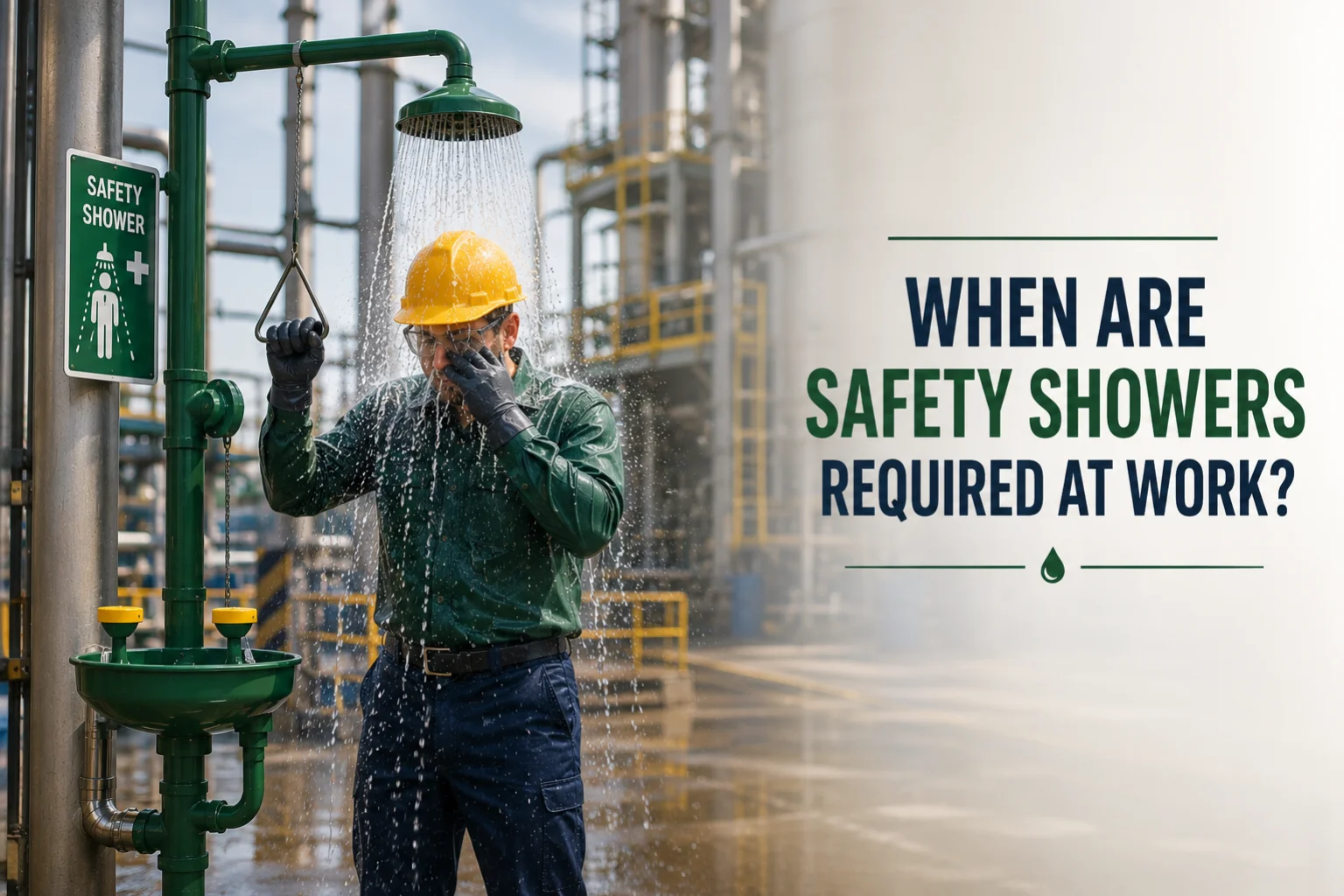
A chemical splash does not give your team time to look up a standard. If corrosives, strong irritants, or hazardous materials are handled on site, the real question is not whether an emergency shower would be useful. It is when are safety showers required, and whether your facility has them in the right place, with the right performance, before an incident happens.
For EHS managers, maintenance teams, and procurement buyers, this is a practical compliance issue tied directly to response time, injury severity, and site readiness. The answer depends on the hazards present, how those materials are used, and whether a worker could need immediate whole-body drenching after exposure.
When are safety showers required?
Safety showers are required where employees may be exposed to corrosive materials or other injurious substances that can damage the skin, eyes, or body and where immediate flushing is necessary. In the U.S., OSHA refers employers to suitable facilities for quick drenching or flushing within the work area for immediate emergency use. In practice, ANSI guidance is commonly used to determine what suitable means in terms of location, flow, activation, and maintenance.
That means a safety shower is typically required in places such as chemical process areas, battery charging rooms, laboratories, manufacturing lines using caustics or acids, bulk chemical storage and transfer points, wastewater treatment areas, and maintenance zones where hazardous liquids are dispensed or mixed. If the risk is limited to the eyes, an eyewash station may be enough. If the risk includes splashing to the face, torso, clothing, or a larger part of the body, a drench shower or combination unit is usually the better fit.
The key point is that requirement is driven by exposure risk, not by industry label alone. Two facilities in the same sector may need different emergency equipment based on the chemicals used and the task being performed.
The standard behind the decision
OSHA’s general industry rule states that where the eyes or body of any person may be exposed to injurious corrosive materials, suitable facilities for quick drenching or flushing must be provided within the work area for immediate emergency use. OSHA does not spell out every design detail in that sentence, which is why ANSI Z358.1 is widely used as the recognized benchmark for emergency eyewash and shower equipment.
For most buyers and site managers, this matters because compliance is rarely judged on presence alone. A shower installed too far away, blocked by pallets, or fed with inadequate water pressure may not meet the practical intent of the requirement. A unit has to be reachable fast, operate reliably, and deliver enough flushing to reduce injury.
ANSI guidance generally points to emergency equipment being accessible within 10 seconds of the hazard, on the same level, and along an unobstructed path. That 10-second rule is one of the most useful screening tools during a site walk. If an exposed worker would need to open a door, move around stored stock, or cross into another room to reach the shower, your layout likely needs attention.
When a shower is required instead of eyewash only
This is where many facilities under-spec equipment. An eyewash station is designed for localized exposure to the eyes. It does not replace a shower where larger body exposure is possible.
A safety shower is generally required when the hazard involves a reasonable chance of chemicals contacting the skin, soaking clothing, or splashing across a broad area of the body. That includes drum filling, IBC decanting, acid dosing, chemical mixing, washdown with aggressive cleaners, and operations where pressurized lines or hoses could fail.
Combination shower and eyewash units are often the safest choice when both eye and body exposure are possible. For many industrial settings, this avoids the common gap where an eyewash is installed because it is smaller and cheaper, even though the actual task creates a splash risk to the whole worker.
There is a trade-off here. Not every hazardous substance needs a full drench shower, and over-installing equipment without matching the actual risk can create unnecessary cost and maintenance. But under-protecting high-risk work areas is the more serious mistake, especially where corrosives are handled in volume.
Hazard types that usually trigger the need
Corrosives are the clearest trigger. Strong acids and alkalis can cause rapid tissue damage, so immediate flushing is essential. Sulfuric acid, hydrochloric acid, sodium hydroxide, and similar materials are classic examples.
Other substances may also justify a safety shower depending on concentration, temperature, and exposure route. Solvents, oxidizers, irritating cleaning chemicals, formaldehyde solutions, and certain process chemicals can warrant drenching capability if they can contact the body and cause significant harm. Hot liquids, steam condensate with chemical content, and contaminated rinse streams may also need assessment.
The safest way to make the call is to review each chemical’s Safety Data Sheet together with the task. If first-aid measures specify immediate flushing for skin or body exposure, that is a strong sign emergency shower provision should be considered. The SDS alone is not the whole answer, but it is a key input.
A simple risk-based test for buyers and site managers
If you are deciding whether to specify a safety shower, ask four practical questions.
First, could a worker be exposed to a corrosive or injurious substance on the body, not just in the eyes? Second, would immediate flushing materially reduce the severity of injury? Third, can the worker reach suitable equipment within about 10 seconds without obstruction? Fourth, is the task routine enough, or the chemical severe enough, that relying on improvised response would be unacceptable?
If the answer to those questions is yes, a safety shower is likely required or strongly recommended.
This approach is especially useful for warehouses, workshops, utility plants, and mixed-use industrial sites where hazards are spread across different rooms. It helps procurement teams avoid buying from a checklist alone and instead match equipment to real operational risk.
Placement, performance, and real-world compliance
Installing a shower somewhere in the building is not the same as being prepared. The unit has to be near the hazard, easy to identify, and immediately usable by an injured person who may have limited vision or mobility.
In practical terms, that means clear access, good signage, visible location marking, and reliable water supply. Tepid flushing fluid is also part of effective emergency response because water that is too cold or too hot can reduce the injured worker’s ability to complete the full flush duration.
Testing and inspection matter just as much. A neglected shower may fail at the moment it is needed, which creates both safety and liability problems. Routine activation checks, documented inspections, and preventive maintenance should be part of the site’s standard operating discipline.
Portable or self-contained units may be appropriate where plumbed supply is not available, such as temporary work zones, remote yards, or construction environments. That said, portable units are not a shortcut. They still need to meet the use case, capacity, and maintenance demands of the hazard.
Common situations where facilities get it wrong
One common issue is assuming PPE removes the need for emergency equipment. Gloves, aprons, goggles, and face shields reduce exposure risk, but they do not eliminate the requirement where a significant splash hazard remains. Emergency showers are a backup control, not a replacement for PPE and not made unnecessary by PPE.
Another issue is treating all chemicals the same. A mild detergent in closed handling is different from concentrated caustic in open transfer. The shower requirement depends on severity and exposure potential, not just whether a material is technically chemical.
A third problem is poor site changes over time. A compliant layout can become noncompliant when storage racks move, production lines expand, or a new chemical is introduced. Emergency equipment needs review whenever operations change.
What procurement teams should verify before purchase
For buyers, the right question is not just whether a unit is available for fast delivery. It is whether the selected configuration matches the hazard profile and the site conditions.
Check whether you need shower only, eyewash only, or a combination unit. Confirm plumbed versus self-contained requirements. Review flow performance, valve activation, materials of construction, visibility, and whether the installation location supports the expected response time. In corrosive or outdoor environments, product durability and maintenance access also affect long-term readiness.
This is where working with a supplier that understands industrial safety applications saves time. Ocean Safety Supplies supports facilities that need practical, in-stock emergency response equipment aligned with real workplace hazards, not generic catalog assumptions.
When are safety showers required in lower-risk areas?
Sometimes the answer is no. If the only credible exposure is minor and localized to the eyes, an eyewash may be sufficient. If hazardous chemicals are fully enclosed and there is no meaningful splash or contact risk during normal operation or foreseeable upset, a drench shower may not be required.
But lower-risk does not mean no review. Tasks like maintenance, line breaking, sampling, cleaning, and refilling often create exposure potential that is absent during normal production. Many shower decisions should be based on the exception task, not just the steady-state process.
The most reliable standard is simple: if a worker could need immediate whole-body flushing after foreseeable exposure, plan for a safety shower before the work starts. That decision is far easier to make in a review meeting than after an incident on the floor.