

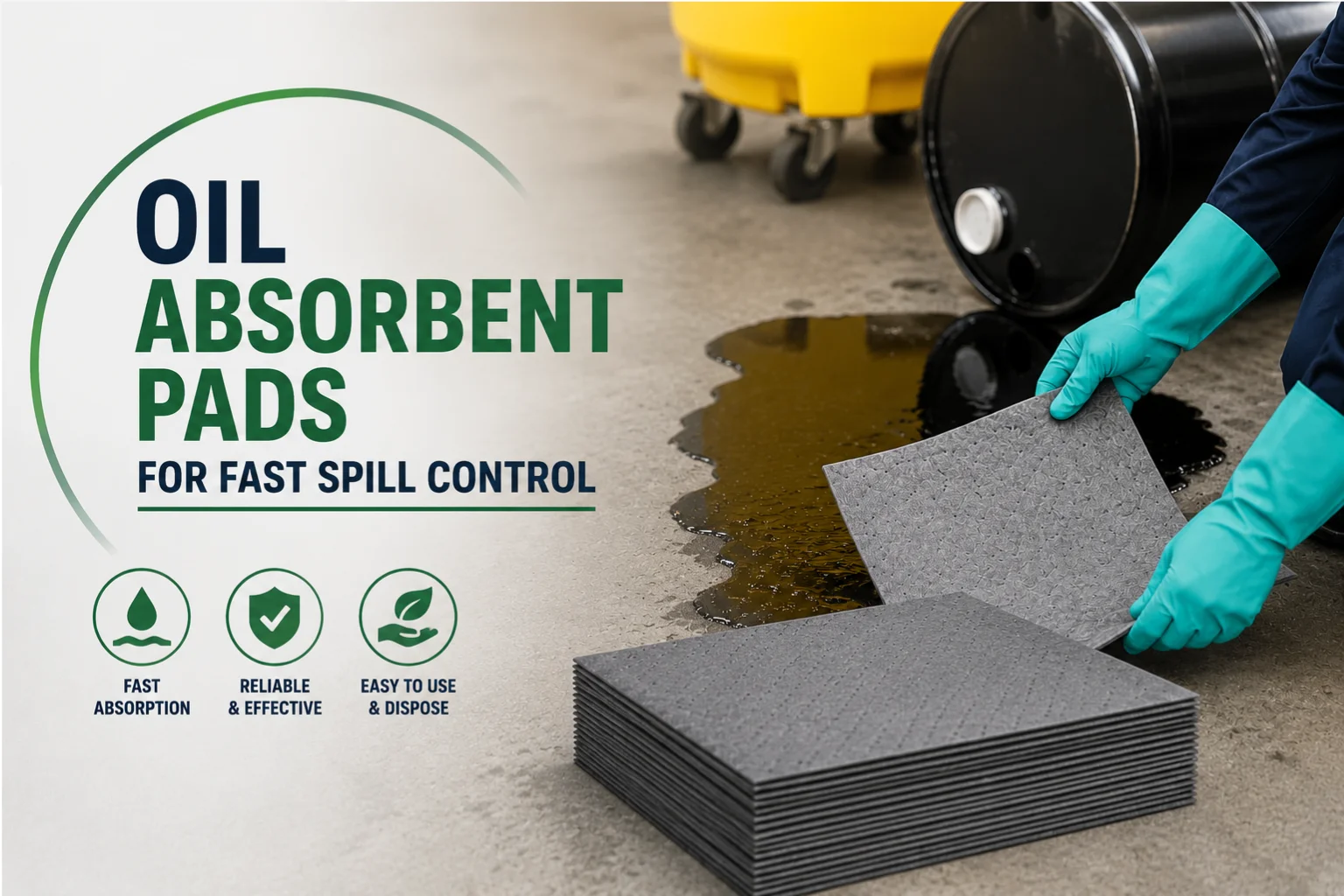
A leaking drum near a loading bay does not stay a small problem for long. Oil spread creates slip hazards, contaminates surrounding surfaces, and can quickly turn into a reporting and cleanup issue. Oil absorbent pads are one of the simplest and most effective tools for controlling that risk at the source.
Why oil absorbent pads matter on working sites
For maintenance teams, warehouse supervisors, marine operators, and EHS personnel, spill response is not just about cleanup. It is about limiting downtime, protecting workers, and preventing a minor leak from becoming a larger environmental incident. That is where oil-only absorbents earn their place.
Unlike general-purpose absorbents, oil absorbent pads are designed to attract hydrocarbons while repelling water. That makes them especially useful in areas where rainwater, washdown water, or marine conditions are part of daily operations. If your site handles fuels, lubricants, hydraulic fluids, diesel, or petroleum-based products, using the right absorbent media matters.
This is also a purchasing decision with operational consequences. Pads that saturate too quickly, tear during use, or are not matched to the spill type can increase consumption rates and raise replacement costs. On busy industrial sites, product choice affects both readiness and ongoing spend.
Where oil absorbent pads are used
These pads are common across manufacturing plants, marine facilities, workshops, transport depots, warehouses, power generation sites, and construction operations. In practice, they are used for daily drips under equipment, emergency response to active leaks, and routine housekeeping around oil handling points.
In a machine shop, they may sit under hydraulic lines or near maintenance benches. In a warehouse, they may be deployed around forklifts, charging zones, or stored liquid containers. In marine applications, they are often part of a larger spill response plan, used alongside booms and socks to recover oil while leaving water behind.
The value is speed. A pad can be placed immediately under a leak, wrapped around a small spill area, or used by hand to wipe residual oil from surfaces. That fast response helps reduce spread before a spill kit or larger containment system is required.
What to look for in oil absorbent pads
Not all pads perform the same way, and that is usually where buying decisions go right or wrong. Absorbency capacity is the obvious factor, but it is not the only one. Thickness, construction, surface finish, and use environment all affect performance.
Heavyweight pads are typically better for larger leaks, ongoing drip areas, and higher-volume cleanup. They hold more liquid and reduce the frequency of change-outs. The trade-off is cost per pad, though many sites find the total usage rate drops enough to justify it.
Lightweight pads can make sense for low-volume drips, bench work, and situations where frequent replacement is expected. They are often more economical for controlled indoor environments, but they may not stand up as well in demanding conditions.
Bonded or laminated pads offer better strength, especially when saturated. That matters if operators need to lift, carry, or drag the pad during cleanup. A low-cost pad that falls apart when wet can create a second cleanup problem.
Perforated formats are also worth considering. They help teams use only what is needed and reduce waste on smaller spills. For procurement teams managing recurring usage across multiple departments, this can improve stock efficiency without compromising response time.
Oil absorbent pads vs general-purpose absorbents
This distinction is often overlooked. General-purpose absorbents are useful for mixed industrial liquids, but they are not always the best option for hydrocarbon spills in wet conditions. If water is present, they can absorb both oil and water, which reduces efficiency and increases disposal volume.
Oil-only pads are built for selective absorption. That makes them the better choice for outdoor yards, marine settings, stormwater-sensitive areas, and any operation where oil contamination must be isolated quickly. If a spill occurs around standing water, choosing the wrong pad can mean burning through stock far faster than expected.
That said, it depends on your site profile. Facilities handling coolants, solvents, and non-oil liquids may still need universal absorbents as part of a complete spill control setup. Many operations keep both categories in stock because real spill conditions rarely stay within one neat product type.
Choosing the right oil absorbent pads for your operation
The best selection starts with three practical questions: what liquid are you managing, where will the pad be used, and is the need routine or emergency-driven?
If your main issue is equipment drips in a dry indoor area, a lighter pad may be enough. If you are supporting a dock, plant room, fuel storage zone, or outdoor maintenance area, a stronger and higher-capacity pad is usually the better fit. If your team responds to incidents rather than just daily leaks, fast-access packaging and compatibility with spill kits become more important.
Storage and deployment also matter. Pads should be kept where leaks are most likely to happen, not locked away in a distant storeroom. For many sites, that means placing stock near maintenance areas, transfer points, workshops, and loading operations. A good absorbent product is only effective if staff can reach it immediately.
For larger organizations, standardizing pad types across departments can simplify replenishment and training. For specialized sites, a mixed stock approach often works better. A marine operator, for example, may need compact packs for vessels, heavier pads for dock use, and additional floating containment for open-water scenarios.
Operational benefits beyond spill cleanup
Oil absorbent pads are often viewed as a consumable, but they also support broader safety and compliance goals. Fast removal of surface oil helps reduce slips and falls. Cleaner work areas support better housekeeping standards. Controlled spills are easier to document, isolate, and dispose of correctly.
There is also a readiness benefit. When teams know the correct absorbent is in stock and close at hand, response becomes more consistent. That reduces hesitation during incidents and supports site procedures. In regulated environments, that consistency matters.
For procurement and operations leaders, the bigger advantage is reliability. Consistent product availability helps avoid reactive purchasing when an incident occurs. That is one reason many industrial buyers prefer working with a supplier that carries spill control products as stocked inventory rather than special-order items.
Stocking strategy and supply considerations
Buying oil absorbent pads based only on unit price can be shortsighted. Consumption rate, pad strength, packaging format, and response speed all affect true cost. A lower-cost product that requires double the quantity or creates more handling waste may not be the better purchase.
It is usually more effective to assess usage by application. High-volume drip stations may justify bulk packs and heavyweight pads. Mobile maintenance teams may need smaller packs that fit service vehicles. Emergency response locations may require sealed, visible, easy-to-grab packaging.
This is where supplier support becomes important. Buyers often need more than a catalog description. They need to know whether a pad is suited for daily maintenance, marine deployment, or heavy leak control, and whether matching products like socks, pillows, and spill kits should be stocked alongside it. Ocean Safety Supplies supports that decision process with practical product guidance, stocked inventory, and fast supply for industrial and environmental response needs.
Oil absorbent pads as part of a complete spill control plan
Pads work best when they are part of a broader system. They are excellent for first response and surface recovery, but larger spills may also require socks to contain spread, pillows for pooling liquids, drip trays for source control, and proper disposal bags and PPE for safe handling.
That is why many facilities build spill readiness in layers. Pads are the front line because they are quick to deploy and easy to use. But they should sit within a clear plan that covers containment, escalation, disposal, and restocking.
If your site handles oil, fuel, or lubricants regularly, absorbents should not be treated as an afterthought. The right stock in the right location helps protect people, surfaces, equipment, and the environment with very little delay.
A well-chosen oil absorbent pad does a simple job, but on a busy site, simple tools are often the ones that keep operations moving safely when something goes wrong.