

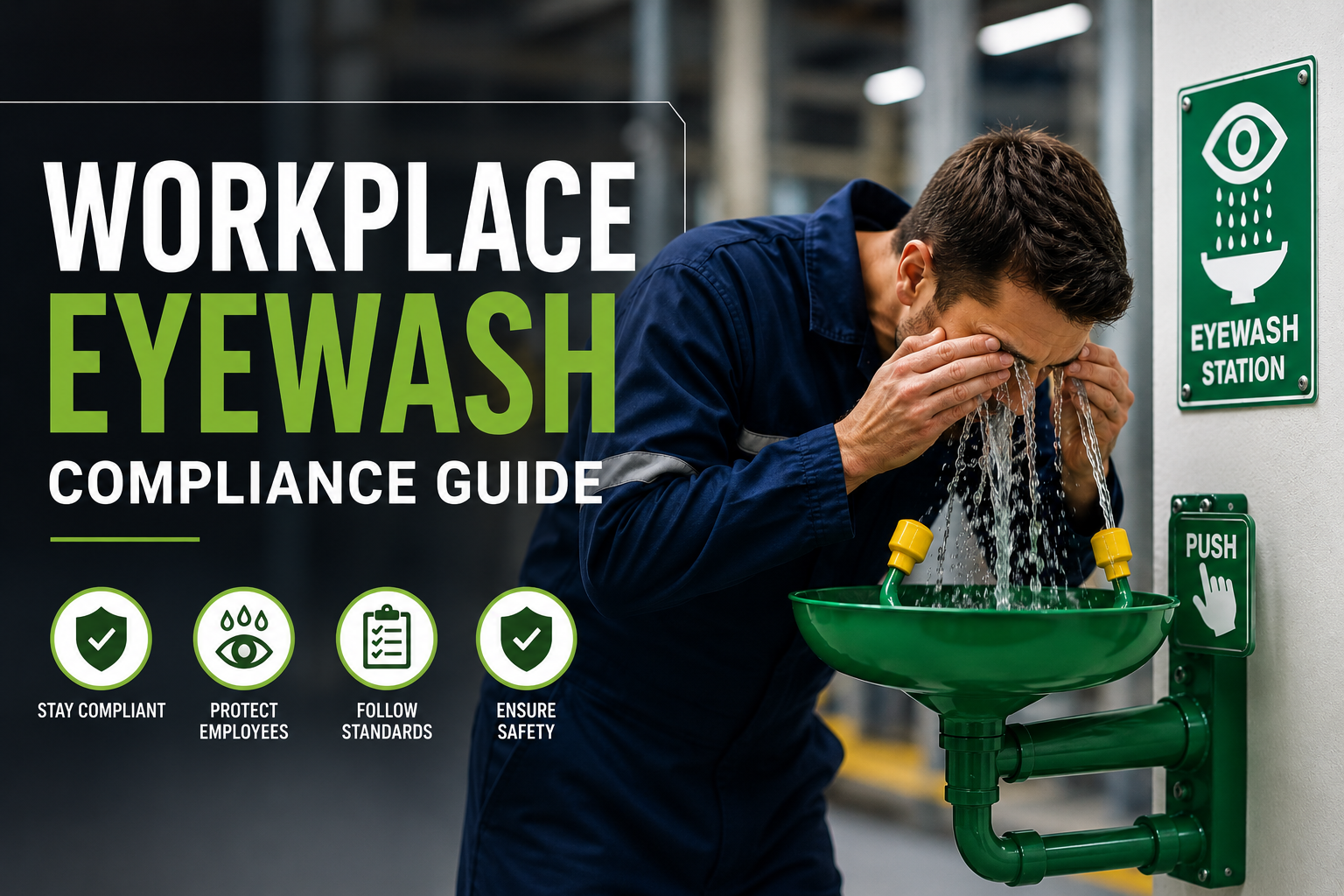
When a worker gets a chemical splash in the eyes, the difference between a near miss and a recordable injury often comes down to seconds. A practical workplace eyewash compliance guide helps safety managers, EHS teams, and facility operators make sure the right equipment is installed, reachable, and ready to perform when there is no time to troubleshoot.
For most sites, eyewash compliance is not just about having a unit on the wall. It is about matching the hazard to the equipment, placing stations where employees can reach them fast, maintaining adequate flow, and keeping inspection records that stand up during audits. If one of those pieces is missing, the station may satisfy a purchase checklist but still fail the worker who needs it.
What workplace eyewash compliance really means
In practice, compliance means your eyewash equipment is suitable for the exposure risk and remains operational at all times. That includes plumbed eyewash stations, self-contained units, or combination shower and eyewash systems, depending on the process and hazard level.
The standard many organizations use as the benchmark is ANSI/ISEA Z358.1. Local regulations, internal corporate standards, and insurer requirements may add to that baseline. For procurement and operations teams, the key point is simple: buying any eyewash unit is not the same as meeting the requirements for your site.
A battery charging room, chemical warehouse, laboratory, maintenance bay, paint handling area, and marine transfer point may all need eyewash protection, but not necessarily the same configuration. Hazard severity, water supply, ambient conditions, and layout all affect the correct choice.
Start with the hazard, not the catalog
The most common mistake is selecting equipment before assessing the exposure. If workers handle corrosives, solvents, acids, alkalis, dusts, or pressurized chemicals, eye exposure may occur in a fraction of a second. In those environments, the eyewash station has to be immediately accessible and capable of sustained flushing.
A low-risk area may only require a smaller solution, while a process area with a significant splash risk may require a combination emergency shower and eyewash. If chemicals can contact the face and body as well as the eyes, eyewash alone is usually not enough.
This is where a site-specific review matters. The right answer depends on chemical type, concentration, quantity in use, PPE practices, and whether employees work alone or in teams. A station that looks adequate on paper may be poorly matched to real operating conditions.
Placement is where many sites fall short
A compliant station must be reachable quickly. That means it should be located on the same level as the hazard, along an unobstructed path, and close enough that an injured worker can get there without delay. Doors, narrow passages, stored materials, and temporary equipment can all turn a compliant layout into a non-compliant one.
For busy warehouses and production floors, this is a recurring issue. A unit may be installed correctly on day one, then gradually blocked by pallets, drums, carts, or maintenance items. During audits, this is one of the easiest failures to spot because it reflects operational discipline as much as equipment selection.
Visibility also matters. Eyewash stations should be clearly identified so workers and visitors can find them fast. Good signage, adequate lighting, and consistent site marking help reduce hesitation during an emergency. In loud or high-traffic industrial environments, clear visual cues are not optional.
Water flow, temperature, and duration are not minor details
An eyewash station is only effective if it delivers a controlled flow that can flush both eyes properly without causing additional injury. Plumbed units need reliable water supply performance, while self-contained units need enough capacity to meet flushing duration requirements.
Water temperature is another factor that gets overlooked. If water is too cold or too hot, an injured worker may not be able to complete the full flush time. Tepid water supports better compliance in actual use, especially in facilities where ambient conditions swing or where long pipe runs affect temperature stability.
This is one reason some sites choose tempered water systems or insulated solutions. The added cost may be justified if it improves usability and reduces the risk of non-performance during an emergency. For procurement teams, the cheapest unit is not always the lowest-cost compliance decision once installation and operating conditions are considered.
The workplace eyewash compliance guide for inspections and testing
Inspection and testing are where many organizations either stay audit-ready or drift into risk. Eyewash equipment should be activated and checked regularly to confirm function, clear the supply line, and identify leaks, valve failures, sediment buildup, or pressure issues.
Plumbed units generally require routine weekly activation, while a broader annual evaluation is used to confirm full compliance with performance criteria. Self-contained units need their own maintenance schedule, including solution replacement, cleaning, and capacity checks according to manufacturer instructions.
Documentation matters here. If a station is tested but not recorded, that creates unnecessary exposure during inspections, incident reviews, and internal audits. A simple log with date, result, corrective action, and responsible person can prevent a lot of avoidable back-and-forth later.
For larger sites, centralized tracking is worth considering. It helps safety teams identify repeated failures, spot neglected areas, and coordinate maintenance before issues become compliance gaps.
Training is part of compliance
Even a correctly installed station can fail in practice if workers do not know when to use it or hesitate because they are unsure of the procedure. Employees in exposed areas should know the location of the nearest eyewash station, how to activate it, and why immediate flushing takes priority over reporting to a supervisor first.
Training should also cover contact lens considerations, assistance protocols, and post-exposure escalation. In higher-risk environments, drills can be useful, particularly where contractors, temporary labor, or shift-based teams are involved. It is one thing to point at a station during induction. It is another to confirm workers can reach it fast under pressure.
Supervisors should be included as well. They often control housekeeping, access routes, and local maintenance requests, all of which directly affect station readiness.
Common compliance gaps across industrial sites
Most eyewash failures are not dramatic. They are routine oversights that accumulate over time. A blocked path, a failed inspection tag, a dust-covered bowl, a unit installed too far from the hazard, or a self-contained station with expired solution can all create serious exposure.
Another frequent issue is assuming portable bottles replace compliant emergency eyewash equipment. Personal eyewash bottles may support immediate first aid in some situations, but they are generally supplementary, not a substitute for a proper station where a plumbed or self-contained unit is required.
There is also the issue of expansion. A facility adds a chemical process, reconfigures a work cell, or converts storage space, but the emergency equipment layout is never updated. Compliance should be reviewed whenever operations change, not only during annual audits.
Choosing the right equipment for your site
The right product depends on your operating environment. Plumbed eyewash stations are often the preferred choice where reliable water supply is available and fixed hazards are present. Self-contained units make sense in remote areas, temporary work zones, marine applications, and places where plumbing is impractical.
Combination units are often the better fit for higher-risk chemical handling areas because they address both eye and body exposure. In corrosive or outdoor environments, material selection also matters. Stainless steel, protective covers, insulated assemblies, and freeze protection may be necessary depending on conditions.
Buyers should also think beyond the unit itself. Mounting options, alarms, drain considerations, water tempering, signage, and replacement parts all affect long-term performance. A dependable supplier should be able to support not just the first purchase, but the ongoing readiness of the equipment.
For organizations managing multiple locations, standardizing specifications can make inspections, training, and spare parts management much easier. That is often a smarter operational decision than mixing different station types with different maintenance requirements across sites.
Building an eyewash program that holds up under pressure
A strong eyewash program connects risk assessment, equipment selection, installation, maintenance, and training. It also assigns ownership. If nobody is responsible for weekly checks, signage, housekeeping around the station, and corrective action follow-up, small issues tend to stay small until an incident exposes them.
For procurement teams, this means buying with operations in mind. For EHS teams, it means verifying the station fits the hazard. For maintenance, it means keeping the unit functional and documented. Compliance works best when those functions are coordinated rather than handled in isolation.
Ocean Safety Supplies supports industrial buyers with stocked emergency eyewash solutions designed for real operating environments, from routine workplace safety needs to specialized hazard response. For fast-moving facilities, supply availability and practical product guidance can make the difference between delaying a fix and closing the gap now.
The best time to review your eyewash setup is before an injury, before an audit, and before a minor issue turns into a preventable failure.