

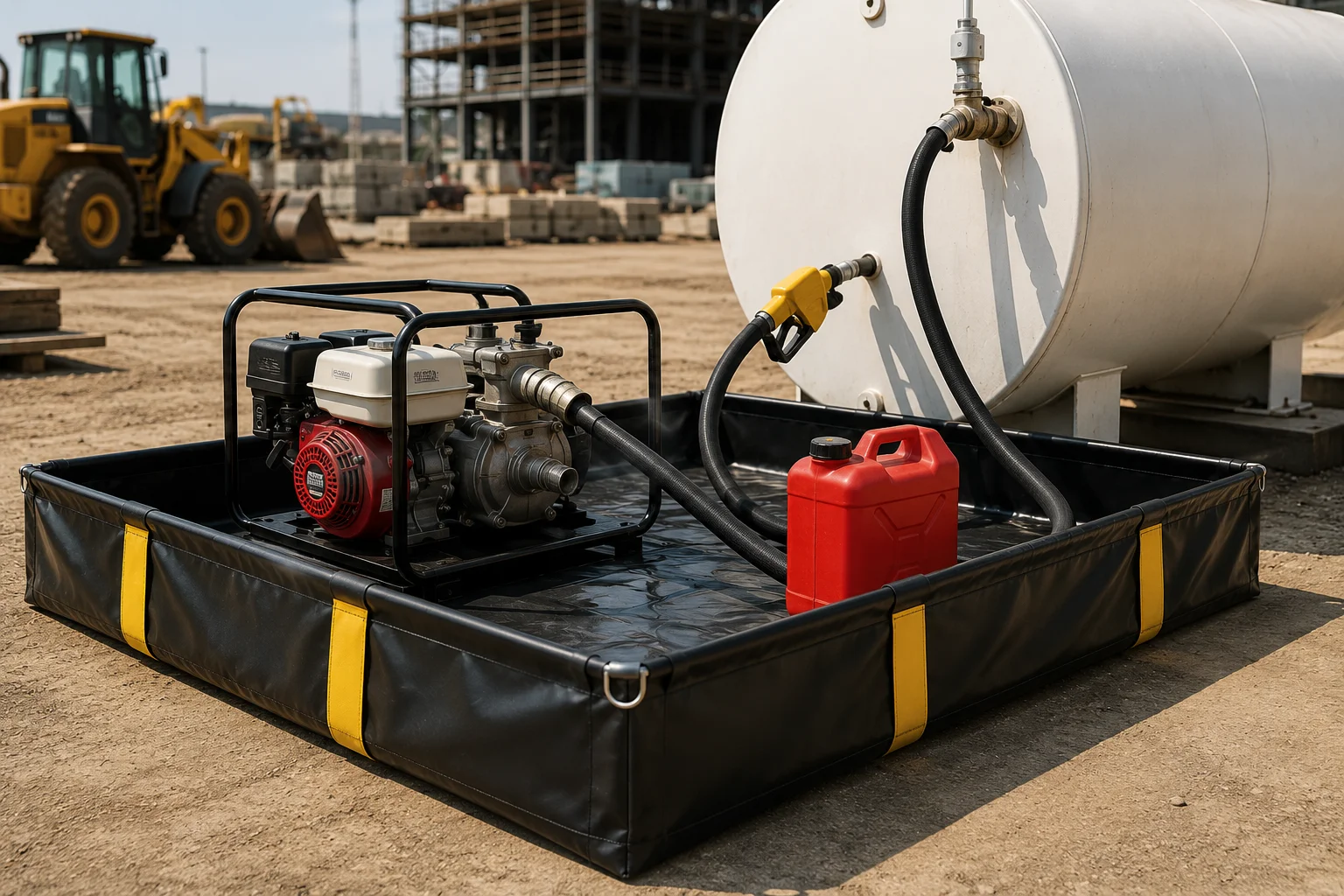
Fuel transfer rarely fails at the pump. It fails at the edges – when a hose coupling weeps, a drum nozzle slips, or a mobile tank is filled on uneven ground without proper containment. That is exactly where a portable bund for fuel transfer earns its place. For operations teams, contractors, fleet yards, marine operators, and maintenance crews, it provides fast secondary containment where fixed infrastructure is not available or simply not practical.
Why a portable bund for fuel transfer matters
Fuel handling is often temporary, mobile, and exposed to changing site conditions. Refueling may happen in a yard one day, beside equipment the next, and at a remote work area after that. A permanent containment area does not solve every transfer point, especially when fueling activity moves with the job.
A portable bund gives you a controlled footprint for drums, jerry cans, pumps, IBCs, hoses, and portable tanks during transfer. If a spill occurs, the fuel is captured within the containment area instead of reaching soil, drains, loading zones, or walkways. That reduces cleanup time, limits environmental impact, and helps support compliance with site spill control requirements.
For many buyers, the value is operational as much as regulatory. A portable system can be deployed quickly, folded away when not in use, and kept ready for planned maintenance or emergency response. That flexibility matters when procurement teams need practical readiness, not another product that sits unused because setup is too slow.
Where portable fuel transfer bunds are used
The most common use cases are straightforward. Mobile fueling of generators, construction machinery, forklifts, pumps, and service vehicles is one. Temporary decanting from drums or IBCs is another. They are also widely used in workshops, warehouses, marine service areas, plant shutdowns, and utility maintenance operations.
The best fit depends on the transfer method. A small bund may be suitable for drum-to-equipment refueling with manual pumps. A larger, drive-in style unit may make more sense when equipment or portable tanks need to sit inside the containment zone during transfer. If hoses are routed across the side wall, the bund design and wall flexibility become more important than many buyers expect.
What to look for in a portable bund for fuel transfer
Capacity comes first, but not just the size of the item sitting inside it. You need to consider the total spill scenario. That includes the volume of the largest container being handled, the likely discharge point, and whether a hose or fitting failure could release more product than a simple drip tray would contain. Undersizing is one of the most common buying mistakes.
Material compatibility is the next check. Fuel transfer bunds are commonly made from chemical-resistant coated fabrics or heavy-duty polymers designed to hold hydrocarbons. Diesel, gasoline, oils, and mixed hydrocarbon environments can place different demands on the bund material. If the same area may also be exposed to cleaning chemicals or solvents, that should be reviewed before purchase.
Wall design affects daily use more than the specification sheet suggests. Foam sidewalls, folding brackets, and drive-over supports each suit different tasks. Soft collapsible walls are useful where operators need quick access and occasional foot or trolley traffic. More structured walls may be better when shape retention and defined containment edges are a priority.
Portability should be genuine, not just a claim based on the product folding flat. Buyers should ask how quickly the bund can be deployed by one or two people, whether it needs tools, and how easily it can be cleaned and repacked after use. If your team works under time pressure, a complicated setup often means the bund is left in storage.
Sizing the bund correctly
A good purchasing decision starts with the actual transfer activity, not the catalog image. Think about what will sit inside the bund during use. That may be one drum and a pump, or it may be a fuel bowser, hose reel, and receiving equipment. The bund needs enough working space to keep all likely leak points inside the containment area.
It also helps to allow room for operator movement. If the bund is so tight that people step on the sidewalls or place equipment partly outside the perimeter, containment is compromised. In practice, a slightly larger bund is usually the safer and more usable option, provided the site has enough floor space.
There is also a trade-off. Larger bunds improve containment coverage, but they take up more room, collect more rainwater in outdoor use, and can be heavier to move when contaminated. For intermittent fuel transfer, the best choice is usually the smallest size that still gives proper containment around the real operating footprint.
Indoor and outdoor considerations
Indoor fuel transfer areas often prioritize floor protection, access, and housekeeping. Here, low-profile portable bunds can work well because they reduce trip hazards and are easier to position in tight spaces. They are especially useful in maintenance shops, warehouse service areas, and temporary decanting stations.
Outdoor use adds weather, surface conditions, and drainage risks. Rain can reduce available containment capacity if water accumulates inside the bund. Uneven ground can create pooling or stress points. UV exposure and rough surfaces may also shorten product life if the bund is not designed for repeated field use.
For outdoor operations, buyers should think beyond the transfer itself. Ask where the bund will be stored, how it will be cleaned, and whether it will be used on gravel, asphalt, concrete, or compacted soil. A portable bund that performs well in a warehouse may not last long on a construction site without the right material weight and reinforcement.
Common buying errors to avoid
The first error is treating a portable bund like a general-purpose tarp tray. Fuel transfer requires secondary containment that is built for liquid exposure, repeated handling, and realistic spill scenarios. Light-duty products may appear cost-effective at first, but early failure or poor chemical resistance quickly changes that calculation.
The second error is focusing only on dimensions and ignoring the transfer method. If pumps, hoses, fittings, and nozzles are the true spill points, the bund must accommodate those components in use, not just the storage footprint of the container.
The third error is buying for compliance on paper without thinking about operator behavior. If sidewalls are too high, setup is too slow, or access is awkward, crews may bypass the bund when they are busy. The right product is the one your team will actually use every time.
Portable bunds as part of a spill control system
A bund should not be viewed in isolation. Fuel transfer is safer when containment is backed by absorbents, drain protection, spill kits, and clear handling procedures. If a coupling fails outside the bund perimeter or an operator overfills a tank, nearby spill response materials still matter.
This is where a practical product mix helps. Many sites pair portable bunds with hydrocarbon absorbent pads, socks, and portable spill kits so the response is immediate and contained. For higher-risk areas, adding drain covers or larger response equipment can provide another layer of control. The point is simple: containment catches the spill, but response equipment finishes the job.
How procurement teams can evaluate suppliers
For industrial buyers, product availability is often as important as specification. A fuel transfer task rarely waits for a long lead time. That makes stocked inventory, responsive technical support, and clear product guidance valuable parts of the buying decision.
Ask suppliers about material suitability, usable containment capacity, wall type, packed size, and expected deployment conditions. If the answer is vague, the product may not have been selected with real industrial use in mind. Good supply partners understand the application, not just the SKU.
For businesses that manage multiple facilities or field teams, it also makes sense to standardize where possible. Using the same containment approach across sites simplifies training, reordering, and replacement planning. Ocean Safety Supplies supports that kind of practical readiness by helping buyers source spill control and containment products from one dependable channel.
Choosing for the job, not the catalog
The best portable bund for fuel transfer is not necessarily the largest, cheapest, or most heavily featured. It is the one that matches the fuel type, transfer setup, work area, and pace of your operation. A compact workshop decanting station has different needs than a remote generator refueling point or a marine service yard.
If you start with the spill risk, the operating footprint, and how your team actually works, the right choice becomes much clearer. Good containment should make fuel transfer safer without slowing the job down. That is usually the standard worth buying to.